Types of Fences, Planning and Legislation
TYPES OF FENCES
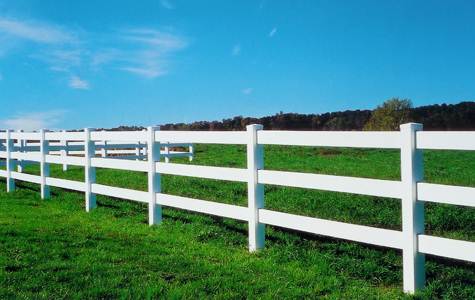
White Rail Fence
Fences are usually categorized by either the type of material used (i.e. barbed wire fence), whether or not it is electrified, or by its intended use (i.e. snow fence).
All-Wood Fences
These traditional fences have been built of materials close at hand, such as trees removed when clearing the fence right-of-way, with labour being the main cost. With rising labour costs, a wood/wire fence may be more cost-effective.
Fences such as snake rail, log worm, log and block, buck and pole, jack leg, russell, horse and rider are built of wood and rest on the ground. Most use few or no nails,some use wire to hang the rails. Post and rail designs require setting wood posts in the ground and nailing onhorizontal wood rails. Well-constructed post and rail designs are used for corral and feedlot fences because of their strength. In other cases, these designs may be chosen for their aesthetic value. Properly constructed all-wood fences can have low annual maintenance costs. However, depending on climatic conditions, rotting will occur at ground contact locations and on unpeeled rails limiting fence life. Peeled rails and preservative treatment for posts and ground blocks should be used.
Some log fence designs require a wide right of way to accommodate the zigzag of the logs. This extra area may add to the right of way preparation costs and remove more land from production. The following briefly describes four common all-wood fences most often used for cattle and horses. Design information is available in Factsheet 307.260-1. These wood fences are not generally built for small livestock such as sheep or swine.
Post and Rail Fence.
These fences are the most common of all wood types in general use. Using appropriate designs they are effective for most livestock. For larger livestock and in concentrated areas such as corrals and feedlots, large posts and sturdy lumber (often full, unmilled thickness) are used.
Snake Rail or Log Fences.
These all-wood fences are formed without supporting posts by rails or logs horizontally in a self-supporting zigzag formation. The bottom rail rests on a short ground block. The fence may be three or four logs high depending on material size. Logs are notched where they interconnect. This style of fence is effective for cattle and horses. For the large sized breeds use appropriately larger diameter logs. Most cattle will require a minimum 6 inch diameter log for a four log fence, larger diameter for a three log fence. The base block should be fully peeled to reduce rotting and preferably treated with preservative. All logs should be at a minimum scored on two sides so the bark will fall off. The top two logs may be wired together at the ends to ensure the top log is not easily knocked off. Panels or sections are usually 14 feet long.
Log and Block Fence.
This type of fence is constructed similar to the snake log fence but the logs run parallel to the fence line rather than a zigzag shape. The blocks are set between each set of logs with the panels offset slightly from each other. Panels or sections are usually 14 feet long.
Russell Fence.
This type of fence is constructed by suspending rails between crossed log supports. Wire is used to tie the supports together and to hang the rails. Tie poles run from the support down to ground at mid panel and are wire tied to the bottom rail. Four to five rails are used depending on their size. Panels or sections are usually 12 feet long.
Steel Wire.
These fences are the most commonly constructed agriculture fences in B.C. Posts are Strand Fences either dug or machine driven or vibrated into the ground, and individual strands of wire are stretched and stapled to the posts. Various designs are used for many types of livestock, with woven wire often used for smaller sized animals. Refer to Factsheet 307.260-1. While the majority of posts are wood, other materials such as steel and concrete are used in special circumstances. Refer to Factsheet 307.110-1. To achieve long life, materials such as preservative treated wooden posts and galvanized wire are used. Combined with good construction methods, these types of fences can be expected to last 25–35 years or more, depending on the climate. Two common types of wire are used: barbed wire (single or double strand) and, recently, single strand high tensile smooth wire (htsw). Designs are used having from 4 to 8 strands (nonelectric) and 1 to 8 strands (electric) for a variety of livestock.
Electric fences may also use a lightweight type of wire or tape. This is a braid of fiberglass and metal wire strands suitable for temporary or moveable fences. Refer to Factsheet 307.100-1 and Factsheet 307.100-2 for a discussion on types of wire and wire handling. As the wire is tensioned, brace assemblies must be built at regular intervals to anchor the wire strands. These assemblies become an important part of the fence system with several designs and construction methods. Refer to Factsheet 307.220-1 and Factsheet 307.220-2 . Where livestock pressure is greater or where posts are placed far apart, spacers or
droppers are placed on the wire strands for improved fence effectiveness. Also called stays or dummies, these vertical members are performing some of the functions of posts (locating the wires and keeping them spaced) normally at a lower cost. Refer to Factsheet 307.100-3.
Steel Woven Wire Fences
These fences are used for livestock or wildlife either due to the smaller size of the Wire Fences animal or because greater security is required. For instance, sheep are easier to fence with woven wire than with individual wire strands. For game farm animals such as fallow deer, woven wire is required on the farm perimeter to ensure containment. Woven wire fences are generally more expensive than individual wire strand fences and require somewhat different construction and maintenance practices. Woven wire is available in a variety of configurations relative to the number and spacing of horizontal and vertical wires. Refer to Factsheet 307.100-1.
Polymer Strand and Grid Fences
This material for fences (polymer = plastic) is available as a pure strand, a grid and as a polymer coated steel wire strand. Uses for this material include snow fence, bird barriers, safety fence, horse fence, etc. Polyvinyl Chloride (PVC) “rails” or “boards” that are mainly for residential fences have been used for farm fences, although they may be more expensive than traditional fences. Refer to Factsheet 307.100-1.
Electric Fences
These fences are constructed to form a psychological rather than a physical barrier to control animals. Because this can usually be achieved with fewer materials than the physical barrier of a nonelectric fence, construction costs are often lower. The electricity to energize the wire is delivered by fence controllers or energizers that are powered by either utility power or batteries. Utility power energizers are selected for fences where AC electricity is easily available. Battery power energizers are used for more remote fences. Solar panels are available to “trickle charge” the battery to extend its charge when the sun is shinning. Refer to Factsheet 307.310-1. Electric fencing requires knowledge of the electric circuit that is being constructed. This is often the area where problems occur - poor electric connections, inadequate grounding system, etc. Refer to Factsheet 307.300-1. An electric fence also requires good maintenance to ensure continued effectiveness. Frequent fence checks and maintenance is required that may be more expensive than for nonelectric fences. Some of the construction savings of electric fences may be reduced by this additional annual maintenance cost. Refer to Factsheet 307.320-2.
Special Fences
Unique fence designs such as windbreak fences, high snowfall area fences and snow entrapment fences are detailed in Factsheet 307.230-1.
Wireless Fences
Research is proceeding on the use of electronic technology to replace the need to erect any type of fence. So-called “invisible” fences are currently available for residential fencing of pets. A buried perimeter wire acts as an antenna to transfer a signal from a house-based transmitter to an animal collar alerting the animal it has reached its boundary.
The adaptation to livestock is to have a small implanted “chip” which receives the transmitted signal and “stimulates” the animal for control. These wireless fences may become cost effective and practical, especially for temporary or movable needs.
PLANNING A FENCE
The following quotes might be heard regarding the lack of planning: “They didn’t plan to fail, they just failed to plan.” “If you don’t know where you’re going, any road will get you there.” A fence is nothing more than a management tool which will be most successful when properly planned. In fact, an unplanned or poorly planned fence may create more problems than it solves. Fences should be planned as part of an overall system for a farm or ranch. For instance when fencing a grazing area, the fence must be planned in conjunction with both the water and the forage supply.
Planning should be done in two steps:
Step 1. Choose the location, arrangement and type of fence. There are a number of things to consider but generally all fit into the six factors listed below.
Step 2. Choose the fence design and plan the logistics of the fence construction. As a footnote to planning, there is an old saying that “It’s better to sleep on what you’ve planned than be kept awake by what you’ve done.” A second look at the fence plan before construction starts will be the easiest time to locate and correct problems.
Factor #1 : Purpose of Fence
First of all, why is the fence required? The purpose will determine the design and materials used. The primary purpose of the fence may be obvious but it may have secondary uses that could be optimized at this planning stage. For instance, a range drift fence could be upgraded in one area to serve as a breeding pasture fence. Good initial planning will ensure the best use of materials. While the fence may be primarily for livestock or crops, also consider the “people use” associated with the fence: Have gates been located for good vehicle access? Have people gates been considered for safety and convenience?
Factor #2 :Type of Animal(s)
A fence plan may indicate that the fence will affect one or more types of animals. A cattle grazing fence may also be required to allow passage of deer; a game farm fence must contain stock and repel predators; cattle and sheep may use the same pastures. These fence needs can be dealt with at the planning stage rather than after construction.
Factor #3 : Site Information
Having determined the purpose of the fence and the animals affected, the next factor is the site conditions, which will affect both the location of the right-of-way and the materials used. Site conditions may be fixed, semi-fixed or changeable:
FIXED ITEMS
Topography.
Use the lay of the land wherever possible for efficient fence construction. Make use of natural boundaries if possible but be aware that they may be removed (future logging, road building activities, etc.). Watch for possible soil erosion on steep slopes. Fence grazing areas with livestock movement patterns in mind so as not to create more problems than the fence solves. Plan water and feed availability when fencing rough terrain. Air photos may be useful at this stage.
A site’s slope and north/south exposure will influence forage growth. When planning fences for a grazing system aim for fields that are similar in slope, soil and forage type for best results.
Soil Type.
This will determine the ease of post placement and to some extent, the design of end braces (light soils will be easy to drive posts in but will provide less resistance to brace failures). Where possible, plan to locate braces in firm soil. Hard and/or stony ground may require a fence design using a wider post spacing, dug in posts or, in some cases, steel posts.
As soils affect crop growth, plan fenced grazing areas with the forage in mind. Soil type may restrict or influence right-of-way construction (i.e., risk of erosion).
Snow.
Fences in areas of heavy snow or blowing snow will require special designs such as lay down fences. In extreme cases, material selection may be limited.
Vegetation.
Forested areas will require a fence design capable of withstanding windfalls. Fences along stream banks should be set back to protect riparian vegetation. Electric fence hot wires may ground out in areas of heavy vegetation.
Wildlife.
Fence designs may need to be modified in areas of wildlife movements. For instance, fence heights may have to be reduced, or wooden top rails or nylon ribbon used on wire cattle fences to provide deer and moose a visual height they can safely jump.
Recreation.
Crown land with high recreation use may require fence designs compatible with both livestock and human use.
Legal Boundary.
Fences on legal boundaries may be affected by government legislation. A fence placed in trespass may have to be removed!
SEMI-FIXED ITEMS
Accessibility.
Fence access is important for construction and maintenance. Good access will help to maximize benefits and minimize labour costs. In forested areas,the fence right-of-way should allow access to both sides of the fence. This is important during construction and later for maintenance and livestock movements.
Water.
Fences across streams may require special designs such as floodgate sections. Fencing to lake shores may require low-water-level extensions. Note any seasonal runoff concerns that would affect the fence in an otherwise dry gully, etc. Locate end braces in firm soil away from flooded land.
Visual Impact.
Some sites may have high visibility and a fence design and location may be chosen to reduce the visual impact. Such sites may be near highways, towns or recreation areas. These sites may require lower impact right-of-way preparation.
CHANGEABLE ITEMS
Forage.
Fence location should allow good management of different types of forage. For instance in grazing areas, the fence line should be located to separate native and tame vegetation.
Existing Fences.
These may or may not fit into the new plans, but they should not limit planning at this stage. The best overall plan should be considered.
Factor #4 : Permanent or Temporary Fence
Permanent fences are defined as those fences which are built of durable materials, are not expected to be moved, and will last 25 to 30 years or more. These would beboundary fences, corral fences, cropland fences, etc.
Temporary fences are defined as those fences which, while using quality materials, are built for either shorter life or, more commonly, built to be moved. These would be seasonal fences in grazing areas, perhaps electrified for controlled grazing or fences which need to be relocated from year to year for other reasons.
Factor #5 : Electric or Non-Electric Fence
Electric are constructed to form a psychological barrier to control livestock and wildlife. They may have a low material and labour construction cost but may require additional yearly upkeep to maintain the electrical circuit. They require basic knowledge of electricity for construction, maintenance and trouble shooting. Electric fences can be either permanent or temporary designs usually with individual wire strands. Barbed wire should not be electrified; smooth wire is preferred (a person or animal may be caught in the barbs and not escape the electrical shock).
Non-electric fences are fences constructed to form a physical barrier to control livestock and wildlife. In contrast to electric fences, nonelectric fences generally require more material and labour construction costs but may have a low annual maintenance cost. Both electric and nonelectric designs may be used on the same fence.
Factor #6 : Other Considerations
Environmental (Undesirable).
Will the fence have any specific negative impacts on the environment? If so, how can they be reduced or eliminated? For instance, fences should not be located where they will encourage livestock impact on a riparian area; right-of-way disturbance may cause noxious weed problems.
Environmental (Desirable).
Livestock control fences may allow environmental improvements, such as exclusion from streams. Fences can change the effect wind and snow has on a farmstead or livestock by reducing the wind velocity and controlling snow drifting.
Economics.
If the proposed fence fulfills the intended purpose, is there sufficient “payback” to cover the installation cost? Are there other layout choices or can a less
expensive design be used?
Labour Versus Capital.
Some decisions will depend whether labour or capital is most appropriate to spend on a fence. For example, some fence designs have low materials costs but require more labour to construct.
Future Options.
Consider future uses for areas being fenced. Can the fence be â€?upgraded’ for more intensive use in the future?
LEGISLATION AFFECTING FENCES
Trespass and Livestock Act:
While there are no Acts specific to fencing, these two Acts mention fences and the Livestock Acts need to fence. The Trespass Act and Livestock Act both define “enclosed land”:
Trespass Act
“Enclosed land” includes land that is: - surrounded by a lawful fence (defined in Regulations) - surrounded by a lawful fence and a natural boundary, or a natural boundary alone- or, posted with signs prohibiting trespass
Livestock Act:
“Enclosed land” means land that is surrounded by a natural or man made barrier sufficient to exclude or contain livestock.
In the Trespass Act, a trespasser is defined as “a person …” The Trespass Act is a “people” act and is not meant to deal with livestock. However, it states one of theways to enclose land is with a “lawful fence,” defined in the Regulations in terms of what could be considered livestock fences. These “lawful fence” designs get confused with the Livestock Act, which deals with livestock control but defines no fence design, only “any man made barrier sufficient to contain or exclude livestock.”
The Trespass Act Regulation definition of a “lawful fence” is many years old. Only the actual fence designs stated in the regulations can be used (which curiously are different for different areas of B.C.!). It does not include current fence materials or technology such as high tensile smooth wire or electric fences and requires a wire gauge for woven wire fences that is not commonly used. Also, the required fence
height of 54 inches is not common for most livestock and not “wildlife friendly”.
Livestock and Land Owners - the Legal Requirement to Fence
Trespass Act states that “unless otherwise agreed, owners of adjoining land in a rural area shall make, keep up and repair the lawful fence between their respective land, and each is liable to the other for half of the cost ” (not binding on the Crown).
Section 3 of the Livestock Act allows a livestock owner to have livestock at large (roaming free of fence confinement) in Livestock Districts (subject to the Range Act and any local bull control rules). Much of B.C. has designated Livestock Districts except Northwest B.C., West Kootenays, Vancouver Island and the Lower Mainland (livestock districts also allow the establishment of bull control areas so different Crown land permitees can control their livestock breeding on rangeland).
This livestock at large (or so-called “open range”) allowance is the reason for the arguments that sometimes occur between the livestock owner and adjacent land owners when no fences (or inadequate fences) separate the two. In Livestock Districts, the land owners who do not want other people’s livestock on their land must fence them out.
Section 6 of the Livestock Act however, allows the establishment of Pound Districts that essentially reverse the privileges of Livestock Districts. Livestock at large in Pound Districts are subject to capture (unless permitted by this act or the Range Act). This makes it a requirement of the livestock owner to fence in their livestock.
Section 10 of the Act states that “the owner of livestock is liable for damage caused by the livestock where the livestock is at large contrary to this Act …” but, “a proceeding shall not be brought for trespass where livestock strays into unenclosed land that is located outside a pound district.”
For more information about Livestock and Pound Districts contact Ministry of Agriculture and Lands (MAL).
Our advice? For on-farm, non-boundary fences use the designs and methods in MAL Factsheets. For boundary fences, carefully consider the “lawful fence” designs. Unless neighbours otherwise agreed, “lawful fence” designs may have to be used where one neighbour wants the other to equally share boundary fencing costs. For trespass (people) concerns, fence or post the boundary as by the Trespass Act.
Motor Vehicle Act Regulation
The Motor Vehicle Act regulations has two references to livestock and highways: 19.07 (1) states “… except for crossing at an intersection, use of any highway named in Schedule 1 by the following is prohibited at all times: … (b) livestock, as defined in the Livestock Act …” (This is not usually a problem as these are the freeways) 19.08 states “… no person, being the owner of or having control of any livestock as defined in the Livestock Act, shall permit the livestock to be upon any highway named in Schedule 2, except for crossing the highway from one place on a farm to another place on the same farm …” (These highways are often in agricultural areas and
fencing along their rights-of-way is of concern to producers).
Ministry of Transportation Fencing Policy
Details of policy are not given here as they are subject to change. However, specific policy relates to private land, private rangeland, Crown land under grazing, etc., as to the materials and construction contribution from the Ministry.
Minor Roads.
All costs, construction and maintenance of the fence are the responsibility of the landowner.
Lands Adjacent to Schedule 2 Highways.
Where existing fences are altered or disturbed and where fences are required in new construction, usually an existing enclosed area, the Ministry is responsible for all construction costs. On completion,fence maintenance falls to the landowner unless provided by Order in Council.
It is the livestock owner’s responsibility to ensure the Motor Vehicle Act Regulations are adhered to. This means the landowner or lessee is responsible for the maintenance of the fences (i.e., to ensure livestock are kept off highways). Maintenance means the day-to-day repairs as well as the provision and installation of replacement materials. The repair or renewal of any damaged or deteriorated fencing that can be attributed to poor range management practice will be the responsibility of the livestock/land owner.
When the repair or renewal of fencing is the responsibility of the Ministry, the owner of the livestock or land is expected to arrange for temporary repairs to a fence or take other measures to prevent livestock from being at large on the highway until more permanent repairs are arranged for by the Ministry.
Liability of an owner of livestock or land for livestock straying onto a scheduled highway and causing an accident is determined by the ordinary rules of negligence. This means the owner must take reasonable care to control the livestock.
For policy details please contact your local Ministry of Transportation office.
Game Farm Act
The Game Farm Regulation refers to containment of game animals on a farm but specifies no design requirements. Policy has been to approve perimeter fence designs such as shown in Factsheet 307.271-1 for reindeer and fallow deer. Bison fence designs have typically been cattle fences, or upgrades of them.
Forest Practices Code
The Range Management Guidebook that supports this Code has fence design recommendations that affect Crown range fences. While strictly not legislation, Guidebook recommendations form strong policy.
Two concerns are specifically addressed: 1) in community watersheds, fences must not be located where they will encourage livestock impact on a riparian area; and 2) maximum heights and minimum clearances for wire fences (42 inch height and 18 inch clearance under), log fences (54 inch height at construction and every 1600 feet a fawn clearance of minimum 15 inch block and a wildlife jump where one end of the top log is on the ground) and Russell fences (54 inch height at construction, bottom rail 18 inch clearance and every 1600 feet a wildlife jump where one end of the top rail is on the ground).
Author:
Lance Brown Engineering Technologist Kamloops Office


