Author: Roy Butler, Department of Agriculture, Merredin
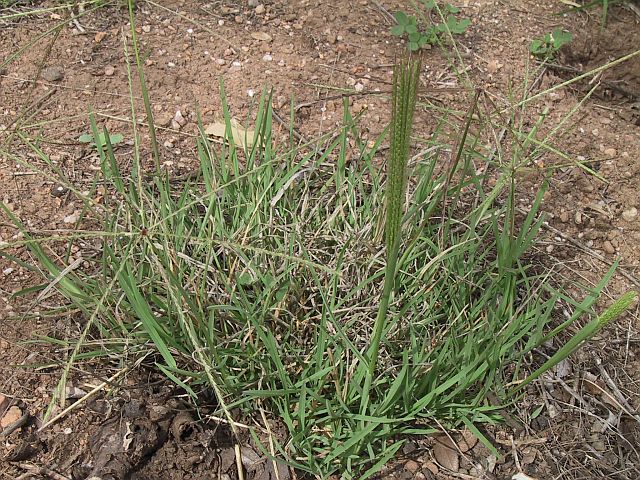
Windmill grass, Chloris Truncata
KEY POINTS
Windmill grass, Chloris Truncata
- In the south west of Western Australia, there are over 100 native grass species, most of which are perennial.
- Little is known about the agricultural suitability and performance of most of these grasses.
- The summer-active native species in particular could be useful components of permanent or long rotation pastures.
- From limited information, it seems that moderate growth rates, of 100 to 200 grams per head per day, could be expected of crossbred sucker lambs on nativegrass dominant pastures.
There has been a resurgence of interest in perennial plants suitable for permanent or long-rotation pastures. The perennials that are particularly desirable are those that will grow in summer, reducing recharge and possibly lowering water tables. For sheep, summer-active perennials supply green, nutritious feed when most annual pasture plants are dead and of low nutritional value. Summeractive perennials can fill or part-fill the summer-autumn feed gap, thus reducing supplementary feed costs. If there is sufficient summer rain or suitable ground water, stock might be finished for sale solely on pastures containing summer-active perennials.
To date, the perennial plants attracting most interest for use in pastures are introduced species. These are comprehensively covered in the publication “Perennial grasses for animal production in the high rainfall areas of Western Australia” (see ‘further reading’ section for details) and so are not covered by this reference. However, some native perennial grasses are also worthy of consideration and so provide the focus of this chapter. They are adapted to our climate and our generally poor soils, and some appear to be both palatable to and safe for stock. However, these are early days in the study of our native grasses, and in particular their possible agricultural benefits.
 Feed quality
The following table shows the analyses for feed quality of three species of native perennial grasses that are summer-active and growing on farms in the eastern wheatbelt. These particular grasses can be quite palatable and nutritious, depending on plant maturity and soil conditions. The samples were collected in summer when the plants were probably nutritionally at their best, that is, leafy, green, and growing vigorously.
How well will lambs grow on pastures containing native grass species? This depends on the plant species, density and stage of growth, and soil conditions, as well as animal and pasture management. The following case study suggests that lambs will probably grow at moderate rates (100 to 200 grams per head per day), especially if there is above average summer rain. Supplementation will be necessary in dry summers, and if higher growth rates are required.
Case study - Crossbred lamb production on native perennial grass based pasture.
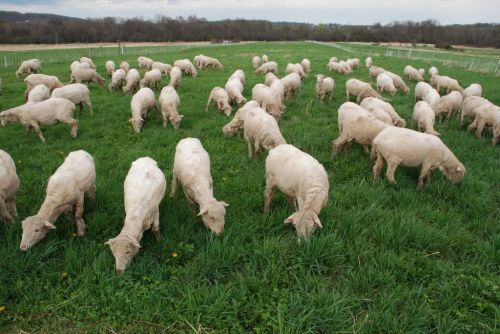
Roy and Judith Butler run a small crossbred flock on a farm near Merredin. The permanent pasture is dominated in summer by native perennial grass species, especially windmill grass (Chloris truncata) and curly windmill grass (Enteropogon acicularis), with some leafy nine-awn (Enneapogon polyphyllus). The sheep are run as one mob, with a ram, throughout the year.
As with other perennial pasture species, careful management of native grasses is essential, especially in summer and autumn. Rotational grazing is practised with rest periods to allow seed set and recovery from defoliation.
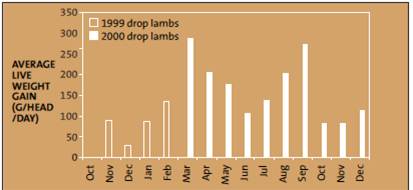
Figure 1. Average monthly growth rates of crossbred sucker lambs on predominantly native grass pasture, Merredin (1999/2000).
The summer of 1999/2000 was one of the wettest ever experienced in the district. The growth of windmill grass, in particular, was exceptional. The stocking rate over the summer was approximately 2.8 DSE per hectare. In early February, the total food on offer (FOO) was 2300 kilograms dry matter per hectare and the green FOO was 1300 kilograms dry matter per hectare. Over summer, the sheep received a small lupin supplement of approximately 30 grams per head per day.
The autumn and winter of 2000 were also unusual, with a late break and a poor germination and subsequent growth of annual grasses and legumes. Windmill grass and curly windmill grass continued to grow through the winter, although they are regarded as summeractive species.Two winter-active native perennial species – a spear grass (Austrostipa species) and a wire grass (Aristida species) – became prominent in the pasture during the winter. The sheep were supplemented with an average of 64 grams per head per day of lupins from April to the end of July, when supplementary feeding ended. The stocking rate climbed steadily through the winter to a peak, in early September at approximately 4.3 DSE per hectare.
Figure 1 shows the moderate, average monthly growth rates of sucker lambs born in 1999 and 2000.
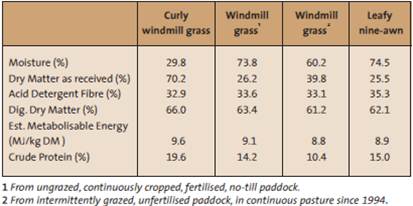
Feed quality of native perennial grasses
Further Reading
Feed quality of native perennial grasses
Miscellaneous Publication 2/98. Greathead K.; Sanford P. and Cransberg L. (1998). Perennial grasses for animal production in high rainfall areas of Western Australia. Department of Agriculture.
Miscellaneous Publication 8/99. The use of native perennial grasses on farms in the wheatbelt of Western Australia. Department of Agriculture.
Native Grasses Information Kit. Produced by Avril Baxter for the Revegetation on Farms Project (May 2000). Sustainable Rural Development Program, Department of Agriculture. Western Australian Native Grass Society Newsletter. Editor Dallas Lynch, Greening Australia (WA) Northam.
Farmnote 43/2001 Native perennial grass-based pastures for livestock.



