General Information:
 The distribution of Murray cod occurs within the Murray-Darling region ranging from southeastern Queensland, throughout Victoria a New South Wales and also South Australia.
The Murray cod is the largest freshwater fish in Australia. The largest fish ever to be caught in the wild weighed in at 113.5kg. Murray cod prefer to live in slow flowing water and deep holes.
They are a particularly territorial fish and individuals are quite often found in the same patches of water for many years.
Numbers of Murray cod in the river systems have been reduced over the years due to habitat destruction and the regulation of river flow.
Stock enhancement programs have been occurring within Victoria and New South Wales for several years to help in increasing numbers of this majestic fish.
Reproduction:
In the wild Murray cod spawn during late spring till mid summer when the water temperature reaches around 200 C. The female will lay up to 40,000 eggs on a submerged log other structures which may be present. The eggs are between 2.5 – 3mm in diameter, swelling to 3 – 4 mm after a few hours.
The eggs will hatch approximately 6 – 13 days later, depending on temperature. Newly hatched larvae released are 6 – 9mm in length and remain near the spawning site usually forming large clumps. After several days the clumps disperse and the young cod begin swimming throughout the water column.
Males become reproductive mature at 5 – 6 years of age (440mm long, 1.4kg) where as females mature at 6 – 7 years of age (485mm long, 2.3kg).
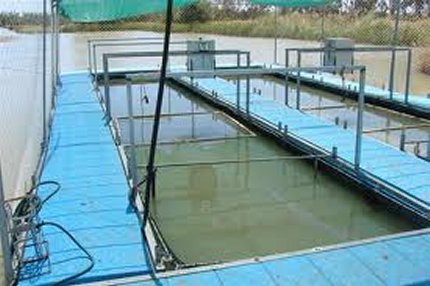 Extensive studies have been completed on the spawning and artificial propagation of Murray cod fingerlings in Victoria and New South Wales.
Fingerlings of Murray cod can be produced in larvae rearing ponds by introducing nesting boxes into the system. This can be in the form of pipes, metal drums or any other hollow object.
Eggs can be collected from the nesting boxes and hatched within tanks. Alternatively, eggs can be left in the pond and allowed to hatch. Ponds should be fertilised to ensure that an adequate plankton bloom is present to feed the fish.
Once juvenile Murray cod reach around 3g they are harvested and weaned on to a dry 2mm starter pellet diet within a tank. 90% of fish can be weaned within a week providing correct management techniques are utilised.
Fish that have not been weaned are usually returned to the pond. Alternatively weaned fingerlings can be purchased from hatcheries specified in Appendix 2.
Diet:
As Murray cod grow their diet shifts from zooplankton to a wide variety of aquatic organisms including both vertebrates and invertebrates. Older fish feed mainly on crustaceans (shrimp and yabbies), bivalve molluscs and fish.
Under culture conditions fingerlings will readily take hatched brine shrimp, artemia salina, until they are weaned onto artificial diets. An extruded pellet which is high in protein is now available from for Murray cod aquaculture. Food conversion ratios have been reported as low as 0.8:1, however with good management techniques, growers can expect an FCR of 1.5- 2:1.
Growth:
Until recently it was initially thought that Murray cod would be unsuitable for intensive recirculation aquaculture due to its territorial and cannibalistic nature. Therefore in the past Murray cod have been extensively cultured in farm dams and ponds. Using this method, fish are stocked at a density of around 15 tonne per hectare and reach 1.5kg – 3kg in around 18 months to 3 years depending on temperature.
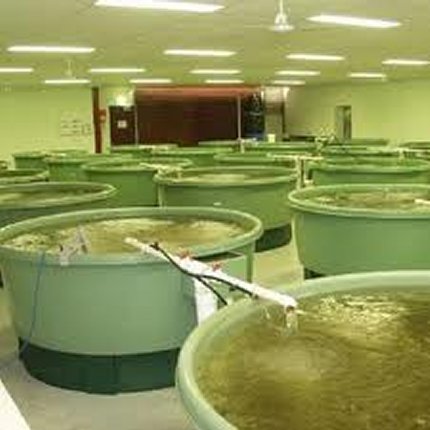 Initial trials have however shown that Murray cod adapt extremely well within recirculation systems. When fish are stocked at high densities, the opportunities for Murray cod to establish territories is reduced and consequently they become a schooling fish.
The use of intensive recirculation systems over extensive pond production of Murray cod shows huge potential. The use of intensive system allows the grower to culture Murray cod within optimum temperature conditions therefore enabling them to produce a market sized fish of between 600g and 1.3kg in around 12 to 18 months.
Stocking rates in tank systems will vary and depend mainly on the capacity of the individual systems. In well developed systems that are highly advanced, stocking rates of up to 60kg/m3 are obtained however most systems will achieve around 30 – 40kg/m3 .
As growth rates of Murray cod are variable, fish need to be continuously graded to ensure that cannibalism is kept to a minimum and fish grow at uniform rates. Cost of Murray cod production using recirculating systems can range anywhere between $8.00/kg to $14.00/kg depending on the system used and its production capacity.
Although Murray cod aquaculture using recirculation systems is currently in its embryonic stage, the potential for production of this species has just been recognised. Future research into the production of Murray cod using recirculation systems will provide best practice in management techniques that will enable growers to successfully produce this fish.
Marketing:
Murray cod has excellent marketing attributes and is know world wide for its exceptional eating qualities. Murray cod has a firm white flesh and is sold live, chilled or gilled and gutted.
The majority of farmed and wild caught Murray cod is sold domestically however there is a keen interest for the product amongst the Asian countries. Murray cod is currently fetching between $15 - $30 on the market depending on supply from wild caught fisheries. With a good marketing strategy that is applied nationally, prices of Murray cod has the potential to remain at these prices once production starts to increase.
Information Sourced From:



