Description: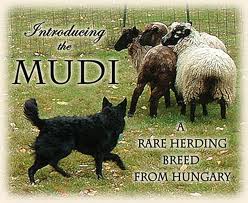
The Mudi has a wedge-shaped head with a pointed nose. The jaws are muscular with a scissors bite. The skull is convex with a well-marked stop. The eyes are oval and dark brown. The ears are erect in the shape of an upside-down “V”. It has a deep thorax. It is not unusual for the puppies to be born without a tail. The back is straight and rather long. The hind legs are surprisingly wide set. The hair on the muzzle is short, becoming bristly toward the ears. Its dense, wavy to curly coat is about 2 inches (5 cm.) long with glossy hair that forms tufts and easy to care for. Coat colors include black, white, red, brown, gray, bread-pale, and fallow. There is also a very rare color called “cifra” (blue-merle) which is dark or light gray and mixed with a black, spotted, striped, stained, marbly color. (The potential coat colors are actually limitless with this breed.)
Temperament:
The Mudi is truly a rare dog. The few owners who employ and favor the Mudi find him incomparable. His seemingly unending list of talents combined with his pleasant disposition makes him a top dog among canines. Highly intelligent, they can learn as quickly as Border Collies or even faster. Extremely powerful and courageous, the Mudi is afraid of nothing, not even wild boar, which it can overpower quickly. It makes a good guard dog. It is very loving and gentle in the family and has therefore gained appreciation as a companion dog that, if the need arises, will defend both property and person. Within the family it also has a tendency to bond with one particular person. Mudis can be wary of strangers. Socialize them well preferably at a young age. Some will not come up to a stranger until it sees that the person is friendly and doesn’t want to hurt it. They are not aggressive when they meet someone they do not know; they just need to get accustomed to them. They will do okay with children if they are treated in such a way that they see humans above them in the pack order. Mudi are friendly with other dogs and will be okay with non-canine pets if they are raised with them from puppyhood or properly introduced as a new pet in the home. It is an obedient and playful companion, but can sometimes be noisy. They need to be taught not to bark unnecessarily. Mudi will do very well with a job to do. They need an owner who knows how to properly communicate the rules and one who has time for daily exercise.
Height, Weight:
Height:14-20 inches (38-47 cm.)
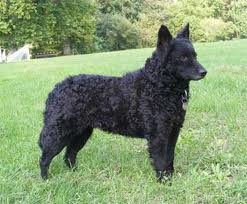
Mudi Full grown.
Weight: 18-29 pounds (8-13 kg.)
Health Problems:
This is a fairly healthy breed, although some cases of hip dysplasia have occurred, but not many.
Living Conditions:
The Mudi can live in an apartment if it is sufficiently exercised; however, they need space to run and play and would do better if not kept in one. They are moderately active indoors and will do best with at least a large yard. This breed can live outdoors.
Exercise:
The Mudi is a very active breed. They need to be taken on a daily, long, brisk walk or jog, where they are made to heel beside or behind the human holding the leash, as in a dogs eyes, the pack leader leads the way. In addition, they will benefit from a large safe area where they can run free. They need a lot of running and other exercises to be in good condition. They love to play and will excel in all kinds of sports such as flyball and Frisbee.
Life Expectancy:
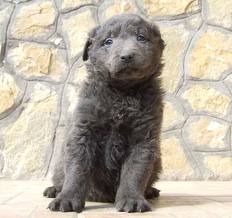
Mudi Puppy
About 13-14 years.
Grooming:
The Mudi is easy to groom. An occasional combing and brushing to remove dead hair is all it needs. This breed is an average shedder.
Origin:
The Mudi’s full name is Canis Ovilis Fenyesi (Dr Dezso Fenyesi separated Mudi from the Puli and Pumi). The Hungarian herdsman’s dogs were all classified together until the 1930′s when the Mudi was separated from the Puli and Pumi. This all-purpose rural breed does not appear to be the result of planned breeding. The breed formed spontaneously and is only about one hundred years old. It is rare, even in Hungary - its country of origin. Its conformation stabilized in the early 1900′s and its standards were written down according to these original traits. Perhaps much of the reason for the rareness of this breed can be attributed to the ever-present Puli and Komondor - older and more popular Hungarian working breeds. Perhaps the least known of all Hungarian dogs, it is noted for the multiplicity of its uses both inside and outside its native land. It has served as a flock guardian, sheep herder, cow herder, guard dog, hunter of wild animals, killer of mice and weasels and as a companion. He is capable of handling his own flock without the assistance of a third paw. In Finland they are used as mountain-rescue dogs. Without the intervention of dedicated breeders, it would be in danger of extinction.
Sourced From: