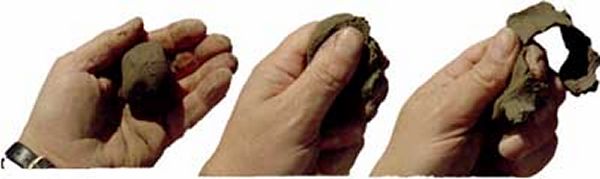
 Estimating soil texture (simplified texture classes)
Method: Take a small handful of soil, add a little water and try to work it up into a ball. If you can make a ball, rub it between your thumb and forefinger to create a worm-like shape (a ribbon). The length of ribbon will be determined by the soil’s clay content.
As the clay content increases clay may stain your fingers. Sand can be heard as you work the ball and will feel gritty as you rub it between your fingers. Use the following guidelines to classify the texture of the soil:
Sand
• Coherence of the soil ball is nil to slight.
• Single sand grains stick to your fingers.
• Minimal ribbon development when extruded between fingers and thumb.
• Clay content less than 10%.
Sandy loam
• Soil ball coherent but very sandy.
• The sand in these soils cannot be seen with the naked eye but can be felt when rubbed between the fingers. A scratchy noise may be heard when the ball is manipulated between the fingers.
• Soil will form a ribbon 15–25mm long when rubbed between fingers and thumb.
• Clay content 10–20%.
Loam
• Soil ball coherent and often spongy. May have a ‘greasy’ feeling if significant organic matter is present.
• Soil will form a ribbon 25–40mm long.
• Clay content 25–30%.
Clay loam
• Soil ball strongly coherent and plastic. Feels smooth.
• Soil will form a ribbon 40–50mm long.
• Clay content 30–35%.
Light/medium clay
• Soil ball like plastic. Slight–to-moderate resistance to shearing between the forefinger and thumb.
• Soil will form a ribbon 50–75mm long.
• Clay content 35–45%.
Medium/heavy clay
• Smooth soil ball that handles like plasticine and can be moulded into rods without breaking.
• Soil has moderate-to-firm resistance to shearing.
• Soil can be rubbed between fingers and thumb to produce a ribbon 75mm long or more.
• Clay content greater than 45%.
Explanation of terms used
• Coherence The ball of soil holds together tightly.
• Sandy Feels gritty, and you can see coarser grains. Very fine sand grains (too small to see and feels a bit like silt) make a grating sound as you rub between your fingers.
• Spongy - A high organic matter content creates a spongy feel that is typical of loams.
• Silky - The smooth, soapy, slippery feel of silt.
• Plastic - The ball can be deformed and it holds its new shape strongly. Typical of clays.
• Resistance to shearing How firm the soil feels as you form a ribbon (place the ball between your thumb and forefinger and squeeze, sliding your thumb across the soil). The firmness is a good way to distinguish light, medium and heavy clays. A light clay soil is easier to shear; a medium clay is stiff; a heavy clay is very stiff and it usually takes two hands to form a ribbon.


