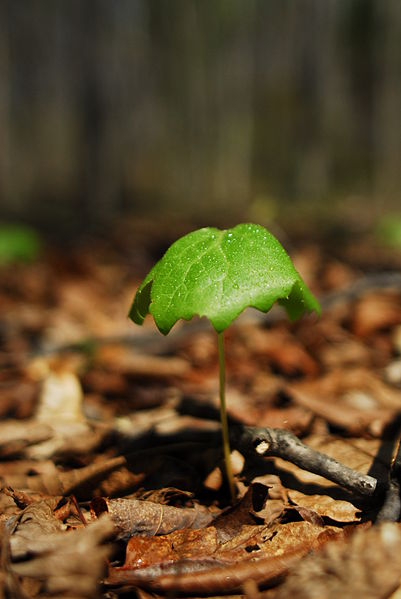
Mayapple Photo by Ashley Bohm on Wikimedia Commons.
Podophyllum peltatum
Common Name American Mandrake, Mayapple.
Family: Podophyllaceae.
Known Hazards: The leaves and the roots are very poisonous.
Habitats Moist soils in rich woods, thickets and pastures.
Range: Eastern N. America - Southern Maine to Florida, west to Texas and Minnesota.
Physical Characteristics
Podophyllum peltatum is a PERENNIAL growing to 0.3 m (1ft) by 0.3 m (1ft in).
It is hardy to zone 4 and is not frost tender. It is in leaf 10-Apr It is in flower from May to June, and the seeds ripen from Jul to August. The flowers are hermaphrodite (have both male and female organs).The plant is not self-fertile. The plant prefers light (sandy) and medium (loamy) soils and requires well-drained soil. The plant prefers acid and neutral soils, and can grow in very acid soils. It can grow in full shade (deep woodland) or semi-shade (light woodland).It requires moist soil.
Habitats
Woodland Garden Dappled Shade; Shady Edge; not Deep Shade;
Edible Uses
Edible Parts: Fruit.
Fruit - raw, cooked or made into jams, jellies, marmalades, pies etc. The fruit can also be dried for later use. The fruit should only be eaten when it is fully ripe, the unripe fruit is strongly laxative. Remove the rind. The fruit is very aromatic, and has a peculiar though agreeable flavour. Sweet and acid. Do not eat the seeds. In excess the fruit can cause colic. The fruit is about 5cm long.
Medicinal Uses
Plants For A Future can not take any responsibility for any adverse effects from the use of plants. Always seek advice from a professional before using a plant medicinally.
Antibilious; Cancer; Cathartic; Cytostatic; Homeopathy; Hydrogogue; Purgative; Warts; Women’s complaints.
American mandrake is a most powerful and useful herbal medicine, exercising an influence on every part of the system and stimulating the glands to healthy action. Its greatest power lies in its action on the liver and bowels. It is a gastro-intestinal irritant, a powerful hepatic and intestinal stimulant. Although often used internally in the past, the plant’s cytotoxic action makes it an unsafe remedy for internal use. The root is antibilious, cathartic, cytostatic, hydrogogue and purgative. The plant contains podophyllin, which has an antimiotic effect (it interferes with cell division and can thus prevent the growth of cells).
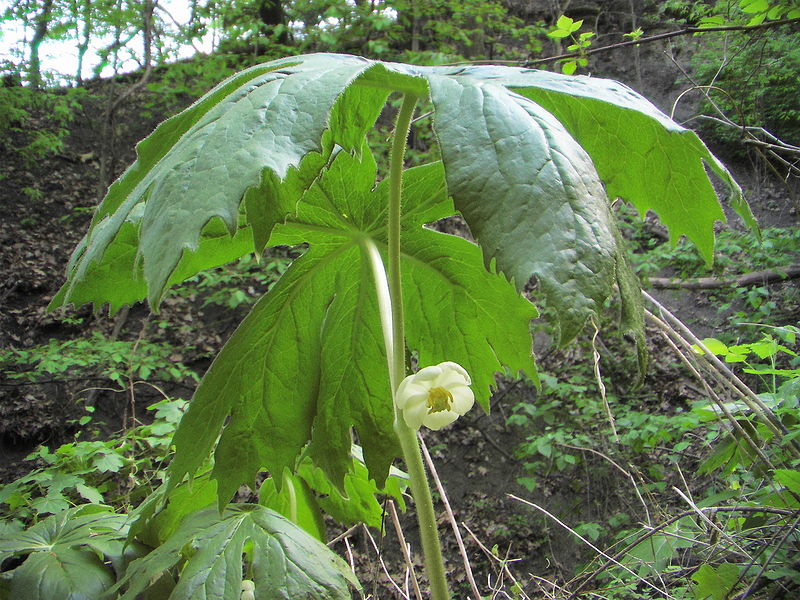
Mayapple flower. Photo by Velocicaptor
It is, therefore, a possible treatment for cancer, and has been used especially in the treatment of ovarian cancer. However, alopecia is said to be a common side-effect of this treatment. The root is most active medicinally in early spring when it is beginning to shoot. The resin, which is obtained from the root, is used in the treatment of warts and has been found to be effective against uterine warts that are sometimes experienced in pregnancy.
It is also used in the treatment of small-cell carcinoma. The root is harvested in the autumn and either dried for later use or the resin is extracted. The whole plant, apart from the ripe fruit, is highly poisonous and should only be used under the supervision of a qualified practitioner. It should not be prescribed for pregnant women. Large doses have been used to commit suicide. A homeopathic remedy is obtained from the fresh root, harvested before the fruit is ripe. This is used particularly in the treatment of diarrhoea.
Other Uses
Insecticide
An infusion of the boiled leaves has been sprayed on potato plants to protect them from insects. Other reports suggest that it is insecticidal rather than repellent. The root ooze has been used to soak corn seed prior to planting it out in order to prevent it being eaten by crows or insects.
Cultivation
Prefers a moist peaty soil and filtered light or shade. Grows well in a moist open woodland and also succeeds under beech trees in a deep moist leafy soil. Succeeds in a pH ranging from 4 to 7. A very hardy plant, tolerating temperatures down to -15°c or lower when dormant, though the young leaves in spring can be damaged by late frosts.
Plants in this genus have excited quite a lot of interest for the compounds found in their roots which have been shown to have anti-cancer activity. There are various research projects under way (as of 1990). The flower has a foul smell. The plant takes some years to become established but is very long lived in a suitable habitat and can become a vigorous colonizer.
Propagation
Seed - best sown as soon as it is ripe in a cold frame. Sow stored seed in a cold frame in early spring. The seed germinates in 1 - 4 months at 15°c. Prick out the seedlings into individual pots when they are large enough to handle and grow on in a shady part of the greenhouse for at least 2 growing seasons. Plant them out into their permanent positions in the winter when the plants are dormant. Division in March/April.
Author: L. On plants for a future.