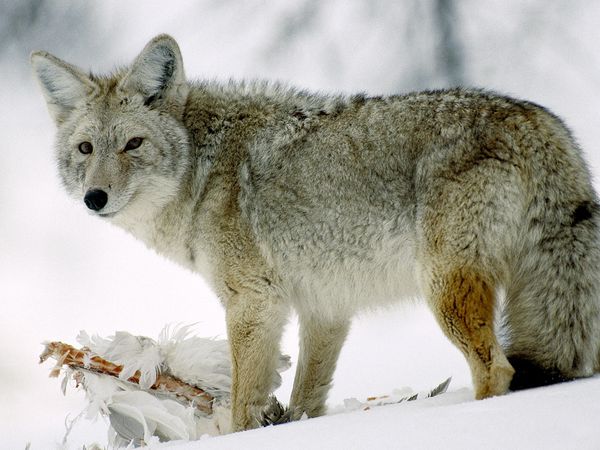
Coyote
Proper livestock management can help to minimize the risk of predation. Many producers use one or more of the following: using lighted corrals, lambing in the barn, regular inspection of the sheep flock, prompt removal and disposal of dead stock, and perhaps confinement at night.
These practices may not be practical for all producers. For example, it would be extremely difficult to confine a flock of 500 pasture lambing ewes each night. Greater losses would be likely from mismothering, and increased exposure to diseases such as coccidiosis and internal parasites.
For managing predation, a variety of methods must be available, one method will not be effective for every producer. Most successful predator control programs use an integrated approach – combining good husbandry with effective control methods.
Prevention cannot be stressed enough, because after predators kill once they are more likely to return and kill again. If predators have started killing sheep, it is important to stop the killing as quickly as possible.
Predisposing Factors
Although many of the following relationships are not clearly defined, it is important to understand the relationship between predisposing factors and actual or perceived losses to predators.
Coyote Behaviour
It is becoming as accepted fact that coyotes will tend to kill, and eat (as adults) what they were taught to kill and eat (as pups). Parker’s book, The Eastern Coyote, The Story of its Success, refers to a number of Canadian studies that strongly support this observation. Coyotes tend to kill animals that are easily caught (least amount of energy expended for maximum gain). Predation may begin because of the availability of sheep weakened by poor nutrition, inclement weather, disease or parasites, or small size (young lambs). This is not to say that these are the only type of livestock that coyotes kill. Many producers will quickly verify that losses are often some of their better ewes, of prime breeding age. A typical pair of mated coyotes in agricultural land in Ontario will have a home range of approximately 10km2 during the gestation period, to over 30km2 during nursing in May and June. Obviously, their home range will take them through many farms, some with livestock and differing livestock husbandry practices. Conditions that lead to coyotes killing livestock on one of those farms, puts all farms in their home range at risk of predation.
Availability of Normal Food Supply
When normal food sources are scare, predators will investigate other potential food sources. Livestock fit that category. Once predation starts, producers must be prepared to implement removal options to prevent further kills.
Previous Predation on Farm
Farms where predation has been a problem in previous years tend to have repeat occurrences of predation each year, particularly if no predator removal program has been implemented.
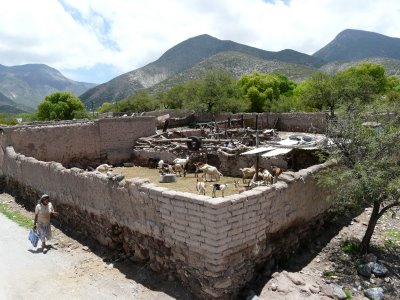
Sheep Corral
Sheep Corral
Health of Flock
Healthy sheep tend to have higher lambing rates, lower overall death losses, and may be less susceptible to predation. Ewes in good condition will generally raise stronger lambs. Orphaned and otherwise abnormal lambs are likely to be initial victims of predation. Once the coyote is used to hunting the flock, older and healthy animals will be at risk.
Recordkeeping
Knowing how many sheep you have in a particular pasture helps to quickly determine when losses begin.
Keeping track of losses can be very beneficial in eventual control or removal of the problem predator. They
can help identify loss patterns, or high risk pastures.
Season and Location of Lambing
Highest predation typically occurs from late spring through September-October due to high feed requirements of raising pups. Lambs born on pasture are more likely to be at high risk to predation than older lambs or mature sheep. On the other hand, winter born lambs, raised indoors and hand fed may be as much at risk since they are not as alert or suspicious of humans or strange animals as lambs born on pasture.
Corrals and Night Confinement
Although this may be a practical option for small flocks, or flocks of dry ewes that lambed during the winter, it is not a feasible option for large, commercial flocks that have young lambs with them on pasture.
Deadstock Disposal
An Alberta study indicated that predator losses were lower on farms where deadstock was promptly removed and disposed of, compared to farms that did not handle deadstock was not properly.
Human Presence
Frequent checking of flocks can discourage predation before problems arise. Periodically changing the time of day when the flock is checked can deter coyotes from attempting kills.
Novelties
Things like bells on a number of sheep in the flock; aluminium pie plates hung around the perimeter of the pasture, playing the radio, etc. can discourage coyotes from preying on flocks. Anything that causes an irregular sound or reflection can be effective. Again, these sorts of things may be suitable to some producers and not others. Each individual situation must be assessed as to what is most suitable.
Author: Anita O’Brien, OMAFRA Sheep and Goat Specialist