 Alligator farming requires specific culture techniques and specialized knowledge on the part of the producer. The commercial production of alligators can be divided into 3 phases:
- management of adult alligators
- egg collection, incubation, and hatching
- grow-out of juvenile alligators to market size
In Louisiana, Florida and Texas eggs and/or hatchlings maybe taken from the wild under special permit regulations. In all other states it is illegal to take eggs or hatchlings from the wild (in 1993).
Therefore, prospective alligator farmers must either purchase eggs or hatchlings from other producers or produce their own. Louisiana law makes it illegal to sell alligator eggs outside of Louisiana.
Hatchlings can be purchased from existing farms or hatcheries in Louisiana, Florida and Texas. The price of hatchlings changes yearly due to the laws of supply and demand. In 1990 hatchlings sold for $30 each or more. In 1992 the price had fallen to about $20 each, largely due to the low market price for hides.
Management of breeding:
alligators Maintaining adult alligators and achieving successful and consistent reproduction is extremely difficult. Exact environmental, social and dietary needs of adult alligators are poorly understood.
The following discussion is based on the limited amount of research available and from personal communications and observations with both researchers and commercial producers. Adult alligators that have been reared entirely in captivity/confinement behave very differently from wild stock.
Farm-raised alligators accept confinement and crowding as adults much better than those captured from the wild. Also, adult alligators that have been raised together tend to develop a social structure, and adapt quicker and breed more consistently than animals lacking any established social structure.
Inbreeding can be eliminated by obtaining males and females from different clutches. However, it may not be possible to obtain adults using the above criteria. If adequate numbers of adults cannot be purchased, then the best strategy may be to select future brood stock from your own young animals or purchase young from another producer.
Try to select fast-growing individuals. Captive alligators raised in temperature controlled environments for three years reach sexual maturity at 5 to 6 years of age compared to the 9 or more years that it takes in the wild.
Pen design for adult alligators:
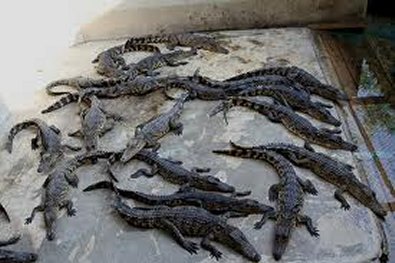 Pens for adult alligators need to be one to two acres in size. Larger pens have been used but can present problems if alligators have to be captured. Pens must be carefully fenced to prevent their escape.
Some general recommendations for fence design include:
- heavy-duty, woven, rust-resistant wire,
- wire should be a minimum of 6 feet high and buried in the ground to a depth of 1 foot
- mesh size should not exceed 2 x 4 inches,
- a 1 x 6-inch treated board should be attached to the interior base of the fence,
- fence posts should be spaced on 8-foot centers,
- fences should have rounded corners (avoid 90° comers as they encourage climbing and piling-up of the alligators),
- gates must be equal in height to the rest of the fence and of comparable fencing material,
- gate frames must be heavy duty, attached by at least 2 hinges, and secured by at least 2 latches along the opening.
Remember, alligators can climb, are very strong, and will probably try to escape. Improper construction of holding pens which allows them to escape is illegal in most states. Check with your state game and fish agency for specific guidelines.
Breeding pen design, particularly the land to water ratio and configuration, is very important. Land area to water area within the pen should be approximately 3:1. Shape of the pond(s) needs to maximize shoreline.
Present thinking suggests that an ‘M’, ‘S’, ‘W’, ‘Z’ or similar shape is best, although other pen designs have been used. One experienced producer observed that male alligators fight less during the breeding season if they cannot see each other in the pond, thus the reason for the shape of the ponds. The pond shoreline should be no closer than 75 to 100 feet from the fence.
Water depth of at least 6 feet must be maintained during the breeding season, which could require a water source (i.e., well, reservoir pond, etc.) When possible, ponds should also be constructed with drains so that water can be removed if the animals need to be captured.
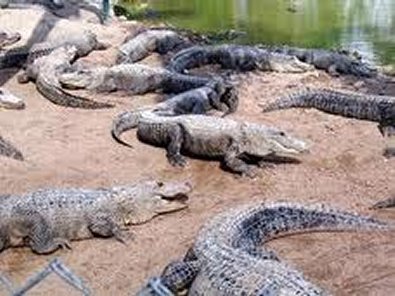 Dense vegetation around the pond is needed to provide cover, shade and nesting material. The natural invasion of wetland plants is sufficient for cover in many areas. However, many producers feel that invading vegetation is not optimal for nesting purposes and prefer to plant alternative types of vegetation.
Brush and cane type vegetation (because of its coarse nature) should be discouraged as nesting material because it can puncture and kill eggs as they are being laid into the nest. In general, vegetation for nesting material needs to be a rank growing grass (i.e., tall, deep grass, 24 to 30 inches in height) that will hold sufficient moisture, not desiccate during incubation, and not rot too quickly.
Tall fescue maybe a good candidate for vegetative cover in much of the South. Many producers add bales of hay to the breeding pens in June to supplement natural vegetation for nest building. Shade is important to prevent overheating during the summer.
Alligators will burrow into the pond banks if adequate shade is not provided. Burrowing can be reduced by building shade awnings in the pens. tocking density of adult alligators (from farm-raised stock) should be between 10 to 20 per acre.
Some producers have been successful at densities as high as 50 per acre; others maintain densities at 6 to 8 per acre. Adults between 6 and 20 years old are usually reliable breeders, females 8 to 10 years old are the most consistent breeders.
Female to male ratio should be approximately 3 to 1 (but less than 4:1). Each pen should have several feeding stations to keep the alligators spread out during feedings. Feeding stations should be established near basking areas where alligators sun themselves or along paths on the shoreline of the pond.
Feeding should begin each spring when temperatures rise above 700 F (usually March or April). Feed 4 to 7 percent of body weight per week (7 percent throughout the summer months). Adults are usually fed only once per week.
Early fall feeding appears to be particularly important so that the females are in good condition for egg development. Adults do not need to be fed during the late fall and winter. It is important hat adult alligators are not overfed; they should be in trim body condition, not fat!
Adult breeders should be disturbed as little as possible from February through August during egg maturation, courting and nesting. Activities such as moving animals or pond maintenance should be performed between September and January.
Alligators are extremely shy animals and are easily stressed. Stress reduces growth rates, fertility rates and probably predisposes the animals to disease and infertility. Farms should be located in areas where outside disturbance can be minimized. Producers must try to limit all stressful contact with people and other animals.
Author:
Michael P. Masser


