 Background information
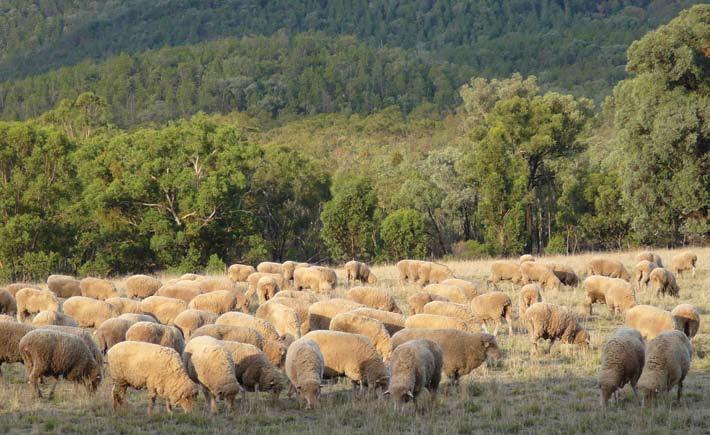
Achieving appropriate nutrition throughout the year is the cornerstone of efficient livestock production. Sheep maintained in adequate body condition will achieve production targets. They will also be healthier and have less disease problems. The appropriate body condition of sheep will vary with the type of enterprise, class of sheep and time of year. If sheep fall below critical body condition or graze poor quality and too little pasture, this will affect:
- Reproductive performance of ewes (see procedure 10.1 in Wean More Lambs);
- Growth rate targets of lambs that fail to meet market specifications
- Merino weaners being at increased risk of ill-thrift death
- Production expectations for all classes of sheep
- Higher risk of disease and health management issues.
Plan to match annual nutritional requirements with feed supply and achieve pasture utilisation without excessive use of supplements. But also know how to formulate cost-effective feeding rations for all seasons.
Key decisions, critical actions and benchmarks
Nutritional requirements
An important management skill is to know when and how much to feed, or when to sell. Be able to recognise when each class of sheep needs supplementary feeding to achieve production targets in a cost-effective way. Successful management of the feed base will ensure you are able to balance enterprise profitability and pasture utilisation, and that sheep exceed minimum acceptable body condition guidelines. The important actions to undertake when assessing nutritional requirements are:
Assessing livestock
- Know the feed requirements of different livestock classes (see tool 11.1).
- Be able to condition score and fat score all livestock classes and know critical minimum condition scores and fat scores of all sheep. Key times to assess stock include weaning, 2- 3 weeks prior to joining, early-pregnancy, midpregnancy, late-pregnancy and lamb marking.
- Draft sheep into priority feeding groups based on condition score when available feed is short or sheep are approaching critical limits. This may mean allocating priority mobs to the best available pasture or supplementary feeding.
- Make supplementary feeding decisions early and if it is not profitable to feed some sheep consider options to reduce grazing pressure. Note: it takes only 17 MJ of energy to maintain 1 kg of liveweight but 65 MJ of energy to increase liveweight by 1 kg.
- Monitor bodyweight of sheep to accurately fine-tune feeding decisions. Weighing is most important when seasonal conditions are unfavourable and supplementary feeding is an option.
- Consider scanning pregnant ewes – empty, single- and twin-bearing ewes have vastly different feed requirements.
- Be aware of the implications on flock structure and future production of selling different livestock classes.
 Assessing pastures
Assess pasture availability and quality and predict sheep performance. Once livestock and pasture assessments are made, make decisions about feeding management or stock sales. Appropriate levels of supplementary feeding can be provided in a cost-effective way to enable sheep to meet production targets.
Assessing nutritional requirements of livestock is important at all stages of the calendar year. Refer to the example of a farm management calendar (see tool 11.3) designed to map out key management tactics throughout the year.
Feed budgeting
When feed budgeting, understand seasonal growth patterns of pasture. Aim to fit the pasture supply curve with livestock demand. Comprehensive information on feed budgeting is available from a range of sources (see signposts). Within the constraints of pasture growth and animal demand, feed budgeting enables you to better plan feed supply and demand.
Feed quality
Knowing the feed quality of a supplement is important for formulating rations, particularly if supplements vary in quality. Consider testing feed quality through laboratory services such as FEEDTEST® (see signposts). Energy is the essential nutrient requirement for all livestock. Stock can consume higher quantities of feeds that have higher digestibility or metabolisable energy. Purchase feeds based on the cost of energy (cents/MJ). Refer to tool 11.4 or GrazFeed® (see signposts).
Protein is important for lactating ewes and growing young stock. If available pastures are green, protein will usually be adequate; otherwise protein supplements may be required to satisfy the stock requirements. The value of protein can be calculated based on the cost of protein (cents/unit of protein).
Roughage is required in some circumstances. Lactating ewes grazing very short pasture (less than 600 kg DM/ha) will require additional roughage in their ration to ensure lactose production in milk. All sheep in feedlots (whether for production or drought lots) require roughage in their diets.
Supplementary feeding
The basic principles for successful supplementary feeding are:
Introduction of grain
Grains such as wheat, triticale, barley or processed pellets – and, to a lesser degree, oats – that are high in soluble carbohydrates, must be introduced carefully as there is a serious risk of acidosis. Follow the guidelines for supplementary feeding by State Departments of Agriculture/Primary Industries.
Imprint feed lambs
Imprint feeding of lambs with ewes before weaning will reduce the time required to educate weaned lambs onto grain. At least four to six feedings of grain are recommended over a 2-4 week period so that lambs recognise the feeder and remember it.
Frequency of feeding
After the introductory period, ensure supplements are fed two or three times a week. Sheep perform better with less frequent feeding and it is more labour efficient. More frequent feeding is necessary when large volumes of feed are required for late-pregnant or lactating ewes.
Preferentially feed weaners and young ewes
The major cause of deaths in young sheep is usually related to malnutrition. Young Merino weaners are the most likely class of stock to require feeding, usually when pasture feed is dry and quality is poor. Weaning weight is the major determinant of survival over summer and autumn in Mediterranean climates and winter and spring in summer rainfall regions.
The impact of poor growth in their first year will have flow-on effects for the reproductive performance of maiden ewes. Tool 11.1 provides guidelines for the bodyweight of weaners and maiden ewes up to their first mating. Management strategies to ensure adequate weaner growth include:
- Join ewes for 5 weeks to ensure a compressed lambing, and provide ewes with adequate nutrition
- Imprint feed lambs at least four times with their mothers before weaning
- Wean lambs at 14 weeks after the start of lambing
- Wean onto high quality pasture, preferably with improved perennial species and about 10cm high
- At weaning draft off the lightest lambs and allocate the best quality pasture
- If lambs are below target weights start supplementary feeding before pasture senesces and quality deteriorates below 65% digestibility
- Ensure worm control is adequate and investigate unexplained deaths
- Keep annual death rates below 5%
- Provide high quality, clean drinking water. Water quality and quantity are important. In hot weather sheep require up to 10% of their body weight in water.
 Trace element deficiencies
In some regions, copper, cobalt, selenium and iodine deficiencies cause disease or ill-thrift. These occur seasonally in specific areas. High-intensity production systems can exacerbate deficiencies. Trace element supplementation is only cost effective when deficiencies are identified.
Determine the risk of deficiency and if it is likely on your property, consult your animal health adviser Use diagnostic tests to determine if trace element deficiencies are present. Determine the likely impact of deficiency and beneficial options for treatment and prevention.
Signposts
Read
Lifetime Wool Regional Guidelines – a series of guidelines and recommendations for managing ewe flocks throughout the year. Visit the Lifetime Wool website: www.lifetimewool.com.au/guidelines.aspx Managing sheep in droughtlots, A best practice guide.
Managing fodder prices for drought, A guide to help sheep producers. Which sheep do I keep? A guide to assist producers in droughts. Order your free copies of these three publications from AWI by:
- Calling: 1800 070 099
- Downloading from: www.wool.com.au/Publications/Managing_drought/page__7134.aspx
Trace Elements for Pastures and Animals in Victoria (1986), by Hosking, WJ, Caple IW, Halpin CG, Brown AJ, Paynter DI, Conley DN, North-Coombes PL. Victorian Government Printer, PO Box 203, North Melbourne, 3051.
Soil Analysis: An interpretation Manual (1999). Edited by K.I. Peverill, L.A. Sparrow and D.J. Reuter. Provides details of Australia-wide trace element deficiencies (CSIRO Publishing: Melbourne).
Feeding and Managing Sheep – a 72 page practical guide for farmers finishing lambs, feeding due to drought, designing a feedlot and much more. Purchase a copy from the Roseworthy Information Centre by calling: 1800 356 446
 View
View
NSW Department of Primary Industries Feed Cost Calculator – use this internet tool to calculate the value of feed on an energy and crude protein basis, and to examine the energy, protein and cost of any combination of up to four selected feeds. Visit: www.agric.nsw.gov.au/reader/choosing-feeds/dai201b.htm.
Sheep CRC Feedlot Calculator Tool – uses production, economic and feeding scenarios to calculate if feed lotting sheep is profitable. Visit: http://www.sheepcrc.org.au/index.php?id=301 E-sheep® easy weighing systems – keep up to date with new technologies for moving from manual, time-consuming, imprecise flock management to hightech, fast flowing, accurate individual
animal management. Visit: http://www.sheepcrc.org.au/index.php?id=4
Sheep CRC Lamb Growth Rate Predictor Tool – calculate individual growth rates of lambs and predict finishing times. Visit: http://www.sheepcrc.org.au/index.php?id=300.
GrazFeed® – a decision support tool to help graziers improve the profitability of livestock production, through more efficient use of pastures and supplementary feeds. GrazFeed® can be purchased by contacting Horizon Agriculture on www.hzn.com.au/grazfeed.php
GrassGro® – a decision support tool which can help graziers increase profits, minimise risk and test new management methods before committing resources. You can purchase GrassGro® by contacting Horizon Agriculture on www.hzn.com.au/grassgro.php.
Feed testing services to analyse the quality of a range of feeds – an example is FEEDTEST®, a commercial service provided by the Victorian DPI. Contact FEEDTEST® by calling: 1300 655 474
MLA Tips & Tools: Using the MLA Rainfall to Pasture Growth Outlook Tool – describes how to use the MLA Rainfall to Pasture Growth Outlook Tool, a tool designed to help you understand how your pasture typically grows across the year, and how much this can vary between years. Get your free copy from MLA by:
- Calling: 1800 675 717
- Emailing: publications@mla.com.au
- Ordering on-line at: ? www.mla.com.au/publications
Grazclock – a spreadsheet-based tool that matches animal feed requirements with pasture growth throughout the year. It allows sheep (and cattle) producers to select key management times to correspond with feed demand. Contact NSW DPI via email: Douglas.alcock@dpi.nsw.gov.au
The Lambing Planner It provides a systematic basis for planning the management calendar for the breeding flock.



