 Introduction:
By nature, rabbits choose one or a few places (usually corners) to deposit their urine and most of their pills. Urine training involves little more than putting a litter box where the rabbit chooses to go. Pill training requires only that you give them a place they know will not be invaded by others.
Does age make a difference?
Older rabbits are easier to train than younger rabbits, especially babies. A rabbit’s attention span and knack for learning increases as they grow up. If you are deciding whether to adopt an older rabbit OR litter train your older rabbit, go for it! If you are training a baby stick with it!
Does Spaying/Neutering make a difference?
Yes! This is often the most important factor. When rabbits reach the age of 4-6 months, their hormones become active and they usually begin marking their territory. By spaying or neutering your rabbit, he will more likely use his litterbox, as well as be happier & healthier.
What types of litter should I use?
It depends on what’s available in your area and what your rabbit’s habits are. Keep in mind the following as you choose your litter:
- most rabbits spend lots of time in their litter boxes
- rabbits will always nibble some of the litter
- rabbit urine has a very strong odor.
House Rabbit Society recommends organic litters made from: alfalfa, oat, citrus or paper.
For a complete listing of litter types see the litter boxes and liver disease article.
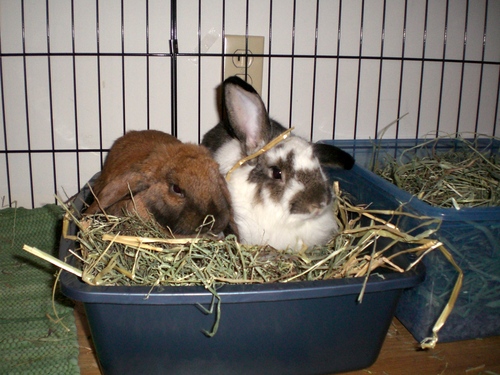
Rabbit litter box
Rabbit litter box
Avoid:
Litters made from softwoods like pine or cedar shavings or chips. These products are thought to cause liver damage in rabbits who use them.
Note:
CatWorks litter has been linked to zinc poisoning.
Swheat Scoop litter should be avoided because rabbits will often ingest it. Being comprised of wheat, it is very high in carbohydrates and can cause obesity, excessive cecal production, diarrhea, bacterial imbalance and other health issues.
Hay Litter Boxes:
Another approach is to place a handful of hay in each litter box or to simply use hay as litter.
It is helpful to put several layers of newspaper under the hay, to absorb urine so that your rabbit is not standing in the urine. Most newspapers today are using soy-based ink which is safe for your rabbit: Check with your local newspaper to make sure first.
Obviously, you need to change the hay fairly frequently i.e daily, given your rabbit will be eating it. This method often helps to encourage good litter habits as well as to encourage hay consumption, since rabbits often eat at or near the same time as they use the litter box.
Pros and Cons of Various Litter Types include:
Clay litter is dusty. If your bunny is a digger, the dust can make her vulnerable to pneumonia. The deodorant crystals in some clay litters are toxic.
Clumping litters will clump inside the rabbit’s digestive and respiratory tracts (the latter if they manage to make enough dust to breathe) causing serious problems and often leading to death.
Pine and cedar shavings emit gases that cause liver damage when breathed by the bunny
Corn cob litter isn’t absorbent and doesn’t control odor. There exists the risk
of it being eaten and causing a lethal blockage.
Oat and Alfalfa Based litters have excellent odor controlling qualities however if a rabbit eats too much they expand and cause bloating. These litters can be added along with the bunny’s waste, to compost.
Newspapers are absorbent, but don’t control odor.
Citrus based litters work well, offer no dangers and can be composted, however they may be hard to obtain/expensive in some areas of the country or world.
Peat Moss has been reported as a successful litter ingredient by some, can also be composted.
Paper pulp or recycled paper products have been used with success by many people. These litters are very good at absorbing and cutting down on odors.
Compressed sawdust pellets: are inexpensive, highly absorbent litters used in many foster homes. They are made from softwood or hardwood sawdust however they are not toxic because the phenolic compounds are removed during their manufacture. Their wood composition helps control bacterial growth and odours. Wood stove fuel pellets and Feline Pine are two examples of this product.
Litters made from Aspen bark are safe and good at absorbing odours.