
Earthworm Castings
Don’t overlook the importance of liquid castings. This is a very profitable line and I know two growers who have produced it. The first made so much money he retired after only a few years. The other, by reports, is doing very nicely packing it in 1 litre jars and selling it for around $4.50 wholesale. If you were selling your castings for as much as $1. per kilo, a litre of liquid castings would only cost 20 cents in raw materials, the bottle and label perhaps another 90 cents, making not a bad profit on a litre of water!
The method of producing liquid castings is simple. Just mix pure castings with water at a 20 per cent ratio. That is to say, add 200 grams of castings to 1 litre of water, shake thoroughly and allow to soak for twenty-four hours, shaking or stirring occasionally. Then allow the castings to settle to the bottom and drain off the liquid. It should be coloured, but tasteless and odourless.
The results obtained from spraying liquid castings over broad acres has been likened to those produced from the Bio-dynamic product called ’500′. It seems believable. Vermicast is known to be rich in bacteria and it seems likely that ED 500 is also. This is another aspect of worm farming which warrants further research. If it were to be demonstrated that vermicast was as good as, or even better than, ED 500 the benefits of bio-dynamic farming methods would suddenly become more readily accessible and less costly,
How to Harvest and Pack Castings
The difficulty in harvesting castings is that they are on the bottom of the bed and your worms are on the top. You have to separate the two, and there are several ways of doing this. Whatever method you use, first scrape all uneaten food from the top of the bed or, better still, starve the worms for two to four weeks before the harvest.
Using Basket’s of Food
Plastic bread baskets are used for the first method. These can often be obtained damaged from a bakery at little or no cost and are very efficient. Place the bread baskets side by side on top of the bed and fill them with fresh feed. Water in well and cover with hessian. The worms are attracted to the fresh feed and, in two or three days, about 80 per cent of them will be trapped in the baskets, which you can then lift off the bed. Use the contents to start a new worm bed, refill the baskets and replace them, this time leaving them for four weeks. During this time, the capsules will have hatched and all the worms, both mature and immature, will have moved into the baskets, leaving the vermicast ready for harvesting.
The second method is equally simple, but takes about twice as long, You lay a fresh bed alongside (touching) the one you wish to harvest and cover it with hessian. Then uncover the bed you want to harvest and stop feeding and watering the worms. Gradually the worms wilt migrate to the new bed, but you will need to allow time for the capsules to hatch and for the young worms to migrate also. The total. process before you can start removing vermicast takes up to two months.
The third method works best if you use beds with wooden sides. First, you place fresh feed in an empty bed and lay some mesh across the top to act as a divider. Then spread the worm-rich bedding from the bed you are to harvest across the screen to a depth of about 50 mm, raking it level. The worms will quickly go through the mesh into the bedding below. Repeat this process, taking the bedding from the top of the harvest bed, until you are sure that all the worms have left and burrowed down into the fresh bedding below the screen/divider This method is quite rapid but laborious, and produces only vermicompost. It must therefore be packed for sale only in porous bags.
Using a Rotary Screen
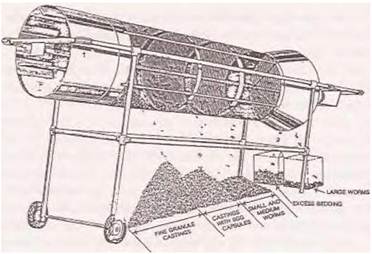
Large scale operators often use a rotary screen to separate castings from worms. Depending on the purpose of your work, the screen can be used to harvest either worms or vermicompost. The bedding is loaded into one end of the screen which rotates at between 8 and 12 RPM, depending on the size. (The larger the diameter, the slower the speed of rotation.) The castings containing capsules and very small worms fall through the screen and the large worms are fed out at the opposite end for collection. These screens are popular in America where the production of vermicast is measured in tons, not in small quantities. Often the vermicast falls through the screen onto a conveyor belt which transports it through a heat, or microwave, tunnel to pasteurise it and then on to an automatic bagging machine
 Packing
Vermicompost, because it contains worms, capsules and some uneaten feed must be packed in a. woven bag so that air can circulate. Polypropylene is perhaps the most suitable. Any bag merchant will be able to sell you small woven bags capable of holding 10 kilos for around 25 cents each. Vermicompost must never be packed in a sealed bag because it needs oxygen. If you were to pack your vermicompost in sealed bags, the worms would suffocate and when opening the bag your customer would be greeted with a foul stench. The castings will still be good, but your chances of a repeat business will not.
If you market vermicast, you will need to reduce the moisture substantially, to the point of drying it. Damp vermicast in sealed bags may sour due to lack of the oxygen needed to sustain the vital bacteria which maintain their activity in the presence of water_ Another reason for drying vermicast before packaging is to reduce its weight which, in turn, will substantially reduce the freight cost. When it is dry, you can quite safety pack it into sealed and attractively printed polythene or wet-strength paper bags.
Dry vermicast resists moisture, so that before you commence drying it you will need to spray it well with a 10 per cent mix of biodegradable detergent and water. The detergent will substantially aid re-wetting when your customer is ready to do this. A suitable detergent is Vicscour, produced by the Victorian Chemical Company, 37 Appleton Street, Richmond, Victoria 3121. Vicscour is supplied in a highly concentrated form which at first actually becomes thicker when you add water. You should use one part of Vicscour to ten parts of water before using it as your base for the 10 per cent mix so that, in fact, the total dilution will be one hundred times.In your packaging, you cannot label either vermicast or vermicompost as a fertiliser because you can’t accurately state the NPK value of each bag as required by law. This value varies from time to time because of variations in your feed over which you have no control. Castings are a growth stimulant and soil conditioner and you are advised to sell them simply as that.
 The Jetstream Harvester
Some people say that castings arc deficient in nitrogen. One reason for the occasional relatively low nitrogen (as nitrate) content is that nitrates arc soluble and, if worm beds are overwatered, it is possible for the soluble nitrates to be leached from the vermicast. The remedy for this is to be careful not to water the beds so much that the moisture exceeds the squeeze test and to feed the worms every other time with a light sprinkle of fresh poultry manure. (This should not constitute your main feed unless it is well aged.)



