 Introduction.
Lighting is an essential component of successful commercial poultry production. With laying birds (including breeders) light is significant in the development and functioning of the bird’s reproductive system, influencing the age when she starts laying and how many eggs are laid in a given period.
The pattern of changing day length experienced by birds influences them in two ways:
1. Increasing natural day length, as occurs in spring, accelerates sexual maturity of growing pullets and stimulates egg production during the laying period.
2. Decreasing day length, as occurs in autumn, retards sexual maturity of growing pullets and restrains egg production.
Consequently it is the changing pattern of light received by the birds which influences them rather than the duration of the lighting pattern. For example, pullets reared on a constant 16-hour day will mature at about the same age as those reared on a constant 8-hour day. The birds in the 16-hour program will have received more total light, but are experiencing the same lighting pattern as those in the 8-hour program, that is, a constant-light pattern.
Supplementary artificial light is a commercial necessity in order to maximise egg production.
Lighting program for laying birds.
The aim of any lighting program for layers is to supplement the varying natural daylight so that an even pattern of total light is received throughout the year.
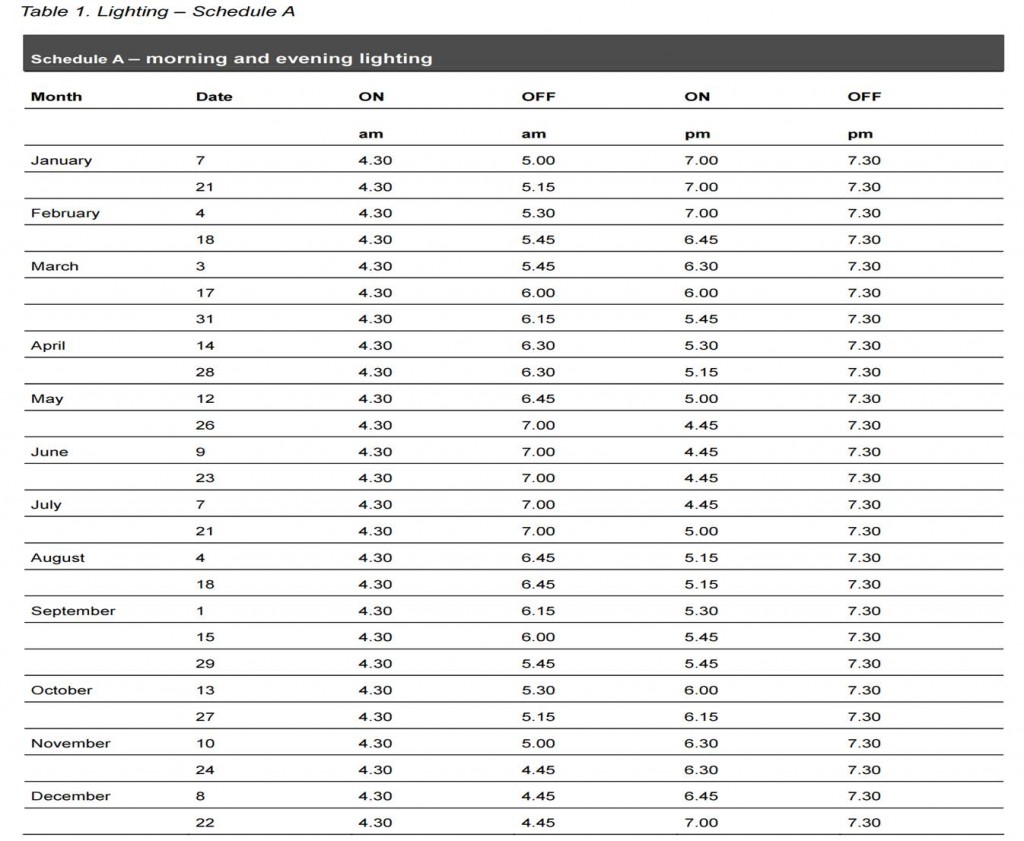
The recommended program for laying hens and replacement pullets in New South Wales is a total of 15 hours of continuous light and 9 hours of darkness. To achieve this, the best lighting program is a combination of extended morning and evening lighting. The basic program is:
- On: 4.30 am
- Off: 7.30 am
- On: 4.30 pm
- Off: 7.30 pm
 Note: All times are Eastern Standard Time, not Daylight Saving Time.
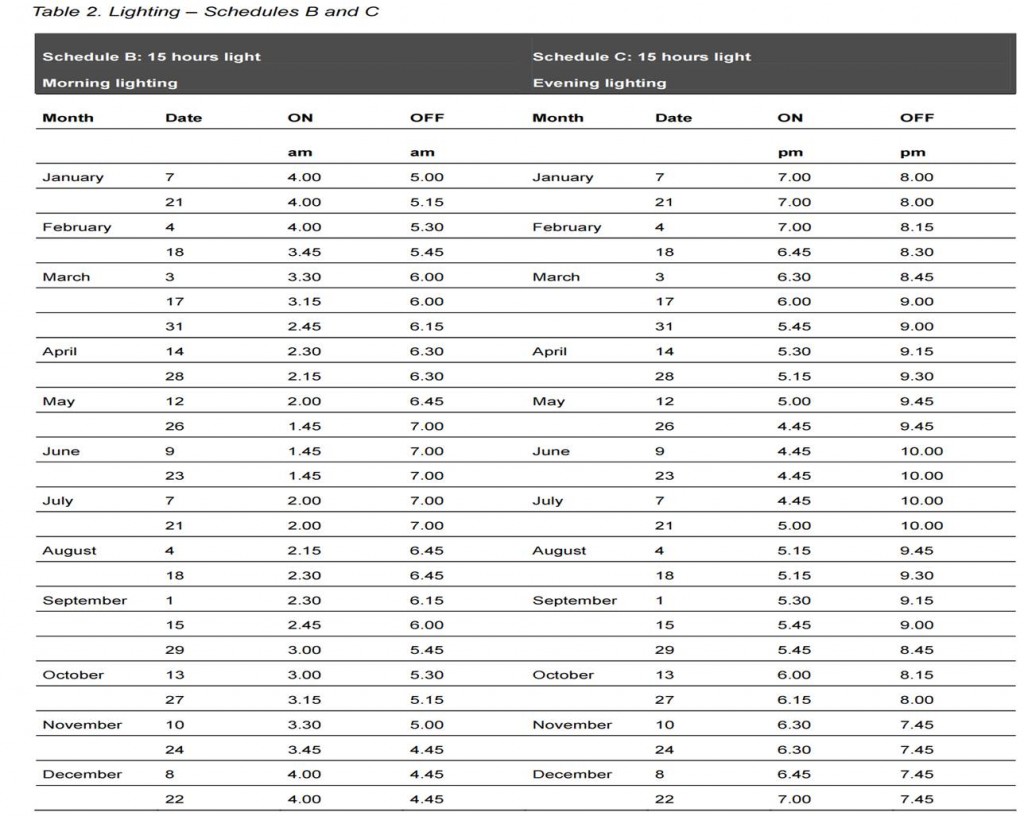
The same program can be achieved using a timer in conjunction with a light-sensitive switch. Schedule A (see page 2), for morning and evening lighting, indicates actual times for switching lights on and off. Another alternative is to use either morning or evening lighting, as given in Schedules B and C respectively (see page 3). Producers have the option of increasing the photoperiod from 15 hours per day to 16 or 17 hours per day to stimulate egg production, usually towards the end of the laying cycle.
For birds raised on the floor, morning lighting (Schedule B) may be the preferred option because birds are not suddenly plunged into darkness when lights go off at night. This is more critical where birds roost on perches at night.
Lighting program for broiler birds.
Lighting patterns for broilers are aimed mainly at stimulating and controlling feed intake. Two programs are commonly used:
- continuous lighting except for 1 hour of darkness;
- intermittent lighting of 2 hours on, 2 hours off.
Blackout training.
All young commercial poultry should be given blackout training from day old in order to accustom birds to sudden darkness. This is achieved by turning light off for between 5 and 60 minutes daily to simulate blackout conditions.
If this is not done there is a very real danger of birds dying in ‘pile-ups’ on the litter if a blackout occurs.
 Types of lights.
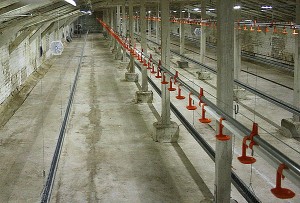
Either incandescent or fluorescent lights may be used. Commercially, fluorescent lights are a cheaper long-term proposition because of their greater light efficiency and low maintenance and running costs. However, installation costs are higher. Another alternative is to use fluorescent globes which fit into normal batten holders used for incandescent globes. These fluorescent globes will reduce running costs significantly, but are more expensive to purchase. As with normal fluorescent installations these represent a longterm investment, and are particularly suitable for Summary of lighting schedules and intensities converting existing incandescent lighting to a fluorescent system without changing any fittings. The conversion to fluorescent bulbs is a costefficient proposition as the savings in running costs soon outweigh the extra cost of the fluorescent globes.
Points to remember.
- Regularly check operation of time clocks and light fittings, especially after power failures.
- Clean light fittings at least annually.
- Keep time clock covers in place to prevent dust and moisture clogging the mechanism.
- Pullets should receive either a constant or decreasing light pattern prior to laying.
- Never let laying birds experience a decrease in light pattern.
- Use light levels specified for the type and age of poultry housed.
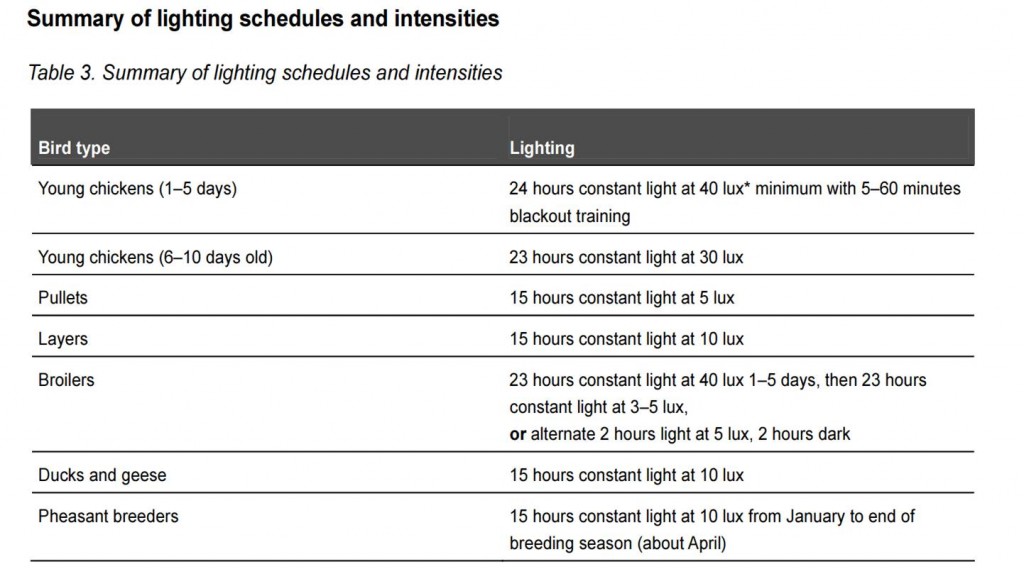
*Lux is the unit of illumination and measures the amount of light per square metre. 50 lux is about the brightness of an average lounge room.
Author.
Gerry Bolla



