 Introduction
Lice irritate cattle, causing the cattle to bite, scratch and rub. This constant irritation can become a welfare issue. Lousy cattle may cause damage to fences, yards or trees which the cattle use as rubbing posts. The coats of lousy cattle take on a rough scruffy appearance, and, at times, areas of skin are rubbed raw. This will reduce hide value at slaughter and be inconsistent with on-farm quality assurance programs.
The effect of lice on the production and growth rate of cattle is a matter for continued debate.
Conflicting results from many trials indicate that various factors interact to influence the degree to which lice affect cattle. Lice can be an important cause of economic loss when cattle are in poor condition or if infestations are heavy. If only a few animals in a mob are severely affected by lice, always look for an underlying cause. Diseased or nutritionally stressed animals will develop more severe lice infestations than healthy animals.
Characteristics
There are two types of cattle lice: biting lice and sucking lice.
Although there are six species of cattle lice in Australia, only four are common in New South Wales.
Biting lice
Biting lice feed on skin debris and can cause severe irritation. The cattle biting louse (Bovicola bovis) is a reddish-brown louse about 2 mm long with a brown head. It is mostly found on the neck, shoulders, back and rump.
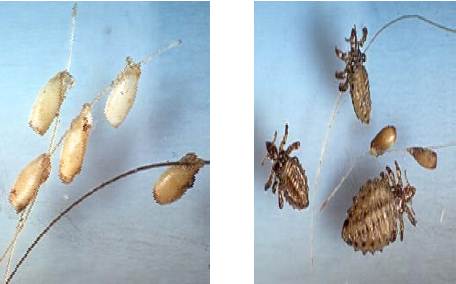
Lice and eggs of Haematopinus eurysternus
Lice and eggs of Haematopinus eurysternus
Sucking lice
Sucking lice pierce the skin and suck blood. In large numbers they can cause anaemia.
• The short-nosed cattle louse (Haematopinus eurysternus) is dark-grey. The female is 3.5– 5 mm long. The male is smaller. It is mostly found around the cattle’s eyes and in the long hair around the neck and tail, but in heavy infestations it can occur anywhere in the hair coat. In summer it is found in and around the ears and under the tail.
• The long-nosed cattle louse (Linognathus vituli) is bluish-black and about 2.5 mm long. Like the short-nosed cattle louse it may be found anywhere in the hair coat including the neck, dewlap, inner thigh and scrotum.
• The tubercle-bearing louse (Solenopotes capillatus) is the smallest louse. At only 1.2 mm long. It has a brown head and a bluish abdomen. It is usually found around the head and neck in distinct dark clusters.
The life cycle
The life cycles of all species are similar. Eggs are laid by the female and glued to hair shafts, and take 8–19 days to hatch as nymphs. The nymphs undergo three moults on the beast, and develop into adults. The entire life cycle takes 3–6 weeks.
Spread
Lice are spread entirely by direct contact between cattle. The lice and their eggs survive for only a few days if removed from cattle. Cattle lice cannot live on other species of farm animals.
Populations
Lice populations are highest in winter and lowest in summer. Cooler skin temperatures are associated with heavier lice infestations. The denser winter coat and cooler weather favours survival of lice.
It appears that well-fed healthy cattle do not develop heavy lice infestations and that those lice present do not adversely affect performance.
The number of lice tends to increase as nutrition for the cattle becomes poorer. It is usually when cold weather is coupled with poorer nutrition in winter that heavy lice infestations can develop.
Cattle in poor condition tend to carry heavier lice infestations, particularly if they have some other problem such as some sort of chronic disease. However, some cattle appear to have a high susceptibility to lice and are described as ‘louse carriers’.
Differences in the greasiness of the hair coat of various cattle breeds has been suggested as a possible reason for perceived differences in susceptibility to lice. However, it is more likely that differences in lice burdens between individuals reflects immunological, nutritional or health status differences between animals.
Control
Insecticides and regulations
There are many commercially available insecticides registered for control of cattle lice. All must be used strictly in accordance with manufacturers’ directions. Read the label thoroughly. Pay particular attention to the withholding periods required for meat and milk production, and to compatibility with other treatments such as drenches.
• Maximum residue limits (MRLs) are set for chemical/food combinations by Australian law.
• Withholding periods (WHPs) are designed to ensure a safe time period between pesticide application and slaughter of livestock, so that any chemical residues that may exist in the final product (meat or milk) are below the MRL.
• Export slaughter intervals (ESIs) have been developed for the red meat industry through Meat and Livestock Australia to reflect the differences between domestic and overseas MRLs. ESIs may be quite different to WHPs. Produce destined for overseas markets must satisfy the ESI. Read the product label carefully before use and adhere to the WHP and ESI time intervals.



