 Two classification systems are used in NSW to assess land for agricultural and other rural uses. As each system fulfills a distinct purpose, the resultant classifications and maps are not directly comparable.
The eight-class Rural Land Capability system defines land based on the capacity for a site to be used for agriculture, urban or other purposes without permanently damaging soil resources. Hence, it focuses on the physical (or biological) constraints imposed by geology, soils, slope, climate, drainage and groundcover. Land Capability is generally used in soil conservation and property plans to identify constraints to urban development or areas requiring different soil management practices.
The five-class Agricultural Suitability system was developed to support land use planning and focuses on the potential agricultural productivity of the site and its suitability for grazing or cultivation. Agricultural Suitability Class I land has few if any constraints, can sustain high levels of agricultural production and a wide range of crops.
In the Hunter region, this typically corresponds with alluvial river flats used for vegetable, lucerne or turf growing. At the other end of the scale Class 5, land has severe production constraints (eg steep slopes, forest cover) and is generally unsuited to agriculture. Agricultural Suitability Classes associated with grazing enterprises are described further in Table 1.
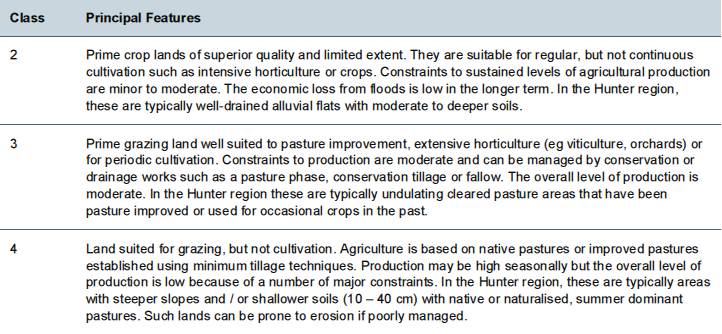
Table 1 Agricultural land suitability classes for grazing enterprises
Properties that comprise mostly Class 4 Agricultural Suitability have relatively low levels of pasture productivity and a larger area is required to sustain the year round feed requirements of each animal or breeding unit. Hence, smaller properties of less than 60 ha are only capable of supporting small numbers of cattle. Such properties, however, may require the same level of effort and costs as a larger property and are unlikely to ever be capable of covering the costs of running and selling the livestock.
Grazing properties that have a better balance of resources (eg a mix of Class 3 and 4 lands) are able to balance out available feed supplies over a longer period via improved pastures, lucerne hay or silage production, or to provide higher value feed at critical periods. Better returns are consequently obtainable because of higher calving rates, lower mortalities and better finished (i.e. fattened) stock. They also have the potential to sustain higher stocking rates (more head of cattle per hectare on average).
Landholders who consistently produce higher quality cattle in larger numbers typically secure higher prices per head by targeting premium markets.
Agricultural Suitability mapping for the Hunter and Mid Nth Coast regions was progressively undertaken between 1983 and 2002 to help land use planners identify the productive potential of a locality or shire. They are not suitable for identifying the agricultural suitability of individual properties as local variations, smaller than 40ha, are not mapped.
Procedures for mapping agricultural suitability are set out in The Rural Land Evaluation Manual. Knowledge of current agricultural practices and enterprise options within a region as well as physical, social and economic constraints to agricultural production is required. Hence, agricultural suitability mapping is usually only considered when planning for regional land use options or major projects.
An assessment of productive carrying capacity (DSE rating) is the more usual basis for deciding land use options for a particular site or locality. This requires an understanding of the areas climate, soils, pastures, fertiliser history and environmental values (such as the protection of catchment values or remnant vegetation). A broad over view of these factors is provided in the main section of this document.


