Alfalfa
Authors: Keith Devenish, Department of Agriculture, Northam and Gary Hepworth and Natalie Coonan, Curtin University of Technology, Muresk, Northam
KEY MESSAGES
- Cover cropping legume pasture with a small amount of sweet lupin seed improved the performance of crossbred lambs grazed on matured medic pasture over summer.
- Sowing 15 kilograms of lupin seed per hectare with medic reduced the medic seed yield by less than ten per cent whereas sowing 30 kilograms of lupins per hectare reduced the seed yield of medic by 30 per cent.
- Weekly growth rates of up to 1.4 kilograms per head were achieved for crossbred lambs when lupins were added to the pasture mix.
Introduction
In the past, farmers have often under-sown oats with sub-clover to provide sheep with a cheap but valuable summer feed. The usual recommendation for establishing a medic pasture is to sow it as a pure stand. However, one prime lamb producer has found that lupins are ideal to sow with new medic pasture; helping to increase growth rates of sheep without reducing the pasture’s seed yield.
This technique has now been evaluated for use with sheep meat enterprises; the results of which are detailed below.
Trial results
A grazing trial was conducted during the summer of 1996/97 on a farm at Perenjori. Santiago medic pasture was established on a red loamy soil with,or without, a small amount of sweet lupin seed that was mixed with the medic at seeding time. The trial investigated the amount of lupin seed that can be sown with medic seed before the seed yield of medic is reduced. The benefits of using this pasture mix for prime lamb production were also evaluated.
The newly sown pasture was allowed to mature before the area was fenced into one-hectare plots. Each plot was stocked with store lambs (Border Leicester x Merino) at 6 DSE per hectare for eight weeks from 18 December to 12 February. The average weight of the lambs at the beginning of the trial was 32 kilograms.
The growth rates of the crossbred lambs grazed on a pure medic pasture sown with 15 kilograms per hectare of seed were compared with those of similar lambs grazed on medic pastures mixed with either 15 or 30 kilograms per hectare of sweet lupins (Merrit).
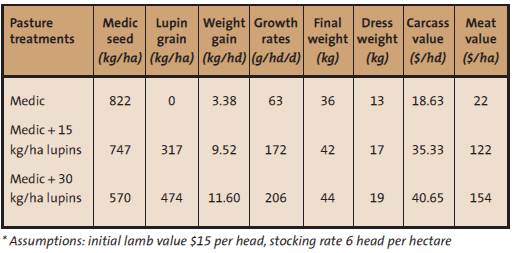
Table 1. Growth rates and carcase values of prime lambs grazed on medic pastures with and without a narrow-leafed lupin cover crop
At the conclusion of the grazing period, all lambs were transported to the Linley Valley Abattoir where they were slaughtered and each carcase was evaluated in terms of its dressed weight and carcase quality.
Similar amounts of plant dry matter were produced by all treatments. Lambs on the mixed medic/lupin pasture grew more than twice as fast (172 to 206 grams per head per day) as those on the pure medic pasture (63 grams per head per day) (Table 1).
There was also a large difference in carcase value; with those from the lupin treatments achieving double the value of those grazed on pure medic pasture ($35.33 and $40.65 compared to $18.63 respectively). This was mainly because the dressed weight and condition score of lambs from the pure medic pasture failed to reach optimum slaughter weight and carcase characteristics.
Adding 15 kilograms per hectare of lupin seed to the medic at seeding only reduced the seed yield of the medic by nine per cent. However, at 30 kilograms per hectare, the lupins reduced the seed yield of the medic by30 per cent.
Conclusion
Sowing a small amount of lupin seed as a cover crop with medic pasture increased the performance of prime lambs grazed on the mature pasture. The pure medic pasture (more than 80 per cent medic) only produced a growth rate of 0.44 kilograms per head per week compared to the medic lupin pasture which increased the growth rate to more than 1.2 kilograms per head per week. At low seeding rates of lupins, the impact of competition on medic seed production is minimal.
Cover cropping with lupins provides the opportunity to finish prime lambs (or any other meat sheep) during summer while recovering the costs associated with establishing a new legume pasture.


