Description: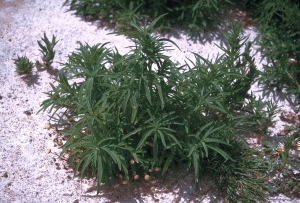
Kochia (Bassia scoparia) is a fast growing annual herb that grows to 1.5 m high. As the plant ages the colour of its stems, leaves and flowers changes from green to pale yellow, pink and dull brown. It has an erect main stem with many upward-curving side stems and forms a pyramidal to rounded bush. The leaves have no stalk, are arranged alternately along the stems, and grow up to 50 mm long and up to 8 mm wide. The flowers are the same colour as the leaves and occur singly or in pairs, in short, hairy spikes (up to 10 mm long) along the upper parts of the stems. The seeds of Kochia are dull-brown, 1.5 mm wide and are contained in small star-shaped fruits. When the seed is ripe the plants die, break off at the base and are blown around by the wind in a tumbleweed fashion, dispersing seed as they move.
The species Bassia scoparia is extremely variable. Where it is native, several geographical races occur and are usually recognised as different subspecies. A narrow-leaved ornamental form with bright red autumn foliage, known as Bassia scoparia forma trichophylla (summer-cypress), is widely cultivated and sometimes escapes from garden plantings. This form is reported to be a minor weed in South Australia and Western Australia. Bassia scoparia subsp. densiflora is a more problematic plant and is reported to be the form that was deliberately introduced into Western Australia and subsequently became a major weed. It is also thought that this is the same form that appeared as a weed in carrot crops in Tasmania. In North America, Bassia scoparia subsp. scoparia is the main weedy form that is encountered. Bassia scoparia subsp. densiflora is also present in North America but is regarded only as a casual weed.
For further information and assistance with identification of Kochia contact the herbarium in your state or territory.
Distribution:
Prior to Kochia being eradicated from Western Australia, it was introduced widely and became a widespread weed, particularly in Western Australia’s Southwest region including in the Avon wheatbelt, Esperance Plains, Geraldton Sandplains and Mallee sub-regions. A total of 81 infestations, ranging in size from less than 10 ha through to more than 1000 ha, were recorded in Western Australia. In Tasmania, infestations have been recorded in carrot crops near Deloraine and Devonport in the state’s north. Kochia is now regarded as eradicated in Western Australia and Tasmania. Kochia is also recorded in South Australia, Victoria, New South Wales and Queensland (AVH 2007 - as both Kochia scoparia and Bassia scoparia).
Note: Bassia scoparia subspecies trichophylla is excluded from the Kochia weed declarations in the Northern Territory and New South Wales. Bassia scoparia variety trichophylla is excluded from the Kochia weed declaration in South Australia.
Kochia is naturalised throughout the United States especially in the Southwest and Great Plains regions where it has become a serious weed in pastures and rangelands. It is also naturalised in Canada, Africa (African Plants Database), South America, parts of temperate Asia and most of Europe.
Habit: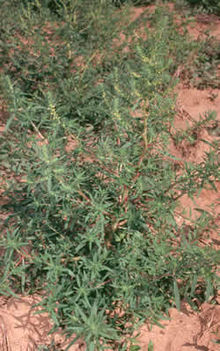
Herb
Key points:
- Although originally planted for fodder and to help rehabilitate saline soils, Kochia (Bassia scoparia) quickly became weedy.
- Kochia’s tumbleweed behaviour, coupled with its annual lifecycle allows it to spread seed over long distances in short times.
- A concerted effort to eradicate Kochia from Western Australia was highly successful with the species being eradicated from over 2000 ha of infested land.
- Preventing the spread of Kochia will protect the cereal crops and pastures of much of temperate, semi-arid and subhumid Australia.
- Populations of Kochia should be reported to your local council, or state or territory weed management agency.
- Kochia is an extremely hardy plant that can tolerate both drought conditions and saline soils.
How it spreads:
Kochia reproduces by seed. Up to 50 000 seeds may be produced by a single plant during its one-year lifespan, although typically about 14 600 seeds are produced. The main mechanism for the dispersal of seeds is by the tumbleweed nature that the plant exhibits. After the seeds are mature, the plants die off, break at the base and get blown around by the wind, spreading seed as they go. Water currents may also disperse seed. Seeds of Kochia have a very short viability, and if the seeds don’t germinate, they usually decay within one year.
Where it grows:
Kochia is native to arid and desert regions of Eurasia. It is an annual weed of crops and pastures throughout the world, especially in regions with warm climates. Kochia grows well in conditions similar to those required by cereal crops in southern Australia; that is, climates with hot, sunny summers . It is extremely drought tolerant and, in the United States, grows in areas that receive as little as 150 mm of rainfall per annum. It invades disturbed sites, crops, pastures, flood plains, riparian habitats and rangelands . It tolerates saline soils and can flourish even when irrigated with water that is one-third the salinity of seawater. It prefers open unshaded areas. Much of central and southern Australia is climatically suitable for Kochia. The ability of Kochia to prosper on degraded and saline sites has lead to it being used as a revegetation and fodder species in Australia and North America.
Flower colour:
Multi-colour
Distribution map: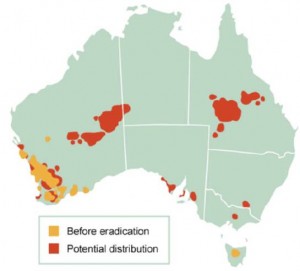
Impacts:
Kochia is on the Alert List for Environmental Weeds, a list of 28 non-native plants that threaten biodiversity and cause other environmental damage. Although only in the early stages of establishment, these weeds have the potential to seriously degrade Australia’s ecosystems.
Livestock readily graze Kochia, and it is considered a good forage plant in arid and semi-arid parts of the United States of America. However, it may be toxic if overgrazed. High levels of oxalate, nitrate and alkaloids are contained in the plant, and accumulations of these compounds can lead to toxicity.
Kochia is well adapted to out-compete crop, pasture and native plants. Its fast growth rate results in a large plant that competes for both light and nutrients. Kochia is allelopathic, i.e. it gives itself a competitive advantage by producing chemicals that reduce the growth rate and germination of other nearby desirable plant species. Its tumbleweed behaviour and annual lifecycle allows it to spread seed over long distances in short times.
Origin:
Kochia is native to eastern Europe and western Asia (Mosyakin 2003). In Europe, it is thought to be native only in southern and eastern Russia, but it is widely cultivated elsewhere, and is naturalised in the central, southern and eastern regions.