 Background information
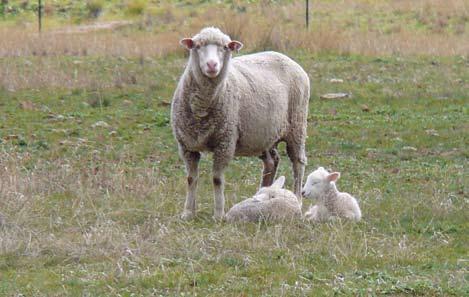
The profitability of high performance lambing systems depends on targeting those management practices that are cost effective and will improve lamb survival. Most lamb loss occurs in the first three days after birth so reducing lamb losses must focus on factors that can improve survival of new-born lambs. As the condition score of ewes at lambing increases, so does lamb survival, especially in twin bearing ewes.
Introduction
Important principles to increase lamb survival are:
- Select a lambing time that is likely to maximise survival of new-born lambs.
- Manage ewes to produce lambs with optimum birth weights. There is a close relationship between ewe condition at lambing and lamb birth weight.
- Cold, wet and windy weather increases lamb mortality, particularly with lambs that have a low birth weight.
Manage ewes to minimise the impact of weather at lambing.
- Early selection of lambing paddocks on the basis of size, availability of shelter, and pasture quality and quantity available for ewes are critical management decisions affecting the ability to wean more lambs.
- The effects of prolonged birth and the combination of hunger and mismothering account for the majority of lamb deaths.
- If ewe nutrition is poor, there is delayed production of colostrum and new-born lambs are at risk if they do not receive a drink soon after birth. In addition, mothering ability and lamb behaviour are depressed when ewe nutrition is poor.
- The longer a ewe stays at the birth site, the greater the chance of the ewe and lamb bond forming.
- Depending on the individual ewe and the breed type, it takes up to six hours for a ewe to recognise her lamb and in this time a ewe may accept any lamb as her own. It also takes lambs twice as long to recognise their mothers and if a lamb is abandoned within six hours of birth it has little chance of survival. Merino ewes do not recognise twins very well.
- Ewes about to give birth may ‘pirate’ recently born lambs only to abandon them when their own lamb is born.
- When the number of ewes lambing is at its peak, the lambing paddock is a busy and cluttered place. Best practice is to minimise any disturbance in the lambing flock.
- Predators can account for between 5–10% of losses in some situations. But predators are usually of secondary importance compared with hunger, mismothering and hypothermia.
- When predators are known to cause lamb loss, start baiting well before lambing and continue until well into lambing.
Key decisions, critical actions and benchmarks
Lamb survival rate targets
Lambing management needs to aim for lamb survival better than:
- Merino ewes: single bearing – 90% survival; twin bearing – 70% survival
- Crossbred ewes: single bearing – 90% survival; twin bearing – 80% survival As ewe condition score at lambing increases, so does lamb survival, especially in twin bearing ewes. In the period from three days after birth to before weaning, aim to keep lamb death rates at less than 3%.
Selection of lambing paddocks
Several key features need to be considered when selecting lambing paddocks.

Figure 1 Increasing twin lambing.
Pasture availability targets
Figure 1 Increasing twin lambing.
The following pasture targets provide a guide to best practice:
- Where ewes are scanned and drafted into single and twin bearing, allocate ewes to lambing paddocks that have the best pasture/best shelter to least pasture/most exposed on the following basis:
As a guide, aim for:
- FOO of at least 1,200 kg green DM/ha in lambing paddocks, and preferably more with twin lambing groups.
- On annual clover-based pastures, FOO of 1,500-1,800 kg green DM/ha is recommended at commencement of lambing.
- Prioritise the available pasture resources to ensure paddocks have adequate quantity for ewes at lambing.
- If pasture is likely to be limited during lambing, save pasture in early pregnancy or consider adopting strategies to increase pasture production.
- If pasture availability targets cannot be met on a regular basis use tool 10.2 to review your current lambing time.
Lambing paddock shelter
The factors contributing to the risk of hypothermia in lambs include combinations of temperature, rainfall and wind speed. Of these, only wind speed can be controlled by using naturally sheltered lambing paddocks. As a guide, sheltered paddocks can reduce lamb mortality rates by about 10%. Ideally, lambing paddocks that are sheltered from the prevailing winds and provide shelter over the entire paddock are best for lambing. Satisfactory shelter can be provided by trees, shrubs and tussocks. It is important that shelter belts are designed properly otherwise they may act as wind tunnels when grazing livestock remove the foliage from the lower branches.
When selecting lambing paddocks, consider the sheep grazing behaviour and paddock characteristics and avoid those where ewes are likely to lamb in exposed areas. Preferred paddocks are north and east facing, have good sunlight in the morning, are well drained and provide good access to water.
Paddocks with low worm risk
In high rainfall regions, gastrointestinal parasites are a major cause of production loss in ewes and poor growth in lambs. Ideally, graze ewes on paddocks with low worm contamination during lambing.
Paddock and mob size
The most important consideration is to stock lambing paddocks to match pasture availability with breeding ewe demand. As a general guide, keep stock densities under 18 ewes/ha in twin lambing paddocks. A smaller mob size will also improve lamb survival, most probably due to lower incidence of mismothering. Table 10.2 outlines suggested maximum mob sizes. These are only guides and many other factors must be considered, including the cost of subdivision and management issues with extra mobs.

Table 10.2 Suggested mob sizes
Predator control
The main predators of new-born lambs are foxes and in some regions, pigs. In some circumstances predators can kill more than 10% of lambs. If foxes are a problem, baiting, using products such as Foxoff® in conjunction with Feralmone™ (see signposts) in the three months before lambing and during lambing, is recommended. Pig predation is best managed by selecting lambing paddocks where pigs can be controlled.
Investigating neonatal lamb deaths
Investigate excessive new-born lamb losses and discuss with your animal health or livestock adviser. Tool 10.8 contains a check list to diagnose common causes of lamb losses so you can improve management to reduce deaths in future years.
Supervision during lambing
Best practice is to minimise the disturbance of the lambing flock. If supervision is warranted, the best time to enter the maternity paddock is in the afternoon. Develop a routine so ewes will become accustomed to human presence and will not leave their lambs.
Stock husbandry
After lambing there are two major risk periods for lamb losses.
 Lamb marking and mulesing
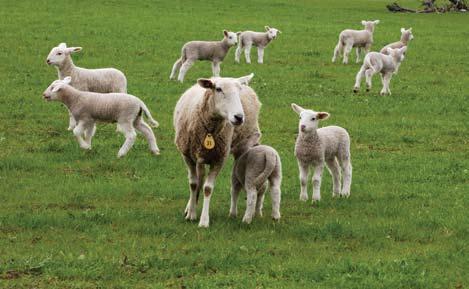
Losses associated with marking are normally less than 1%. Time marking and mulesing for about two weeks after the last possible lambing date. Hygiene is most important for equipment. Conduct mulesing in accordance with industry guidelines using an accredited operator (see signposts). If mulesing is conducted when flystrike is possible, treat lambs with a product to prevent flystrike on healing wounds.
Carry out marking and mulesing in clean yards close to the paddock being grazed and ensure the operation is completed early in the day so ewes and lambs can successfully mother up.
Nutritional management of lambs until weaning
To achieve target weaning weights ewes and lambs need to graze high-quality pasture. Pasture quality (especially legume content) and quantity are the best indicators of potential lamb growth rates. If pasture availability falls below the critical limit of 1,000 kg green DM/ha after the start of lambing, supplementary feeding may be necessary. Mismothering losses due to feeding are likely to be lower if paddocks and mob sizes are smaller.
When available feed resources are low, consider identifying ewes that have lost their lambs or failed to lamb, at marking and remove them to save pasture for lactating ewes. Dry ewes can be managed separately or sold.
Imprint feeding lambs before weaning
Train lambs to feed supplements by ‘imprint’ feeding before weaning. Feed lambs at least 4-5 times while with their mothers using the supplement most commonly used on the farm at a low rate. The idea is to introduce the lambs to feed so they can recognise the supplement after they are weaned. This is an important management strategy that reduces the period taken to train sheep to eat a supplement once they are weaned.
 Signposts
Read
- Planning for Profit A practical guide to assist woolgrowers recover from drought. Order your free copy from AWI by:
- Calling: 1800 070 099
- Downloading the document from: www.wool.com.au/Publications/Managing_drought/page__7134.aspx
National Mulesing Accreditation Manual – details the preparation and planning, mulesing equipment, chemical and animal health product use and mulesing procedures that meet the welfare standards in the Code of Practice for the Welfare of Animals: the Sheep. To receive a copy of the manual from AWI, or to register for the National Mulesing Accreditation Program (NMAP), call 1800 221 076.
Problems of mismothering and misidentification especially of mulitple births – a summary of observations of maternal behaviour in a range of sheep breeds, including the causes, consequences and management options to minimise mismothering. G Alexander (1984). Wool Technology and Sheep Breeding: Vol 32: No. 3, Paper 7, pp. 121-124. Download this paper from: http://sheepjournal.une.edu.au/sheepjournal/vol32/iss3/paper7



