Description
Karroo Thorn (Acacia karroo) is a shrub or tree which grows up to 12 m high. It has straight, white, dark-tipped, paired thorns, usually up to 100 mm long although occasionally as long as 250 mm. The bark is dark red-brown to blackish and rough. Its mature leaves are bipinnate (composed of 8-20 pairs of small oblong leaflets), to 120 mm long and to 50 mm wide. The yellow flower heads are globular, 10-15 mm in diameter (like Australian wattle flowers), and are sweetly scented. Seedpods are thinly woody, sickle-shaped, to 160 mm long and to 10 mm wide, hairless and slightly constricted between seeds. The tree is usually evergreen but loses its leaves in droughts or in very cold or dry localities.
For further information and assistance with identification of Karroo Thorn contact the herbarium in your state or territory.
Distribution:
Karroo Thorn is well suited to much of Australia’s rangelands. It has been widely planted in botanic gardens and zoos in South Australia, Victoria and New South Wales as it is particularly evocative of the African landscape and is said to be the favourite food of the Black Rhinoceros.
Habit:
Tree, Shrub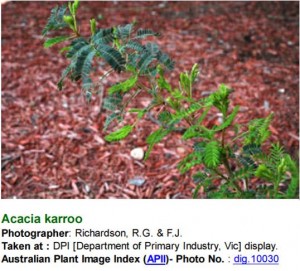
Key points:
- Karroo Thorn (Acacia karroo) is drought tolerant and forms dense, impenetrable thickets.
- Seeds are spread by animals, wind and water, as well as by people - it has been intentionally cultivated in several states.
- The widespread distribution of Karroo Thorn in southern Africa indicates that it could become established over most of subtropical and southern Australia.
How it spreads:
Karroo Thorn reproduces by seed; large trees produce up to 19 000 seeds per year. The seeds can survive for up to 7 years in the soil. Seeds are dispersed by wind and water or in the droppings of animals. Germination is improved when the hard outer casing of the seed is disturbed, for example by fire, passing through the digestive system of animals or gradual weathering over time.
Where it grows:
Karroo Thorn occupies a diverse range of habitats including dry scrub, river valley scrub, woodland, grassland, banks of dry watercourses, rivers, coastal dunes and coastal scrub. It prefers light to medium well drained soils in an open sunny position and does well in alkaline soil. It is highly drought tolerant. In very dry areas it occurs along watercourses and in other situations where underground water is available.
Flower colour:
Yellow
Distribution map: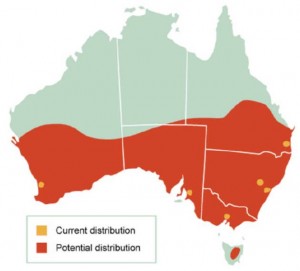
Impacts:
Karroo Thorn is on the Alert List for Environmental Weeds, a list of 28 non-native plants that threaten biodiversity and cause other environmental damage. Although only in the early stages of establishment, these weeds have the potential to seriously degrade Australia’s ecosystems.
Karroo Thorn has considerable potential to become a troublesome weed. It is a known invader of established vegetation over a wide climatic range. It has a persistent seedbank and is fire resistant, fast growing and protected from browsing by its thorns. It is weedy in South Africa, where it grows in similar habitat and climate to that found in native grasslands from central New South Wales to southern Queensland. Losses to agriculture in these areas would be significant as the dense, thorny thickets it forms suppress the growth of grasses, prevent stock movement and restrict watering, adding to the costs of mustering (CRC 2003).
Origin:
In southern Africa Karroo Thorn is the most widespread acacia. It is very adaptable, growing under many different soil, climate and altitude conditions. Its limiting factors appear to be intense cold and lack of moisture. Eastern Cape Province (with 400-900 mm annual rainfall) is the area mainly affected by infestations of Karroo Thorn, where it forms a major part of the vegetation and has invaded grasslands and large areas of rangelands. Plant densities of 1000-2000 trees/ha have been recorded.
In Natal (with 750-900 mm annual rainfall) Karroo Thorn forms part of the coastal dune forest. It is common in the watercourses of the Karroo region of central Cape Province. It is also present in southern Angola, Zambia, Zimbabwe and Mozambique. In the early days of colonisation in southern Africa, Karroo Thorn was used for fuel, fodder and shade, and for the construction of wheels, poles and rural implements. The thorny branches were also used for protection against wild animals.