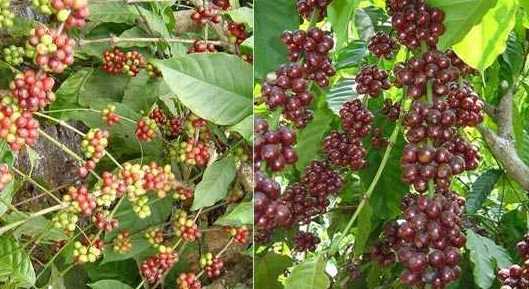
A lack of uniformity in cherry colour indicates a lack of water
Irrigation:
Coffee trees can survive water stress, but for maximum production they need plenty of water. Plant trees at the beginning of the wet season in North Queensland and February/March in northern New South Wales when plant growing conditions are ideal. In young trees aim to supply enough water for maximum growth year round.
Coffee trees have been grown successfully using either overhead or undertree irrigation (see ‘Coffee Planting and Irrigation’ article). Overhead irrigation can offer protection against frost, can be used to water in fertiliser, and more easily triggers good flowering after a period of water stress. The disadvantages are shorter cherry life (see article on Coffee Planting and Irrigation, also Managing Bearing Trees) and higher establishment costs.
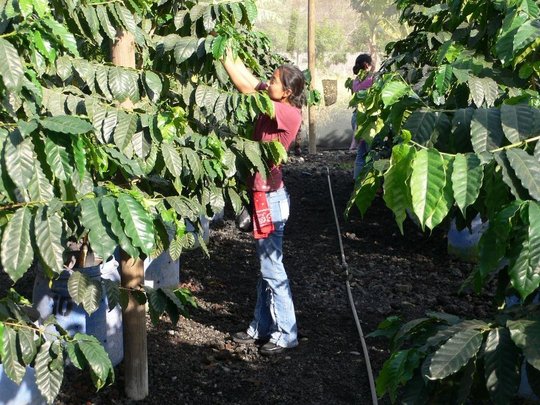
A micro irrigation project in Nicuragua has helped poor farmers achieve lower costs and higher yields
Drip irrigation offers more efficient use of water, the possibility of fertigation, easier flower control and extended cherry life. On balance, drip irrigation with close spacing of output holes and a good flow rate is recommended. Whatever system you choose, it must be able to supply small regular amounts of water initially but have the capacity to supply the water demands of mature bearing trees. Irrigation trials indicate a peak demand of 50 mm per week for overhead irrigation or 80 to 140 L/tree/week for drip irrigation. Peak daily water requirement may be 20 L/tree. These figures are based on data for trees growing on a sandy soil in a hot dry climate. You can also estimate irrigation needs from the crop factor which for coffee is around 0.8. This means that irrigation should supply 80% of the pan evaporation rate.
To make the most efficient use of irrigation water, install tensiometers at 15, 30 and 45 cm depths to check irrigation requirements. Maintain the tensiometers at 20 to 30 centerbars on sandy soils and 30 to 40 centerbars on medium-textured soils. If you have access to a pressure bomb for measuring plant moisture, maintain leaf moisture at more than -1.0 MPa leaf water potential. Below this level stomata begin to close and photosynthesis is reduced. Purchasing of this equipment may be justified for a large scale plantation. A pressure bomb can also be used to monitor stress levels during water-stressing for flower control (see article Managing Bearing Trees).
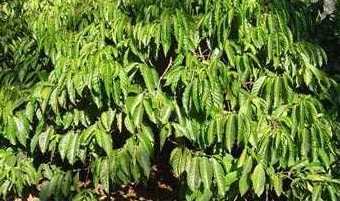
Visual symptoms of stress (wilting) indicate plants need water
Visual symptoms of stress (wilting) provide an early indication that the plants need water. You can see the first signs of wilting on the young terminal shoots on the upper branches. As water stress continues the leaves droop, and the leaf margins roll inwards and become wavy. After this the older leaves turn yellow and eventually fall.
During the first year after planting, irrigate three or four times a week for the first six to eight weeks, then only twice a week. After the first year irrigate sandy soils two or three times a week, and heavier soils once a week.
Watering at more frequent intervals may cause restricted, shallow root systems to develop because the roots are not encouraged to explore the soil more deeply and extensively for water. Any water stress which causes leaf yellowing and fall in the first year after planting can slow growth and jeopardise successful tree establishment.
Overwatering can lead to waterlogging which can result in similar symptoms to water stress - wilting, leaf yellowing and poor growth. To be sure you are not overwatering check soil moisture levels just before irrigation - soil should not feel wet.
TREE SHAPING:
The ideal trees for machine-harvesting are single-stemmed and upright with strong branches. Windbreaks are particularly important when coffee trees are young because trees which are blown sideways tend to produce a lot of suckers.
Trees can be staked but this is expensive and time-consuming. Cherry removal by machine-harvesting from leaning trees is poor and can result in excessive tree damage. Suckering and branching low on the main stem can interfere with the catching system of the machine-harvester resulting in considerable losses.
To shape the tree, remove suckers and branches up to 40 cm from the ground as these carry cherry which cannot be machine-harvested and interfere with herbicide spraying. By removing cherry which cannot be harvested, more of the tree’s reserves are directed towards vegetative growth. Remove branches and suckers close to the main stem and after trees have formed a canopy otherwise regrowth and further suckering may be a problem.
Trees need to be desuckered three or four times in the first year and once or twice after that. It is easiest to desucker when suckers are small and soft.
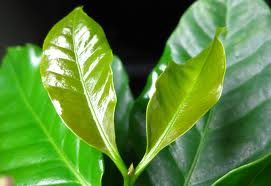
Coffee tree showing new summer growth
EARLY FLOWERING:
Trees planted in full sun and grown intensively tend to flower and fruit very early at the expense of plant growth, placing a big demand for nutrients on the young trees. This cherry cannot be removed by machine-harvesting because the trees are too small, so it stays on the trees for a long time, drawing further nutrient reserves away from plant growth. If possible, strip this cherry from the trees as soon as practicable. Studies are currently underway to investigate techniques to reduce flowering in young trees. Removing low branches as previously recommended in ‘Tree Shaping’, will also help to reduce crop load in young trees.
Source: James Drinnan and Ted Winston