Remember dogs are dogs!
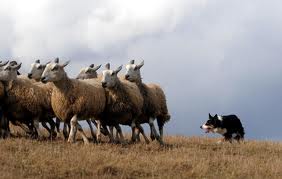
Sheepdog Herding
So many of the problems we humans find with dogs are because we forget this simple fact. There seems to be a clear “love-hate” relationship between mankind and the dog! A dog can go from being loved to being hated, neglected and cruelly treated within a very short space of time.
Ask any Dog Control Officer and they’ll tell you that there are no such thing as “dog problems” - they are all people problems! They will also tell you that most people will always see the owning of an animal as a “right” and not a very special privilege.
Today’s dogs are all descended from the first canids, and they were the first animals to be domesticated by man. The reason was simple - the wolf (the main member of the canid group) has a similar social structure to the human family, so when the first stray pups would be brought home as pets, they easily fitted into the human family.
Humans found a dog to be very useful for guarding, helping in the hunt, and to provide warmth on a cold night! They were working dogs! The dog became “man’s best friend” and from these early canids - the diversity of today’s dogs arose.
So despite the passage of time, people who keep dogs should expect them to behave like dogs! The dog is a pack animal. It is also a scavenger. Males will wander in search of females and to define territory. Dogs will bark - a trait that developed with domestication as no wild canid (eg dingo, fox or wild African dog) barks.
Dog’s senses:
Appreciating how a dog perceives life is also important in avoiding trouble. Many owners forget that dogs are different. How different?
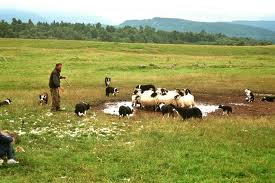
Many Sheepdog's Herding
Touch is very important to a dog - indeed because of its early environment, to touch a dog is to pay it the highest compliment - provided it’s in the correct non-threatening place. Don’t grab it by the scruff or the testicles or you’ll find out. Hold your hand out and let it sniff you, then rub its chest.
In general a dog’s vision covers an area up to 70 degrees wider than a man’s, but binocular (two-eyed) vision which provides perception of distance is about 20 degrees narrower. So a dog’s ability to pick up movement at the side of the head is about 10 times more sensitive than man’s. Dogs have good long vision and better night vision than man but they don’t have our ability to see things close up and in detail. At close quarters a dog’s nose is more useful. They have limited colour vision.
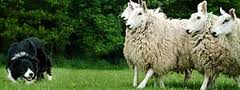
Sheepdog herding
Dogs have very acute hearing covering a much wider frequency than ours (20 to 50,000 cycles/second). Human hearing peaks at 20,000 cycles/second and dogs can hear sounds out of our range. Some people use the high pitched “silent” whistles for dogs that we can only hear as a hiss. People seem to forget that a dog does not understand English!. It is responding to a sound and the tone of that sound is critical. I know many dogs that can tell their owner’s car engine from the others that drive past.
Dogs have a very acute sense of smell and it is generally described as at least 100 times more sensitive than ours. The sense of smell is due mainly to a very sensitive nose structure, a special scent organ behind it’s canine teeth on the roof of its mouth (the vomeronasal organ) and a much larger part of the brain concerned with smell compared to man.
Dog body language:
Dogs do a lot of communicating through body language - something that anyone who visits or passes strange houses should recognise.


