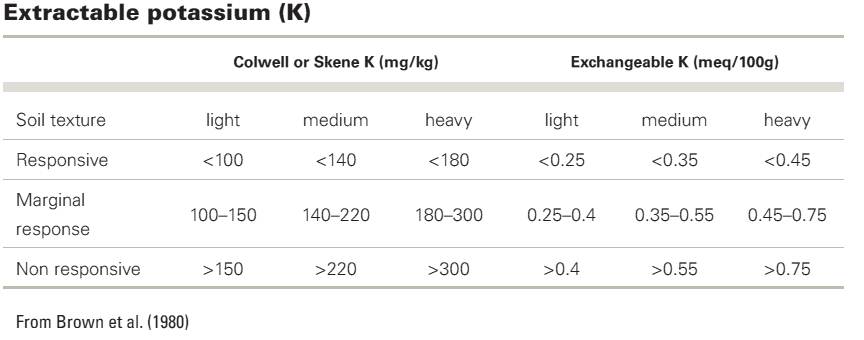
 The levels described in the following tables apply to tests performed by accredited laboratories using procedures defined by the Australian Soil and Plant Analysis Council (ASPAC) proficiency testing program. Sheep producers are advised to use only ASPAC accredited soil testing laboratories. Check the accreditation status of your regular soil testing providers on the website:
www.aspac-australasia.com
Tool 6.5 in the Healthy Soils module lists key benchmarks for problem soils, and signposts a number of resources to help you manage acid, saline, sodic and compacted soils, and nonwetting sands.
Extractable phosphorus (P)
Most soils in Australia are responsive to applications of phosphorus (P) fertiliser. The following tables show the responsive levels for commonly used P tests, for pastures that have been improved by the introduction of exotic legumes and perennial grasses.
High levels of P application can make it difficult to retain some native perennial grasses. As P levels increase, legumes and annual grasses may replace native grass species. Grazing management, involving pasture rest at critical times, can lessen the rate of loss. The potential reduction in native grass content and the likely change in profitability through the application of P fertiliser need to be considered.
Note: The interpretation of Colwell soil test values is dependent on soil type, or more specifically the Phosphate Buffering Index (PBI) of the soil.
Sheep producers wishing to optimise pasture productivity while retaining native grass species should seek advice from agronomists to establish grazing management strategies and minimum and maximum P limits for their region and soils.
The Phosphate Buffering Index (PBI) typically increases with soil texture as it moves from sands through to heavy clays. Some laboratories now routinely supply a PBI with all analysis reports. The PBI affects the rate at which the soil test value changes with the addition of phosphorus fertiliser. P is a relatively immobile nutrient once it has entered the soil, usually remaining within a few centimetres of where it was applied. Losses of P by fixation and leaching depend on soil type and rainfall and are generally greater as rainfall increases. Well fertilised pastures are generally protected from P loss associated with soil erosion as they retain high levels of groundcover throughout the year.
Extractable sulphur (S)
Soil sulphur benchmarks using the KCl40 method for measuring soil sulphur levels are:
- Responsive Less than 6mg/kg
- Marginal response Between 6 and 8 mg/kg
- Non responsive Above 8 mg/kg