 Cultivar selection
The most important factors in the persistence of lucerne cultivars are the resistances to phytophthora root rot and colletotrichum crown rot and the application of appropriate cutting and/or grazing management. Of the cultivars now available for irrigated hay production, the best semi-dormant cultivars are generally more persistent than the best winter-active cultivars. This is because the more winter-active cultivars regrow quickly and are often cut too frequently. Their crowns also appear more susceptible to damage under conditions of frequent cutting.
In dryland grazing stands that are well managed, the most disease-resistant cultivars are invariably the most persistent. However, a combination of high disease resistance and broader and lower crowns should result in better persistence. The best cultivars in all winter-activity categories now have moderate to good resistance to the major root and crown diseases. The more dormant cultivars may be less competitive as seedlings with weeds and vigorous sown grasses, although there is no conclusive proof of this.
Seeding rates
Lucerne populations generated by different sowing rates eventually reach similar numbers. On well-drained alluvial soils, the persistence of irrigated hay stands is maximised when established populations are 150 plants/m2, or more. There is no benefit to long-term persistence by increasing plant populations above this. Seeding rates of about 15 kg/ha are sufficient to obtain such a population if seedbeds are well prepared and irrigation for establishment is adequate.
However, seeding rates as high as 25 kg/ha are being used commercially in some irrigation areas. Reasons given by experienced growers for this include improved competition with weeds, to obtain finer stem thickness, and to obtain an earlier cut. However, the use of herbicides is a cheaper way to control weeds, especially as an early cutting may limit the development of adequate root reserves and the subsequent productivity of the stand. Very high plant populations are suspected as the cause of higher leaf disease infections, owing to the humidity in the canopy of those stands.
Much lower seeding rates are recommended for dryland lucerne stands where the potential for production is lower. Recommended sowing rates for pure lucerne stands used for non-irrigated grazing are between 3-4 kg/ha producing populations of 30-40 plants/m2, with rates for lucerne/grass mixtures from 2-3 kg/ha.
Mowing
 Timing the harvest is vital for hay quality, hay yield and stand persistence. The highest quality lucerne hay is low in fibre and high in digestible protein and total digestible nutrient. Lucerne hay of this quality must be mown before ‘normal’ harvest maturity and before the maximum yield has been attained. Mowing at this stage can weaken the stand and lead to premature plant mortality if repeated over a number of consecutive cuts.
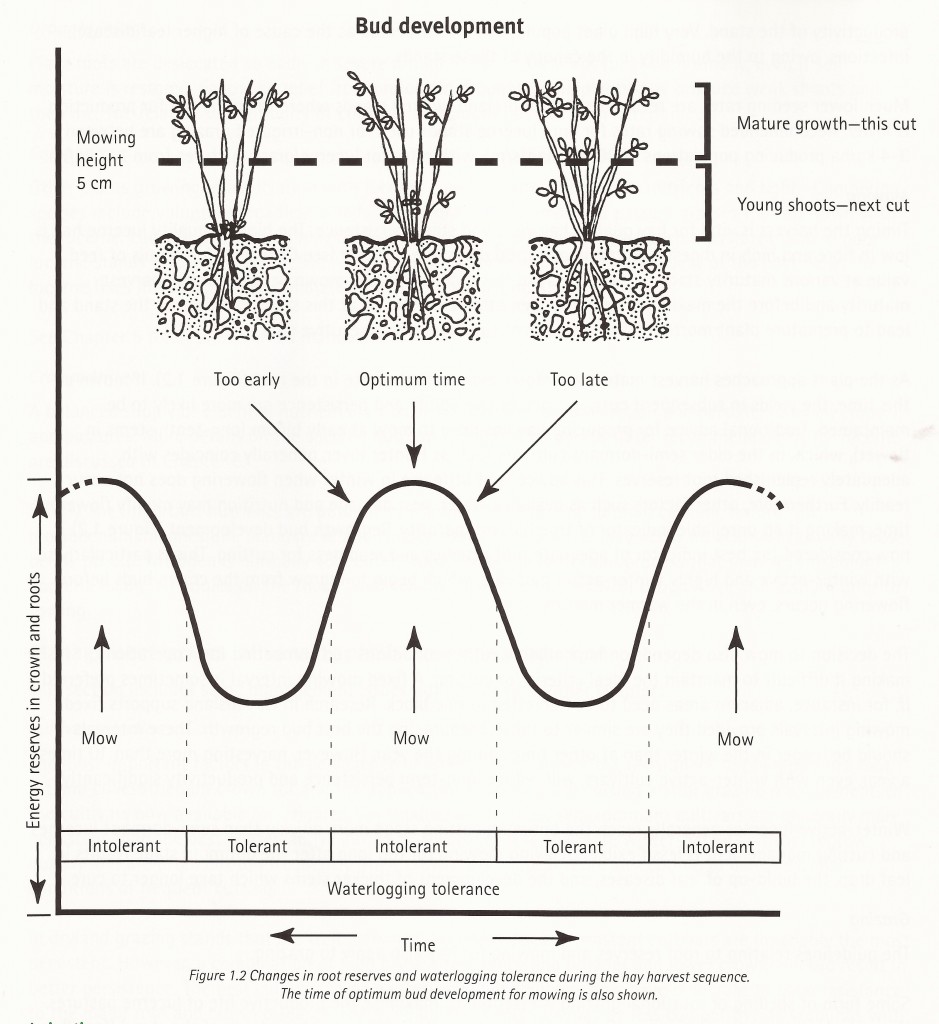
As the plant approaches harvest maturity, it stores more carbohydrate in the root. If mown at this time, the yields in subsequent cuts, its competitive ability and persistence are more likely to be maintained. Traditional advice for producing hay has been to mow at early bloom (one-tenth stems in flower), which, in the older semi-dormant cultivars such as Hunter River, generally coincides with adequately replenished root reserves. This advice is of little use in winter when flowering does not occur readily. Furthermore, other factors such as available water, pest damage and nutrition may modify flowering time, making it an unreliable indicator of true harvest maturity. Regrowth bud development (Figure 1.2) is now considered the best indicator of adequate root reserves and readiness for cutting. This is particularly so with winter-active and highly winter-active cultivars, which begin to regrow from the crown buds before flowering occurs, even in the warmer months.
The decision to mow also depends on impending weather conditions and competing farm operations, making it difficult to maintain the ideal criteria for cutting. A fixed mowing interval is sometimes preferred if, for instance, adjacent areas need to be harvested as one block. Research in Queensland supports fixed mowing intervals provided they are similar to those encouraging the best bud regrowth. These intervals should be longer in the winter than at other times during the year. However, harvesting more than 10 times a year, even with winter-active cultivars, will reduce long-term persistence and productivity significantly.
Winter-active lucernes generally reach the optimum cutting stage more quickly than semi-dormant lucernes and cutting management is less flexible. Delaying mowing for too long after the optimum stage results in leaf drop, the build-up of leaf diseases, and the development of thicker stems which take longer to cure.
Grazing
The guidelines relating to root reserves and mowing for hay also apply to grazing.
Some form of spelling or rotational grazing is essential to maximise the productive life of lucerne pastures. Heavy and continuous stocking, particularly by sheep, results in the premature death of the stand (for all current lucernes, irrespective of their winter dormancy characteristics). If winter-active cultivars are used in pastures, rotational grazing management should be applied more strictly than with semi-dormant cultivars. Allow only a short grazing time and at least a 28- to 35-day recovery period that allows either most of the plants to begin flowering, or buds to regrow (Figure 1.2).
Where lucerne is sown with vigorous subtropical grasses such as green panic and buffel grass, lax summer grazing enables the grass to become a strong competitor. Grazing management should be lenient enough to allow restoration of lucerne root reserves, but not the uncontrolled growth of the grass. This is difficult to attain in wet summer seasons.
Irrigation
Excessive watering, particularly on poorly drained soils, causes localised ponding on uneven surfaces and increases root damage, both as a direct physiological result of waterlogging and as a result of phytophthora root rot.
Both recently cut and well-grown plants are the most susceptible to excessive irrigation. Damage is slower when waterlogging occurs midway through the regrowth cycle (Figure 1.2). The risk of damage due to waterlogging can be minimised by confining irrigation to as close to this mid-growth stage as possible.
.



