Humidicola growing in dense semi-erect tufted habit
Scientific name
Humidicola growing in dense semi-erect tufted habit
Brachiaria humidicola
Urochloa humidicola
Strengths
- Vigorous and productive.
- Tolerant of heavy grazing.
- Tolerant of waterlogging and some flooding.
- Competitive with weeds.
Limitations
- Limited flowering and low seed production at low latitudes.
- Dormancy in fresh seed.
- Competes strongly with legumes.
- Lower quality than other tropical grasses.
- Can be slow to establish from seed.
- Can be unpalatable to stock.
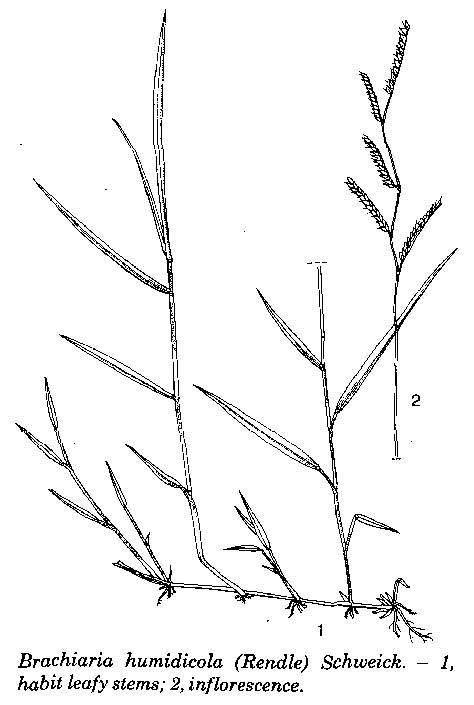
Humidicola plant
Plant description
Humidicola plant
Plant:
Strong creeping perennial grass which forms a dense matted sward.
Stems:
Prostrate and creeping stolons, reddish in colour. Roots vigorously at the nodes.
Leaves:
Linear to lanceolate, tapering to a point. Leaves generally12 - 15 cm long and 8 - 10 mm wide, but can be up to 25 cm long. Leaves are not hairy.
Seedhead:
Inflorescences up to 60 cm high. It consists of 2 - 5 racemes (arms) 2.5 - 5.5 cm long bearing two rows of seeds.
Seeds:
Broadly elliptic, 4.5 - 5.5 mm long, hairy, green and tinged with purple. Approximately 200,000 seeds/kg.
Pasture type and use
It is mainly sown as a permanent pasture for grazing, particularly in wet areas. It is also grown for hay.
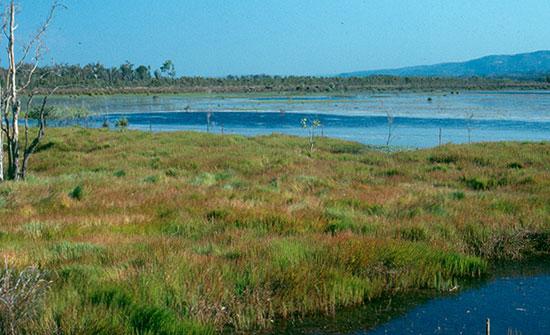
Humidicola likes to grow near water
Where it grows
Humidicola likes to grow near water
Rainfall
It is suitable for areas receiving 1,000 mm/year or more. In the semi-arid tropics, it will only persist in on wet soils or seasonally wetter areas where rainfall is 1,300 mm or less.
Soils
It is tolerant of a wide range of soil types from acid infertile sandy soils to heavy cracking clay soils. It grows well on soils with low phosphorus levels. It is tolerant of poor drainage and seasonal flooding. It survives prolonged shallow flooding, but does not grow until the water recedes. Its growing season is more compressed into the wet season than some other tropical grasses.
Temperature
It is well adapted to tropical lowland environments, but will also grow to 1,000 m altitude in the tropics, and in the lowland subtropics. It has poor frost tolerance.
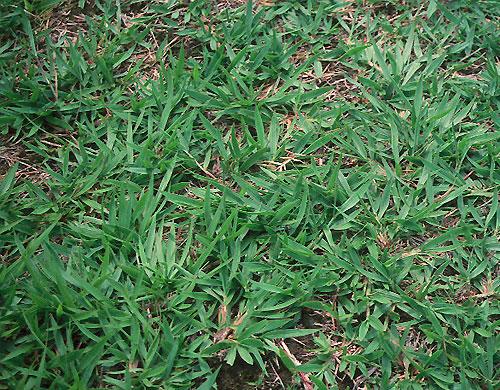
Humidicola has a good recovery from heavy grazing
Establishment
Humidicola has a good recovery from heavy grazing
Companion species
Grasses: None. It is best sown as the only grass in a mixture as it is less palatable than most of the tropical grasses.
Legumes: Is extremely competitive when established and will choke out legumes. Can be sown with ‘Glenn’ jointvetch, ‘Amiga’ or ‘Verano’ stylo, or ‘Wynn’ cassia as pioneer legumes. Pinto peanut can grow with ‘Tully’, in moist, well-drained situations in the wet tropics.
Sowing/planting rates as single species
2 - 6 kg/ha. Have seed tested before sowing. Fresh seed can be dormant for up to 9 months after harvest.
Can also be planted by cuttings or runners. Plant at 1 m spacing, or spread planting material on the surface, and lightly disc into the soil, during the wet season when follow up rain is expected. If soil conditions permit, rolling after discing improves establishment.
Sowing/planting rates in mixtures
2 - 4 kg/ha. The legumes will provide feed during the first year and an input of nitrogen, but generally will not be competitive with the grass after the second year.
Sowing time
Early in the wet season after good opening rains, when there is likelihood of follow up rains. In the seasonally dry tropics, this will range from the first week of December in higher rainfall areas (1,500 mm plus) to the third week of December in lower rainfall areas (1,000 mm).
Inoculation
Not applicable
Fertiliser
Responds strongly to nitrogen and phosphorus. Generally apply 100 - 250 kg/ha of superphosphate or its equivalent at establishment. Apply nitrogen at 25 - 50 kg/ha to grazed pastures and at 100 - 200 kg/ha to hay crops. Applications of potassium, molybdenum, zinc or other deficient elements may be necessary on some soils.
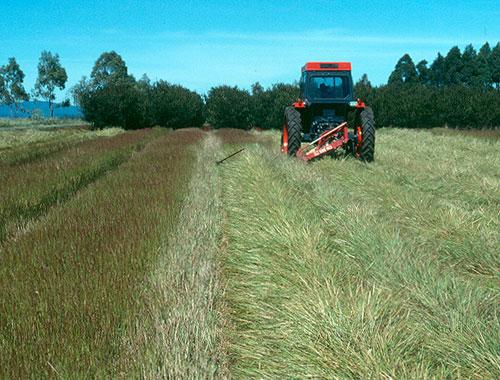
Harvesting Humidicola
Management
Harvesting Humidicola
Maintenance fertliser
Generally apply 50 - 100 kg/ha of superphosphate or its equivalent. Apply nitrogen at 25 - 50 kg/ha to grazed pastures and at 100 - 200 kg/ha to hay crops.
Grazing/cutting
Heavy grazing for a short period in February or March during the wet season of establishment promotes the production of runners. The pasture can be lightly grazed during its first dry season. Once established it can tolerate heavy wet season grazing.
On areas with marginal moisture, a stand can be lost if continually grazed at the start of the wet season before good rain is received. In these areas it will only persist in niches which remain wet longer into the dry season.
It is tolerant of fire, and recovers after burning.
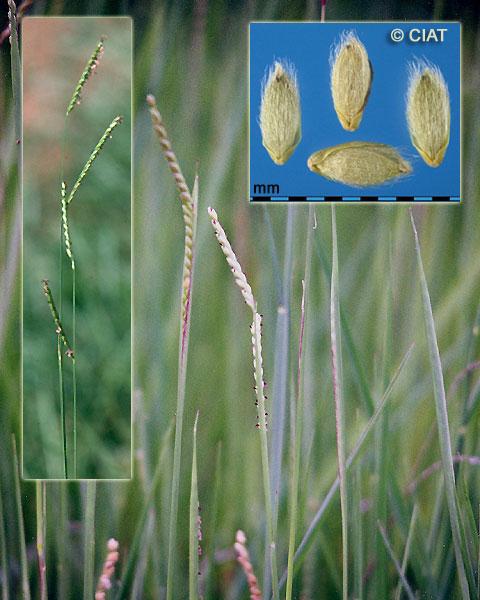
Humidicola seeds
Seed production
Seed production is limited at low latitudes. Expected Commercial seed yields in Queensland are 200 kg/ha. The main seed crop is harvested in the December - February period. A small secondary crop can be harvested in May when conditions are suitable. Timing of harvest is critical as the seed crop ripens over 2 - 3 days, and is shed rapidly. Any stress during the flowering period, particularly water stress, will result in no seed being set.
Ability to spread
Good. Plants are competitive once established, and will spread vegetatively into surrounding areas if the area is suitable.
Weed potential
Moderate. Evaluated with a medium weed risk by the Northern Territory Weed Risk Assessment method. Adapted to wet areas.
Major pests
None recorded.
Major diseases
None recorded.
Herbicide susceptibility
Annual grasses can be controlled using low rates of Diuron.
Tolerant of selective herbicides used to control broadleaf weeds.
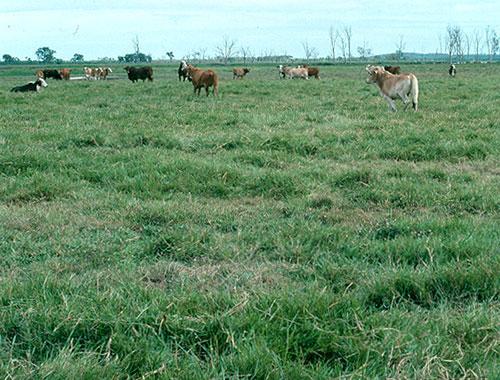
Cattle grazing on Humidicola
Animal production
Cattle grazing on Humidicola
Feeding value
It is of moderate quality compared with other tropical grasses. Crude protein (CP) during the growing season is generally up to 9 - 11 %, which drops to 2 - 5 % CP during the dry season. In vitro digestibility is generally up to 63 % during the growing season, dropping to 40 - 50 % during the dry season.
Palatability
It is moderately palatable. Animal acceptability can vary for no apparent reason. It is more readily grazed by livestock if it is fertilised with a small dressing of nitrogen fertiliser i.e. 25 - 50 kg/ha. It is better accepted by livestock when it is well grazed and fresh rather than tall, rank and hayed off.
Horses vary greatly in their acceptance of the grass as green feed or hay. Some horses readily accept it as green feed or hay, while others will eat green feed only, hay only, or neither.
Production potential
Without applications of nitrogen fertiliser, dry matter yields are generally 4 - 6 tonnes/ha, whereas with application of 100 - 200 kg/ha of nitrogen, yields are 10 - 15 tonnes/ha.
Livestock disorders/toxicity
No major problems reported in Australia. Its low calcium concentration and high levels of oxalate have the potential to induce ‘big head’ disease in horses.
Cultivars
| Cultivar | Seed source/Information |
| Tully | Public varietyAustralian Herbage Plant Cultivars |
Author and date
Arthur Cameron
April 2009