Guidelines to mapping farm grazing land into pasture zones
Assess the soil characteristics and topography of land allocated to the beef enterprise to define pasture zones according to the potential of the grazing land to support high-quality pasture composition and growth and environmental stability.
This assessment involves developing a map of grazing lands to define land capability based on primary land use, pasture productivity, soil, and spatial and environmental constraints. The classification allows for variation in management practices to achieve best possible pasture growth and quality while ensuring economic and environmental sustainability.
Precise mapping enables better planning of the pasture resource base to maximise water use efficiency and adjustment of stocking rates to minimise under and oversupply of pasture throughout normal seasonal variations. It also shows where environmental damage may occur from unsuitable fertiliser application and cultivation practices.
To maximise the productivity of your grazing land you need to be able to manage each pasture zone differently to ensure the needs of each zone are met, such as aligning fences or installing water points. Providing new infrastructure may involve significant capital expenditure, so you need to examine the marginal returns on such an investment and look carefully at cash flow budgeting to determine your priorities.
Mapping pasture zones
The following visual characteristics can be used to assess grazing land and identify different pasture zones:
• Soil texture: Define areas of different soil textures and where there is a change of more than one class for either A or B horizons, create a new pasture.
• Slope: Define areas where the slope is greater than 10 degrees. Slope determines the volume and speed of water run-off.
• Aspect: Identify north-facing slopes as plus or minus 30 degrees from due north, and south-facing slopes as plus or minus 30 degrees from south.
• Streams and drainage lines (riparian areas): Define the areas five to ten metres from the top of the stream bank to disperse flows and prevent soil and nutrients from entering streams and rivers.
• Salinity (EC): Identify areas where soil salinity is limiting pasture growth and productivity by looking for the visual indicators.
• Primary land use: Separate land used primarily for cropping or specialty fodder crops.
Assess existing farm plans and maps against this list and overlay the common mustering routes. The following diagram shows how one producer has mapped his property, ‘Greener Pastures’, to show the features of each pasture zone. The map demonstrates how you can simply chart information such as topography, location, soil type, paddock size, class of stock and average stocking rates for your farm.
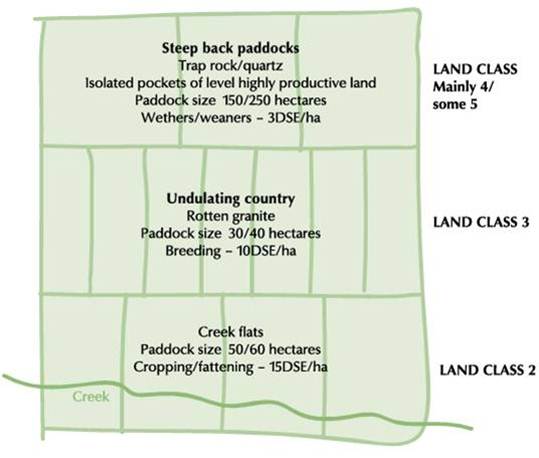
Pasture zone map for ‘Greener Pastures’, South West Slopes, NSW
What to measure and when
As part of the annual planning cycle, review the grazing lands map to determine whether it still accurately shows land capability and class. The map may need to be updated to incorporate any new knowledge or changes in practice or measures (such as the appearance of new saline discharge areas). The growth of tree lines over time may change animal behaviour.