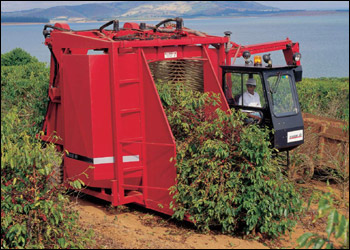
The performance of early harvesters was impressive, with one machine achieving the output of up to 150 coffee pickers
The primary aim of any crop production system is to recover the maximum proportion of the crop at harvest in a state which will maximise final returns for the producer. This means production and harvesting systems must fit together to achieve the most viable final result. Coffee is no exception.
Production of high quality coffee has traditionally involved selective hand-harvesting of prime coffee cherry over several months. The labour required to do this has generally restricted coffee production to countries with low labour costs.
Traditional Harvesting Methods:
Production of coffee in countries with low labour costs has traditionally implied the selective hand-picking of coffee cherry to produce premium`washed’ or wet-processed coffees, known as mild arabicas. Typically, one person has to work seven to ten days to pick enough cherry to produce a 60kg sack of green bean. However, production of selectively picked, washed coffee is not confined to developing countries with low labour costs. In Kona, Hawaii, the very high cost of hand-picking is covered by the high prices received for the gourmet coffees produced. A sizeable industry, producing approximately 1000 t/year, exists. A similar situation occurs in northern New South Wales, although on a much smaller scale.
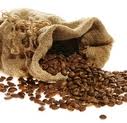
Australian coffee beans
For most coffee producers, cyclical prices, coupled with increasing labour costs, have squeezed profits. Changes in harvesting traditions are an economic necessity. In Brazil, for instance, a hand-harvesting system based on a single strip-pick has been in use for many years. This single pass is delayed until little immature cherry remains and much of the crop has fermented and dried on the tree. The mixed cherry from this harvesting system is dry-processed. The result is a poorer quality, harsher`unwashed’ coffee which attracts a lower price. However, the reduction in price is offset by almost halved harvesting costs.
Development of Machine-Harvesters:
The single pass hand-harvesting system led to the development of the Brazilian coffee harvesters. The machine designs were based on the recently developed berry harvesters and were very large, self-propelled machines, designed to harvest tree-dried and ripe cherry in a single pass. Their performance was impressive, with one machine achieving the output of up to 150 coffee pickers.
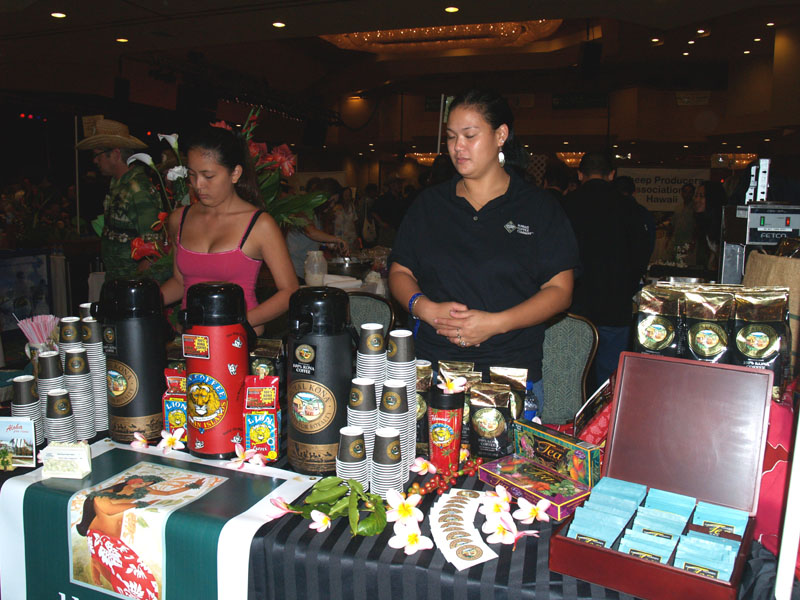
A selection of Hawiian coffee and tea on display
Following the development of these workable harvesters in Brazil, there was significant interest in the production of wet-processed, machine-harvested coffee in Australia and other countries. Unfortunately, the harvesters proved inadequate for the task. Lack of selectivity, poor ripe cherry removal and excessive tree damage were all major problems. The challenge since then has been to develop a lower cost harvester capable of more selectively harvesting cherry of a quality suitable for wet-processing, without excessively damaging the trees.
Progress has included developments in harvesting technology, improved harvest management, and the development of processing systems capable of effectively separating cherry by maturity to allow the production of high quality coffee from cherry of mixed maturity.
Within the last 10 years large scale plantations in North Queensland and Hawaii have been developed using new techniques in harvesting and processing. Grower experience and research results show that to produce high quality, machine-harvested coffee successfully a total production system tailored to machine-harvesting is needed.
Source:
Chris Norris