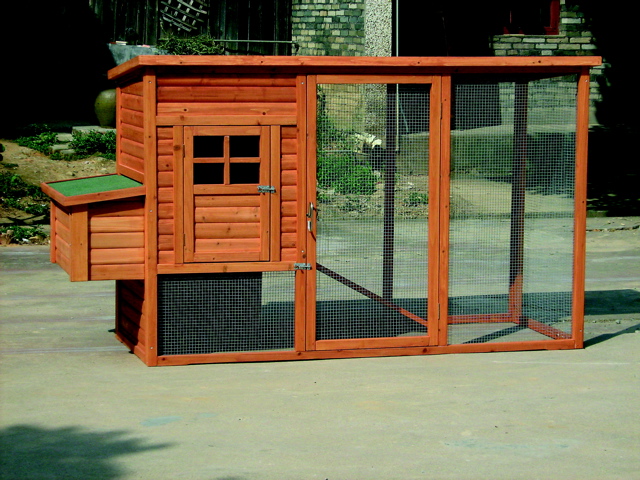
 When siting and constructing housing for small numbers of poultry, designs should optimise the comfort and health of the birds and ease of operation for the poultry fancier. This page also describes the design of a light, strong carry box.
Regulations.
Before erecting a poultry shed consult your local council. Most councils regulate the keeping of poultry, particularly in suburban areas. For example, it may be required that a poultry shed be 1.5 m from fences and more than 6.0 m from a house, with a rat wall under concrete floors and if the shed is over 1.8 m high, council approval may be needed.
Environment.
This includes the climate around the bird, its social environment and lighting needs. Temperature is often seen as the only important factor in the climatic environment, but radiant heat, humidity level and air movement are also important for the birds’ comfort.
Housing.
When birds are housed they cannot seek alternative shelter from the elements if the shed is incorrectly sited. To minimise the influence of sun, rain and cold winds, the long axis of the shed should run east-west and the open front should face north.
A simple skillion for the shed roof will be effective. Several other roof designs can be used, but you should consult the literature on housing for specifics. The roof should be painted matt-white to reflect solar heat.
Ventilation flows are important because they help reduce the adverse effects of temperature on birds. Good ventilation also helps minimise dust and the spread of disease. Ventilation flows for floor-reared flocks should be over the birds’ heads, not directly upon them. Ideally, the back of the shed should be fitted with adjustable shutters so that air movement can be controlled. Fanciers frequently build sheds that are little more than l m high. Such sheds are difficult to work in and reduce your opportunity of moving among the birds. Build your shed about 2 m high; this is a comfortable height for both you and the birds. Also, carefully consider the shed layout. Each pen should be about 1.8 m deep to provide sufficient shade for the birds. In a skillion shed, doors into the pens are fitted in external walls. With a gable type shed, there is a centre path with doors into pens on either side. The layout for a single pen to house up to 12 birds is shown in figure 1.
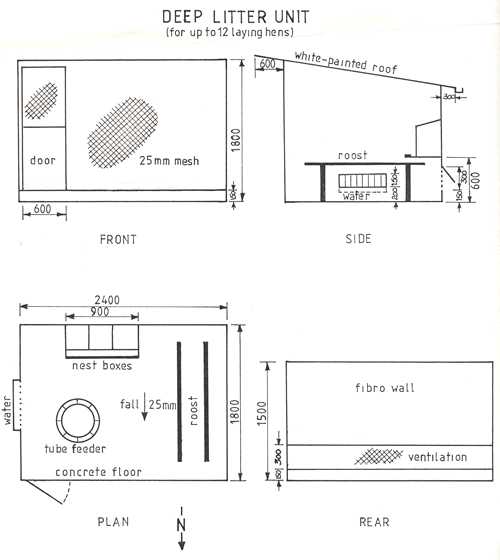
Figure 1. Deep litter shed.
Figure 1. A deep litter shed for up to 12 laying hens (all measurements in mm)
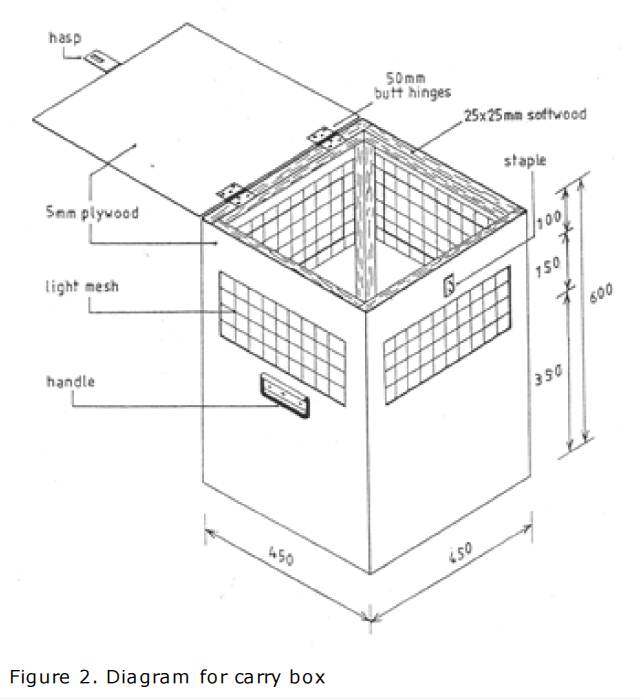 Carry box.
To move your birds to and from shows you will need a light, strong carry box with the following features:
- good ventilation
- lockable door and carrying handles able to be carried by one person
- fits easily into your car.
Construct the carry box using plywood on a light timber frame. Fit a light gauge wire mesh over the ventilation openings in each side wall. The lower part of the ventilation opening should be level with the bird’s back. Make sure no sharp wire protrudes for birds to catch themselves on. If you need several compartments in one carrying box make the internal partitions solid so birds cannot fight. Fit carrying handles on each side of large crates; carrying boxes for bantams are smaller and have the handles on top. A carrying box for a single large bird should be 450 mm square and 600 mm high. For a bantam carry box reduce the dimensions to 300 by 300 by 300 mm.
Author:
B. Davis.



