Saddlebred:
History
The America Horse was first mentioned in official government correspondence in 1776.
It has been written that Paul Revere’s mount for his famous ride was a Narraganset Pacer, a breed which was important in the development of the Saddlebred.
Also, in the Revolutionary War, American cavalry decisively defeated British regulars at King’s Mountain, South Carolina. These farmers and frontiersmen were mounted on American Horses.
American Horses accompanied pioneers following Daniel Boone through the Cumberland Gap into Kentucky. These animals were seed stock, making Kentucky a major horse producing state. In the War of 1812, similarly mounted Kentuckians ranged from Michigan to Illinois to fight the British and their Indian allies.
After that war, the production of good Saddle Horses became a priority in Kentucky. These animals played a major role in the settlement of the upper Ohio Valley. They went south into Tennessee and beyond, and across the Mississippi into Missouri. Animals from Ohio, Indiana, Illinois, Iowa, and Tennessee all made contributions to the breed. Missouri rivaled Kentucky for the best Saddle Horses and Missourians say, “If Kentucky made the Saddle Horse, then Missouri made him better.”
Horse shows became a popular form of public entertainment, often held at fairs. The first recorded show as at Lexington, Kentucky, in 1817, but such competitions undoubtedly took place years before. Denmark, the stallion who would be designated Foundation Sire of the breed, was foaled in 1839.
By the time of the Mexican War in 1846, the American Saddlebred was a well established breed. Entire companies of American volunteers from Kentucky and Missouri, mounted on these horses, fought in Mexico. In 1856, St. Louis, the largest city west of the Mississippi, held its first great fair which featured the nation’s first major horse show.
The American Saddle Horse gained fame as a breed during the Civil War, 1961-1865. Saddlebreds served as the mounts of many famous generals; Lee on Traveller, Grant on Cincinnati, Sherman rode Lexington, and Stonewall Jackson’s mount was Little Sorrell. The three aforementioned horses were American type with close Thoroughbred crosses, and the latter was of pacing stock.
The Confederate commands of Generals John Hunt Morgan and Nathan Bedford Forrest were mounted almost exclusively on American Saddlebreds, and these horses performed legendary feats of endurance during the war.
Because most Confederate horses were privately owned, General Grant’s order at Lee’s surrender which allowed the men to keep their horses perhaps saved the breed. After the war, the St. Louis Fair was revived. All breeds had their day in competition at St. Louis, but in the 1870′s the Denmarks became dominant.
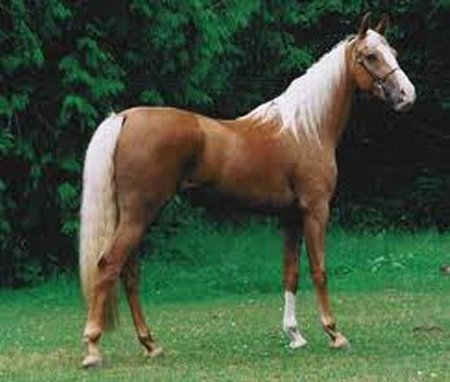 Because of the increased popularity and commercial value of the Saddlebred, enlightened breeders began to call for the formation of a breed association and registry in the 1880′s. Charles F. Mills of Springfield, Illinois, began compiling pedigrees and formulating rules for a registry. The Farmers Home Journal, a newspaper published in Louisville, Kentucky, called for a meeting April 7, 1891 to organize the association, the registry was established that day….the first horse breed association in the U.S.
Despite the fact that during this period of time the American Saddle Horse was still very much a using animal, the rivalry between breeders at horse shows and especially state pride between Kentucky and Missouri, was intense. Gifted horsemen began making a living at training show horses.
A coal black stallion who was to make a great contribution in giving even greater status to shows and the breed, burst onto the show scene at St. Louis in 1893. Rex McDonald was beaten on but three occasions, was idolized by the public, and visited by Presidents of the U.S.
In Kentucky, an unusual colt of predominantly trotting blood with a dash of Denmark was foaled in 1900. Bourbon King was sold as a weanling to Allie G. Jones, North Middletown, Kentucky. He was a sensation as a five-gaited show stallion, winning the grand championship at the Louisville Horse show as a three-year-old. Living to the age of 30, Bourbon King was the great progenitor of the Chief Family.
While most admirers of the Saddlebred love the beautiful show horses, they are now needing to reestablish his worth as a pleasure and using animal. After all, that is how the breed was developed. Country Classic was winner of the Challenge of the Breeds at the St. Louis National in 1984. This contest between selected representatives of the major breeds features the horses in various disciplines including jumping, barrel racing, driving, etc.
Other breeds, notably the Tennessee Walking Horse, (which evolved essentially from Saddlebreds) Standardbreds, Morgans, and Arabians try to emulate them in the show ring, but none can compare.
On the other hand, American Saddlebreds have been successful in most equine disciplines from cow horses to jumpers, dressage to carriage horses. If conditioned and trained properly, Saddlebreds are capable of almost any task they are asked to perform…..and they do it with style.
This breed has a long and proud history, from the battlefield at Gettysburg to the bright lights of Madison Square Garden, and a tremendous legacy of service in between. The creation of man and nature in concert, the American Saddlebred Horse is truly “The Horse America Made.”
Selle Francais:
The Selle Francais is the epitome of what a sport horse should be, athletic, strong, good bone and muscle, intelligent with a tractable disposition. Primarily known for its excellence in show jumping, the versatile Selle Francais also excels in dressage and eventing.
Through an intensive and aggressive breeding program, the French have, over the past several decades, created this extraordinary breed by selectively crossing their sturdy native horses with Thoroughbred stallions. Judicious introduction of the French AngloArab and French Trotter has added brilliance, agility and energy to the breed.
The North American Selle Francais Horse Association, Inc. (NASFHA) was authorized in early 1990 by the French National Stud to register Selle Francais and other French breed horses born in North America. Additionally, NASFRA facilitates an annual inspection of breeding stallions, provides information to promote the breed to the general public, and assists breeders with specific pedigree information.
Shagya:
Shagyas are born riding and carriage horses. The Shagya Arabian is a special Arabian breed which is not very well known worldwide because of its rarity. The breed was developed 150-200 years ago on the famous military stud farms of the Austro-Hungarian monarchy. With its origins deriving from purebred desert Arabians, the Shagya breed was consolidated many generations ago, so that it breeds consistently true to type.
The Shagyas combine the advantages of the Bedouin Arabian, (elegant type, great hardiness and toughness, endurance, easy keeping qualities, and inborn friendliness toward humans), with the requirements of a modern riding horse, i.e. sufficient height, big frame, and great “rideability”, including excellent movement and enormous jumping ability. If purebred Arabians are considered the “diamonds” of the horse world, Shagyas can be considered the “brilliants”, cut and polished in order to fulfill the demand for high quality riding and driving horses in the modern world.
This special Arabian breed, was created on the famous Austro-Hungarian military stud farms, primarily in Hungary at Babolna, Radautz, and Piber. Later studfarms in Topolcianky (Czechoslovakia), Mangalia (Romania), and Kabijuk (Bulgaria) also bred Shagyas. The purpose was to develop a breed of superior cavalry and carriage horses, as well as a breed which could supply prepotent breeding stallions to be used as improvers for other breeds.
The Shagyas not only served as cavalry horses in many European theaters of war, they were also used as brilliant parade horses for Europe’s royalty. The Imperial guard of the Habsburgs in Vienna were always mounted on elegant Shagyas. The toughness, endurance, rideability, and courage of these horses was proverbial in horse breeding circles: “Tough as a Radautz horse”. Every royal guard or officer regarded it a privilege to be able to ride a Shagya. Even today one can still admire many statues commemorating the heroic deeds of theses horses in Hungary.
The Shagya breed can be said to have begun in 1789, when, as a result of an edict from the Emperor, the Babolna stud was founded 36 miles west of Budapest. The conditions for developing a superior breed were extremely favorable. Not only was the studfarm endowed with gigantic pastures ideal for horse husbandry, it was also managed by the Magyars, Hungary’s talented native horsemen, who had highly developed skills as horse breeders.
The foundation stallions of the Shagya breed were original desertbred Arabians. They were bred with mares which showed a great deal of Arabian influence due to the long Turkish occupation of Eastern Europe. English Thoroughbreds and Lippizaners were also used occasionally in order to increase size and to improve movement and riding qualities. Meticulous records were kept of the breeding program in the studbooks. These venerable volumes contain not only the pedigree, color, and measurements of all of the stallions and mares used, they also record many other characteristics of the individuals and of their offsprings.
The oldest mareline recorded is that of Moldvai, born in 1781. Another famous mareline is that of Tine, born in 1810. This mare is from the Hanidani strain from the Nedsch region, famous source of desertbred Arabians. From the basis of these mares and stallions, the breed was further developed by carefully breeding back time and again only to desertbred and purebred Arabians, combined with rigorous culling and selection. This long-term process can be traced in an unbroken line from the Shagyas of today all the way back to the beginning of the breed. Many Shagyas have pedigrees over 20 generations long. Only a few purebred Arabians in Europe can show such long and complete pedigrees.
The major progenitors of the Shagya breed were purchased by experts who were sent from Hungary on difficult and dangerous expeditions to the deserts of Arabia. Very high prices were paid for these prized individuals. The most important stallion to mention is the dappled-grey stallion Shagya, born in 1810. He was bred by the Bani Saher tribe of Bedouins, and came to Babotna in 1836. He was such an outstanding producer that he appears in nearly all Shagya pedigrees.
He not only pressed his stamp on the breed, he also gave it his name. Shagya was not only a “picture perfect” stallion, he also turned out to be extremely prepotent. Other foundation stallions include the original Arabians Gazlan-Gazal, Koheilan, Mersuch, Dahoman, Siglavy, Siglavy-Bagdady, the black O’Bajan, and two stallions which came from the royal studfarm of Weil in Wurtenberg - Amurath and Kemir. Kuhailan Haifi, Ktthaylan Zaid, and the Egyptian stallions Ibn Gaial and Farag were used later and also have influenced the breed.
Shagya Arabians are taller, have a bigger frame, and possess better riding horse qualities than purebred Arabians. This is the result of over 150 years of selection in order to create a horse which is bigger, stronger, and more versatile than purebred Arabians for riding and driving.
Today’s horse is considered obsolete as a war instrument, and instead must earn his keep as a partner in horse sports. The Shagyas are therefore not obsolete because they have the qualities necessary to be ideal for dressage, jumping, endurance, and hunting. They are also eminently suitable to perform as pleasure horses for the enjoyment of the whole family.
They are also outstanding for carriage driving. During the 1930′s Tibor von Petko-Szandtner, the former director of Babolna, thrilled audiences across Europe with his five-in-hand team of Shagya carriage horses. Shagyas have also proven themselves successful in open competitions against warmbloods in dressage, jumping, and 3-day eventing.
Breeds of Iberian Blood:
(Spanish & Portuguese)
- Andalusian
- Lusitano
- Peruvian Paso
- Paso Fino
- Mangalarga Marchador
- Criollo
also:
- Azteca
- Spanish Mustang & Barb
- Sorraia
Short History of Spain
This short course in Spanish history will give the reader some insight into the tremendous importance of the Spanish horse in world history.
History of Spanish Horses
The development of many breeds of Spanish blooded horses uniquely parallels the establishment of many aspects of today’s world order, specially in the New World.
Here is an interesting Facebook entry re the History of the Pure Spanish Horse
Tennessee Walking Horse:
Over one hundred years ago, in the Middle Basin of Tennessee, a unique breed was created - the Tennessee Walking Horse. The early settlers of this region who came from Virginia, the Carolinas and other surrounding states, brought with them fine Standardbreds, Morgans, Thoroughbreds, Canadian and Narrangansett Pacers. By combining the traits of these great horse families, the foundation was laid for the Tennessee Walker who developed distinctive qualities of its own.
The most prominent characteristic of Tennessee Walkers is their swift and smooth “running walk.” This gait is inherited and cannot be taught to a horse who does not possess it naturally. It is a square four-beat gait with a gliding motion, and a bobbing of the head and swinging of the ears accompany each step.
Some Walkers are even known to snap their teeth in time. When performing the running walk, these horses will overstride, placing the back hoof ahead of their forehoof print. Traveling at speeds from 6 to 12 miles per hour, Walkers can sustain this gait for long distances without fatigue to themselves or their passengers.
Tennessee Walkers are also known for two other gaits. They are the “flat-foot walk” which is a slow, bold, and even gait; and the “canter” which is a refined gallop with a slow and high rolling motion. The canter is full of spring, rhythm and grace, and is often referred to as the “rocking chair gait.” All three gaits of the Tennessee Walker are extremely easy on the rider.
Tennessee Walking Horses were developed for the purposes of riding, driving, and light farm work. They also became very popular with Southern plantation owners who called them Plantation Walkers. These men needed horses with comfortable gaits that could carry them the many miles necessary for inspecting immense fields. The Tennessee Walker’s gaits were favored by country doctors who spent many hours on horseback. The traveling preachers, who rode from church to church practicing their sermons on the way, preferred these fast and steady walking horses.
The stallion who was chosen as the foundation sire of the Tennessee Walking Horse, when the registry was formed in 1935, was Allan. This black stallion’s ancestry was a mixture of Morgan and Hambletonian, who was the founding sire of the Standardbred. Allan was considered the greatest contributor to the Walking Horse breed.
In Tennessee the water flows over limestone rocks and the soil is rich in minerals, yielding lush nutritious bluegrass. This in turn produced the hardy Tennessee Walkers making them sound and free from disease. These qualities have been transmitted throughout the breed wherever it’s found today.
Typical Walkers are affectionate, gentle and intelligent animals. The breed is seen in a variety of colors including brown, black, bay, chestnut, roan, palomino, white or gray. Their face, legs and body may also be marked with white. Averaging 15.2 hands, they have a long graceful neck, short back, well-built hindquarters, sloping shoulders, slender but strong legs, and sound feet. The Tennessee Walker’s head is handsome and refined with bright eyes, prominent nostrils, and pointed well-shaped ears. Their manes and tails are usually left long and flowing.
Each year, on the Saturday night before Labor Day, the best walking horses are matched for the title “The Grand Champion Walking Horse of the World.” This ten-day show, The Tennessee Walking Horse National Celebration, is held in Shelbyville, Tennessee. It began back in 1939 and is the largest walking horse show in the world.
The Walker is a popular pleasure, trail and show horse throughout the country. Their good manners and remarkably comfortable gaits make them ideal mounts for novice, middle-aged and elderly riders. For quiet relaxed excursions, the beautiful, poised and dignified Tennessee Walking Horses are indeed a pleasure to ride.
Thoroughbred:
The term Thoroughbred describes a breed of horse whose ancestry traces back to three foundation sires — the Darley Arabian, the Godolphin Arabian and the Byerly Turk.
Named after their respective owners — Thomas Darley, Lord Godolphin and Captain Robert Byerly — these three stallions were brought to England from the Mediterranean Middle East around the turn of the 17th century and bred to the stronger, but less precocious, native horse.
The result was an animal which could carry weight with sustained speed over extended distances, qualities which brought a new dimension to the burgeoning, aristocratically-supported, sport of horse racing. So began a selective breeding process which has been going on for more than 250 years, breeding the best stallions to the best mares, with the proof of superiority and excellence being established on the race track.
Key to this selective breeding process is the integrity of the breed’s records.
In early days, Thoroughbred breeding records were sparse and frequently incomplete, it being the custom, among other things, not to name a horse until it had proved outstanding ability. It was left to James Weatherby, through his own research and by consolidation of a number of privately-kept pedigree records, to publish the first volume of the General Stud Book.
He did this in 1791, listing the pedigrees of 387 mares, each of which could be traced back to Eclipse, a direct descendent of the Darley Arabian; Matchem, a grandson of the Godolphin Arabian; and Herod, whose great-great grandsire was the Byerly Turk. The General Stud Book is still published in England by Weatherby and Sons, Secretaries to the English Jockey Club.
Several years later, as racing proliferated in the fast-expanding continent of North America, the need for a pedigree registry of American-bred Thoroughbreds, similar to the General Stud Book, became apparent. The first volume of The American Stud Book was published in 1873, by Col. Sanders D. Bruce, a Kentuckian who had spent almost a lifetime researching the pedigrees of American Thoroughbreds.
Bruce closely followed the pattern of the first General Stud Book, producing six volumes of the register until 1896, when the project was taken over by The Jockey Club.
Integrity of The American Stud Book is the foundation on which all Thoroughbred racing in North America depends.
Without assurance, beyond all reasonable doubt, of the identity of every Thoroughbred which competes, or which is bred with a view to continuing the breed, the sport of racing as it is known today, could not exist. Nor would there be any possibility of measuring results of the centuries-old quest to improve the Thoroughbred.
When The Jockey Club published its first volume of the Stud Book the foal crop was about 3,000. By 1986 it exceeded 51,000. The Jockey Club embraced new computer technology to meet the registration challenges posed by such large numbers. Today, The Jockey Club manages one of the most sophisticated computer operations in the country.
Its database holds the names of more than 1.8 million horses on a master pedigree file, names which trace back to the late 1800′s.
The system also handles daily results of every Thoroughbred race in North America, as well as processing electronically-transmitted pedigree and racing data from England, Ireland, France and other leading Thoroughbred racing countries around the world.
Further giant strides in improvement of the integrity of the Stud Book came in 1977, when The Jockey Club, taking advantage of medical science advances, took the first steps of an extensive blood-typing program. Today every Thoroughbred foal registered in The American Stud Book, and its sire and dam, is blood-typed to insure parentage verification.
Guardianship of The American Stud Book is a responsibility of The Jockey Club, almost as old as the very tradition of racing in North America. But its implementation involves some of the most sophisticated developments of the modern technological era.
Although there are records of horse racing on Long Island as far back as 1665, the introduction of organized Thoroughbred racing to North America is traditionally credited to Governor Samuel Ogle of Maryland, through whose instigation racing “between pedigreed horses, in the English style” was first staged at Annapolis in 1745.
As the country developed so did Thoroughbred racing, spreading across the nation from coast to coast until today the volume of racing in America far outweighs that of any other country in the world. American bloodlines, too, have come to be respected in the four corners of the earth.
What began as a pastime and sporting amusement for the wealthy has now become a worldwide multi-million dollar industry whose economic impact is widely felt at regional and national levels. From license fees and direct taxes on pari-mutuel handle Thoroughbred racing generates nearly $500 million in government revenue each year.
But this is relatively minor in comparison to the overall urban and rural economic contribution made by the wide and varied infrastructure of the racing and breeding industry as a whole. A recent estimate, for example, put the industry’s contribution to the economy of New York State alone at more than $1.8 billion each year.
Responding to the aberration of mid-1980′s astronomic yearling prices which were fueled by European and Middle East racing interests, the annual North American Thoroughbred foal crop peaked at 51,293 in 1986. The decade was to show an overall production increase of 65% on the aggregate crops of the 1970′s. But adjustments were inevitable and the foal crop has decreased each year since that high point, with The Jockey Club currently projecting a 1993 registered foal crop of approximately 36,700.
There are indications, however, that this necessary adjustment has more than served its purpose and that a rationalized and more stable breeding industry can once again look forward to controlled growth.
The average height of today’s Thoroughbred is a little over 16 hands, as opposed to the 14-hand average height of the horses from which the breed originated.
But the key word is “average.” Because, for every rule as to what the perfect Thoroughbred should look like, there is a champion whose performances disprove it.
The best guidelines for good conformation come from appreciation of what the body is required to do. Four slender legs must carry more than 1,000 pounds of body weight over extended distances, traveling at speeds of 35-40 miles per hour, yet still have the strength and suppleness to respond to changes of pace or direction as dictated by racing conditions.
But, although mechanical and engineering formulae can be used to measure the most desirable dimensions and angles of the body’s components, there is no way to measure the most important qualities of Thoroughbred — its courage, determination and will.
If there is one place where these attributes are reflected, it is the shape and carriage of the head and the look of the eye. The head should be correctly proportioned to the rest of the body, displaying a good flat forehead and wide-set intelligent eyes. Carried relatively low, the head should sit well on a neck which is somewhat longer and lighter than in other breeds.
The withers should be high and well-defined, leading to an evenly curved back. The shoulder should be deep, well-muscled and sloped along the same parallel as that on which the head is carried. From the point of the shoulder, the forearm should show adequate muscling which tapers towards a clean-looking knee which in turn tapers into the full width of the cannon. This in turn should be short and comparatively flat, with the tendons distinctly set out and clean.
The pastern should be neither too long nor too short and set at an angle a little less than 45 degrees to the vertical. When viewed from behind or in front, the legs should be straight and move smoothly in unison through one plane.
Power comes from the hindquarters and all-important is that the bone structure of the upper hind leg is such as to make room for long, strong muscling. These driving muscles act between the hip bone and the thigh bone which should be long and the angle it makes with the hip bone wide.
This powerful muscling of the hip and thigh should continue down through the gaskin. And, finally, the trailing edge of the hind cannon should follow a natural perpendicular line to the point of the buttock.
In 1970, master equine artist, Richard Stone Reeves, was commissioned by the Thoroughbred Record magazine to paint “The Perfect Horse.” The resulting composite included the outstanding features of horses like Citation, Buckpasser, Vaguely Noble, Jay Trump and Tiepoletto.
“After more than 20 years of painting horses all over the world,” wrote Reeves, “it took a lot of reflection to pick the best head and neck, the finest shoulder, etc., and, in the end, it all only amounts to one man’s opinion.”
Reeves’ comment aptly describes the enigma of what the perfect Thoroughbred should look like. Because, in the final analysis, no dictatorial rule can ever define that arrogant yet beautiful coordination of power and fluid action which is a Thoroughbred in motion.
Trakehner:
The Trakehner is a European warmblood horse of East Prussian origin, the foundation for which was laid at the main stud farm established in Trakehnen, East Prussia in 1732. The breed’s name is derived from this world-famous farm, and the bloodlines can be traced back to this source.
At the beginning, the horse was a stocky, strong native animal which needed size and refinement. The really important and decisive development of the breed, therefore, occurred in the early 1800′s when top quality English Thoroughbred and Arabian blood began to be introduced in small quantities.
The goal of the breeding programs then became directed toward breeding a better endurance horse which would prove himself not only highly efficient as a riding horse during wartimes, but also as a working horse on East Prussian farms during times of peace.
The object, ultimately, was to add the size, nerve, spirit and endurance of the Thoroughbred to the bulk, stability and nobility of the native breed. Further refinement in the breed came with the addition of Arabian blood.
The Trakehner of today is a large horse, standing generally between 16 and 17 hands. The breed is characterized by great substance and bone, yet displays surprising refinement, perhaps more so than any other European warmblood breed. It is a superb performance horse with natural elegance and balance.
It excels in dressage because of its elegant way of moving - the light, springy, “floating trot,” and soft, balanced canter, made possible by a deep sloping shoulder and a correct, moderately long back and pasterns. With its characteristic, powerful hindquarters and strong joints and muscles, the breed also produces outstanding jumpers. However, perhaps the most outstanding attribute of the Trakehner is its temperament. It is keen, alert and intelligent, yet very stable and accepting and anxious to please.
All over the world today Trakehner horses continue to excel in most disciplines of equine competition, although since World War II, when they were driven from their East Prussian homeland, the primary breeding area has been West Germany. The breed was first introduced into North America in significant numbers only in the late 1950s, being imported first into Canada and then later into the United States.
Welsh Pony and Cob:
The original home of the Welsh Mountain pony was in the hills and valleys of Wales. He was there before the Romans. His lot was not an easy one. Winters were severe. Vegetation was sparse. Shelter, most often, was an isolated valley or a clump of bare trees. Yet the Welsh pony managed not only to survive, but to flourish.
Led by proud stallions, bands of mares and their foals roamed in a semi-wild state, climbing mountains, leaping ravines, running over rough terrain. This sort of existence insured perpetuation of the breed through only the most hardy of stock. Hence, the development of a pony with a remarkable soundness of body, a tremendous endurance, and a high degree of native intelligence.
Even an edict of Henry VII that all horses under 15 hands be destroyed did not eliminate the Welsh. Hiding in desolate areas where his persecutors were reluctant or unable to go, perhaps at Nant Llwyd, he continued to live and reproduce, preserving for mankind a distinctive strain of pony that today has generated enthusiasm among breeders and pony lovers all over the world.
Down through the years, the Welsh pony has served many masters. There is evidence to support the belief that he pulled chariots in vast sports arenas. He has worked in coal mines, on ranches, and on postmen’s routes.
The Welsh pony has adapted himself to the whims and needs of humans as easily as to his environment. He loves people. He responds well to proper treatment and discipline. He can be trusted. He is an ideal pony for a growing child, and he has the spirit and endurance to challenge an adult.
Because of his heritage, the Welsh pony is not bothered by the somewhat extreme variations of climate and terrain encountered in the United States and Canada. That the Welsh pony carries a trace of Arabian blood seems beyond doubt. However, he has maintained his own dominant physical characteristics over the years. It has been demonstrated that the Welsh crosses well with many other breeds, and this is, to some breeders, an important aspect of his unusual versatility.
One of the most noted Welsh breeders wrote: “The blood of the Welsh Mountain pony of perfect type can improve any other blood with which it is mixed. This is a very strong statement to make, but I have had ample opportunity to prove it.” The purebred Welsh pony of today is an animal of great beauty and refinement. He has a proud. aristocratic bearing. Yet he has the substance, the stamina, and the soundness of body and wind which are characteristic of animals that long have lived close to nature.
The purebred Welsh of today has a friendly personality and an even temper, intelligent and constantly alert. He has spirit, but this spirit is combined with gentleness and a willingness to obey. He does not resent discipline and shows respect for the master. young or old. who shows respect for him.
For those unacquainted with the Welsh, the first sight of a small herd, perhaps grazing in a hollow near a stream, is something to be remembered… “They are startled at your approach. For one second they stand with heads erect, nostrils distended, ears pricked and tails held high. Then they are off, flying over the rocks and rough ground, sure-footed and beautiful, their manes and tails tossed in the wind.
In selecting the one we want, we shall look for the great bold eye, the tiny head, short back, strong quarters, high set of tail, fine hair, hocks that do not turn in, the laid-back shoulder, the straight foreleg, and the short, so very short, cannon bone.”
One of the outstanding breeders of Welsh has said: "The bigger the eye, the better; the deeper through the heart, the stronger the prouder the lift of the head, the more courageous; the swifter the action, the more fearless.”
The pure Welsh pony may be any color: black, gray, bay, roan, cream, or chestnut. He can never be piebald or skewbald.
Although essential points of conformation can be listed and should be considered, it is the combination of desirable physical characteristics, plus a pony’s highly individual personality, plus one’s own preference for color, which makes a pony exactly the right pony for any one person.
One of the great thrills of breeding Welsh ponies is the chance or calculated mating of two animals, so compatible and complementary, that they produce a near-perfect specimen. This is the challenge. And the goal, with carefully chosen Welsh stock, is not unattainable.
Welsh ponies were imported by American breeders as early as the 1889s. George E. Brown of Aurora, Illinois, appears to have been one of the first real Welsh enthusiasts, importing a large number of animals between 1884 and 1910. Principally through his efforts and those of John Alexander, The Welsh Pony & Cob (the word “Cob” was dropped in 1946) Society of America was formed and certification for the establishment of a breed registry was issued by the U.S. Department of Agriculture on July 30, 1907.
By 1913 a total of 574 Welsh had been registered, and the owner-breeder list showed applications coming from Vermont, Ohio, Kentucky, Virginia, Texas, Oregon, Iowa, Massachusetts, New York City, and Canada. The popularity of the Welsh was spreading, and his great versatility was already becoming apparent, not only because he was adapting himself well to any geographical area, but because he was being put to many uses, both by children and adults.
It was the concern of early importers and breeders that a "purity of the breed” be maintained, and this subject was regularly discussed with Welsh and English breeders who had established their own registry in 1901. Mr. Brown summarized his views in this way in a report to members of the American Society: "With a correct standard fixed and uniformly adhered to, nothing can block the advancement of Welsh to front rank in their classes.” He called the Welsh "the grandest little horse yet produced". Today’s Welsh pony is a quality animal of unusual versatility and wide use. To see him is to admire him and love him. To own him and enjoy his companionship is a privilege that certainly will be enjoyed by more and more people over the years ahead.
The Welsh Pony (Cob type) and Welsh Cob:
No wonder in these days of rising costs and enforced economy the Welsh Cob (and his smaller counterpart, the Welsh Pony of Cob type) becomes more and more popular as he gets better known. He is an “all-rounder” - equally suitable for riding or driving. Moreover he is healthy, hardy and strong, living out all the year round.
For the average horse-loving family he answers the longing for something easy to manage and keep. He meets the needs of young and old alike. He has the warm-blooded lovable pony nature - active, kind, intelligent and willing. He has no pampered background. Throughout the ages he has flourished and worked on the small Welsh farm sharing in the often poverty-stricken conditions that prevailed. This was the sort of life that has made him what he is.
Evidence of the existence of the Welsh Cob in the middle ages and even earlier can be found in mediaeval Welsh literature. According to description he had to be “fleet of foot, a good jumper, a good swimmer and able to carry a substantial weight on his back”. He had also to be capable of drawing loads of timber from the forests and doing the general work on the upland farms long before the introduction of heavier animals. Both in times of peace and war he has played his part.
No doubt in 1485 the British throne was gained by Henry Tudor with the help of the Welsh Militia on their cobs which he gathered round him on his arrival from France at Milford Haven as he traveled up the west coast of Wales. And indeed much later the Morgan Horse almost certainly owed his origin to the Welsh cobs left behind by the British Army after the American War of Independence at the end of the 18th century.
So valuable was he to the Army for the mounted infantry and for pulling heavy guns and equipment over rough and often mountainous terrain that premiums were paid to the best stallions by the War Office up to 30 years ago and not as at present by the Horserace Betting Levy Board.
The founders of the Welsh Pony and Cob Society in 1901, in their wisdom, decided to register and record this ancient breed together with the Welsh Mountain Ponies and the larger Welsh Ponies in the Welsh Stud Book, dividing them into four sections according to height and type.
Essentially the description for each section is similar - the typical short Welsh pony head with small ears, the large prominent eyes and open nostrils, the well-laid shoulder, short back and powerful muscular quarters With gay tall carriage - standing on good clean legs with dense bone on sound feet. The characteristic fast trotting action of the Welsh Cob and Pony of Cob Type like that of the Mountain Pony should be true, bold and free, covering the ground with forceful impulsion from the hocks.
Before the advent of the motor car the Welsh Cob was the speediest mode of transport for the doctor or tradesman and others eager to get from here to there in the shortest time. Business men in South Wales were, known to select a cob by trotting him all the way from Cardiff to Dowlais - some 35 miles uphill all the way. The best would do this in under three hours never slackening or changing pace from start to finish.
Before licensing was introduced in 1918 stallions and breeding stock were selected by this kind of test and by means of the old trotting matches which took place with a stopwatch over a measured distance on many roads in Wales. Such names as the many Comets, Flyers and Expresses which abound in the early volumes of the Stud Book testify to their speed and prowess.
Nowadays the Welsh Cob has come back into his own after a long period of disregard and neglect. He has proved himself as the ideal trekking animal - safe, sure-footed and responsive - and for private driving he is unrivaled. A natural jumper, he is also, owing to his tractable and gentle disposition, perfect for the disabled rider.
At shows Welsh Cob classes always draw the crowds who love to see these magnificent creatures shown in hand by experts, displaying their presence and courageous action. In harness, too, the Welsh Cob is spectacular and has recently proved in combined training events under F.E.I. rules that he can compete against all and beat, them. His innate suitability for high school and dressage in the “Lippizaner” manner is being now realized and demonstrated in Austria.
He crosses especially well with the Thoroughbred to produce hunters, jumpers and event horses or with the Arab to get a riding pony with more bone and substance. At one time cob mares were in great demand as the foundation for Polo Ponies to obtain the agility and nimbleness necessary.
Any color is allowed - except piebald or skewbald. Chestnut, bay, brown and black are most usual. Greys are rare, but there are a number of duns, palominos and creams.
The Welsh Cob is beyond doubt the most versatile of animals in existence and long ago established a reputation as the best ride and drive animal in the world.
Information Sourced From:
Hendricks, Bonnie L., International Encyclopedia of Horse Breeds,


