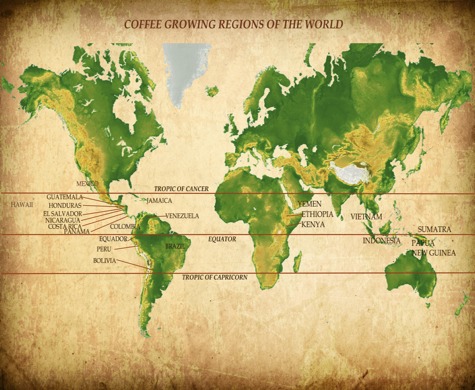
The world's major coffee growing regions exists within the Tropics of Capricorn and Cancer
History of Arabica Coffee
Coffea arabica is a species of Coffea originally indigenous to the mountains of Yemen in the Arabian Peninsula, hence its name. Coffea arabica was first described by Antoine de Jussieu, as Jasminum arabicum after he studied a specimen from the Botanic Gardens of Amsterdam. Linnaeus placed it in its own genus Coffea in 1737. The arabica coffee bean has been described as the Adam or Eve of all coffees. Arabica’s origins date back to about 1,000 BC in the highlands of the Kingdom of Kefa (present-day Ethiopia), where the Oromos tribe ate the bean, crushed it and mixed it with fat to make spheres the size of ping-pong balls. The spheres were consumed for the same reason that coffee is often consumed today: as a stimulant. Around the 7th century the bean crossed the Red Sea from Ethiopia to present-day Yemen and the lower Arab peninsula.
Legend has it that a goat herder named Kaldi discovered coffee on the Arabian peninsula around 500-600 A.D. He observed his goats excited behavior after eating the red cherry-like berries of a coffee plant. In Ethiopia there are still some locales where people drink a tisane made from the leaves of the coffee tree. From humble origins in Africa, coffee cultivation wandered east and west, eventually forming a belt roughly bounded by the Tropics of Cancer and Capricorn.
It could be assumed that the name coffee comes from the word Kaffa which would support the evidence that coffee first appeared in this region, semantics aside, it is accepted that Arabia was the origin of commercial coffee trade so Arabica Coffee is appropriately named. The first written record of coffee made from roasted coffee beans comes from Arabian scholars who wrote that it was useful in prolonging their working hours. The Arab innovation in Yemen of making a brew from roasted beans, spread first among the Egyptians and Turks, and later on found its way around the world.
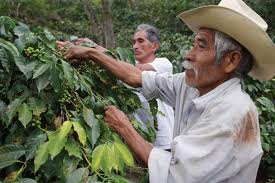
Colombian coffee farmer
Arabica Coffee growing throughout the world
Interestingly, C. Arabica, is self-pollinating as opposed to C. Rrobusta (Coffea canephora) which is not, this might explain why C. Arabica is more abundant throughout the world. Also why it does well at higher elevations where bees might be less active due to cooler temperatures and why Robusta prefers lower, hotter, climates where bees are more plentiful.
The oldest written testimony of the presence of coffee in Colombia is attributed to a Jesuit priest, José Gumilla. In his book The Orinoco Illustrated (1730), he registered the presence of coffee in the mission of Saint Teresa of Tabajé, near where the Meta river empties into the Orinoco. The consolidation of coffee as a Colombian export did not come about until the second half of the 19th century. The United States eventually became the most important consumer of coffee in the world, while Germany and France and Italy became the most important markets in Europe.The South America tropics provide ideal conditions for growing Arabica Coffee. Arabica grows best between 3,000 and 6,500 feet but has been grown as high as 9,000 feet. Generally, the higher the plant is grown the slower it matures. This gives it time to develop the internal elements and oils that give coffee its aromatic flavor.
Originally found in the southwestern highlands of Ethiopia, Coffea arabica is now rare there in its native state, and many populations appear to be mixed native and planted trees. It is common there as an understorey shrub. It has also been recovered from the Boma Plateau in southeastern Sudan. C. arabica is also found on Mount Marsabit in northern Kenya, but it is unclear whether this is a truly native or naturalised occurrence.
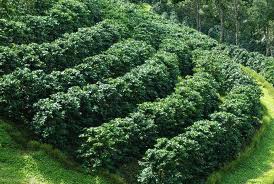
Arabica coffee trees Northern Thailand
Arabica coffee production in Indonesia began in 1699. Indonesian coffees, such as Sumatran and Java, are known for heavy body and low acidity. This makes them ideal for blending with the higher acidity coffees from Central America and East Africa. On Java Island, trees are planted at all times of the year and are harvested year round.In parts of Brazil, however, the trees have a season and are harvested only in winter. The plants are vulnerable to damage in poor growing conditions (cold, low pH soil) and are also more vulnerable to pests than the C. robusta plant. Gourmet coffees are almost exclusively high-quality mild varieties of arabica coffee, such as Colombian coffee.
In 1989, the late Princess Mother of Thailand called for the introduction of coffee as an alternate crop for hilltribe farmers in northern Thailand as part of a development project to help restore the ecological balance of the region.The Nestlé Experimental Coffee Development Farm was established in Doi Tung, Chiang Rai province, with partner organisations the Doi Tung Development Project and Mae Fah Luang Foundation. During the project 22,000 seedlings of 57 Arabica coffee varieties were planted to determine those most suitable for cultivation in northern Thailand. Two of these varieties were identified as suitable for cultivation in the hillsides. Since the project began, more than 1.5 million improved Arabica seedlings have been provided to hilltribe farmers. In 2009, the capital income of farmers in this area had improved tenfold since the beginning of the previous decade.
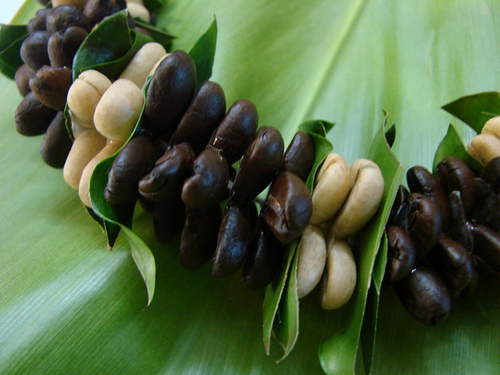
Kona Coffee lei
The Kauai Coffee Company in Hawaii began planting coffee trees in 1997 on what was formerly the McBryde Sugar plantation. In 1992 Hurricane Iniki inflicted $8.5m in damages on the coffee crop. Despite this setback, by 1996 Kauai Coffee’s harvest exceeded the volume of coffee produced by the entire Kona region. Kona coffee is the market name for coffee (Coffea arabica) cultivated on the slopes of Hualalai and Mauna Loa in the North and South Kona Districts of the Big Island of Hawaii. It is one of the most expensive coffees in the world. Only coffee from the Kona Districts can be described as “Kona”. The weather of sunny mornings, cloud or rain in the afternoon, little wind and mild nights combined with porous, mineral rich volcanic soil, creates favorable coffee growing conditions.
A viable coffee industry existed in the 1890s and 1920s in Queensland and northern New South Wales, Australia with coffee quality being reported as excellent. The industry declined for several reasons, including the high cost of hand-harvesting, and competition with the sugar industry for cheap harvesting labour. Around 1980, commercial interest in coffee growing in Australia regenerated due to high world prices and, more importantly, the development of a mechanical harvester in Brazil. Two overseas growers independently selected the Mareeba irrigation area on the Atherton Tablelands in North Queensland as a suitable site to grow coffee for machine-harvesting. These growers had a wealth of overseas experience which needed to be modified for local conditions. They encouraged Queensland Department of Primary Industries to undertake a research program that started in 1981. Their research findings/machine harvesting developments are documented in other Informed Farmers Coffee articles.
Source
Australian Coffee Research and Development Team, Kauai Coffee Company, Kona Coffee, PapaNicholas University/Coffee 101, Nestle Coffee Development Farm Project, National Geographic.