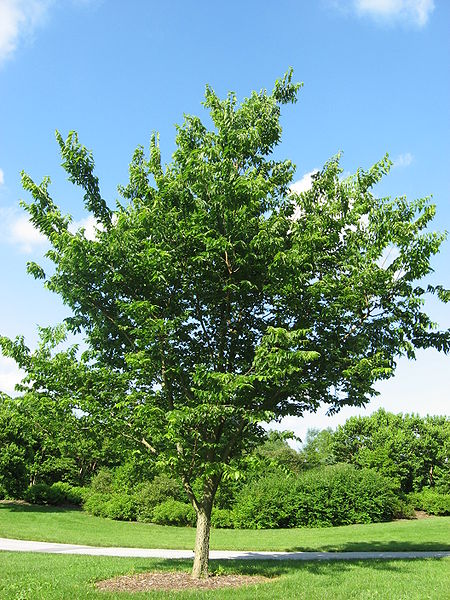
Hackberry Author Chhe on Wikimedia Commons
Celtis occidentalis
Common Name: Hackberry
Family: Ulmaceae
Known Hazards: None known
Habitats: Dry to moist and rich woods, river banks, rocky barrens etc. Frequently found on limestone soils.
Range: Eastern N. America - Quebec to Manitoba, North Carolina, Missouri and Oklahoma.
Fully Hardy Well drained soil Moist Soil Full sun
Physical Characteristics
Celtis occidentalis is a deciduous Tree growing to 20 m (65ft) by 20 m (65ft) at a fast rate. It is hardy to zone 2. It is in flower in May, and the seeds ripen in October. The flowers are hermaphrodite (have both male and female organs) and are pollinated by bees.
The plant prefers light (sandy) and medium (loamy) soils, requires well-drained soil and can grow in nutritionally poor soil. The plant prefers acid, neutral and basic (alkaline) soils..It cannot grow in the shade.It requires dry or moist soil and can tolerate drought.The plant can tolerates strong winds but not maritime exposure.
Habitats
Woodland Garden, Canopy.
Edible Uses
Edible Parts: Fruit; Seed.
Fruit - raw Very sweet and pleasant tasting, they can be eaten out of hand or can be used for making jellies, preserves etc. The fruit is often produced abundantly in Britain, it is about the size of a blackcurrant, but there is very little flesh surrounding a large seed and it is therefore a very fiddly crop. The fruit is dark orange to purple or blue-black when fully ripe, usually about 7-11mm in diameter, though occasionally up to 20mm. The flesh is dry and mealy but with a pleasant sweet taste. Seed. No more details. The fruit and seed can be ground up finely together and used as a flavouring. The N. American Indians ate them with parched corn.
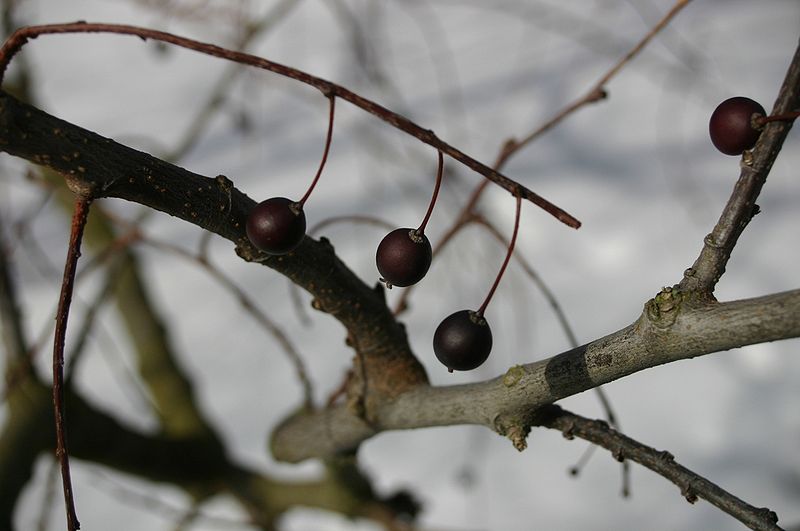
Hackberries Author Sten Porse on Wikimedia Commons
Medicinal Uses
Plants For A Future can not take any responsibility for any adverse effects from the use of plants. Always seek advice from a professional before using a plant medicinally. An extract obtained from the wood has been used in the treatment of jaundice. A decoction of the bark has been used in the treatment of sore throats. When combined with powdered shells it has been used to treat VD.
Other Uses
Dye; Fuel; Miscellany; Shelterbelt; Wood.
A dye is obtained from the roots . No more details are given. Fairly wind-tolerant, it can be planted as part of a shelterbelt. Wood - rather soft, weak, coarse-grained, heavy. It weighs 45lb per cubic foot and is sometimes used commercially for cheap furniture, veneer, fencing fuel etc.
Cultivation
Succeeds in any reasonably good soil, preferring a good fertile well-drained loamy soil. Succeeds on dry gravels and on sandy soils. Tolerates alkaline soils. Established plants are very drought resistant. Wind resistant. Trees transplant easily. Trees prefer hotter summers and more sunlight than are normally experienced in Britain, they often do not fully ripen their wood when growing in this country and they are then very subject to die-back in winter. Plants in the wild are very variable in size, ranging from small shrubs to large trees.
They are fast-growing, and can be very long-lived, perhaps to 1000 years. Only to 200 years according to another report. They usually produce good crops of fruit annually. Trees respond well to coppicing, readily sending up suckers after cutting or the top being killed off in a fire. Plants in this genus are notably resistant to honey fungus.
Propagation
Seed - best sown as soon as it is ripe in a cold frame. Stored seed is best given 2 - 3 months cold stratification and then sown February/March in a greenhouse. Germination rates are usually good, though the stored seed might take 12 months or more to germinate. The seed can be stored for up to 5 years. As soon as they are large enough to handle, prick the seedlings out into individual pots. The leaves of seedlings often have a lot of white patches without chlorophyll, this is normal and older plants produce normal green leaves. Grow the seedlings on in a cold frame for their first winter, and plant them out in the following late spring or early summer. Give them some protection from the cold for their first winter outdoors.
Author: L. on Plants for a future.
References available from source website.