 Application descriptions
• Capital applications of fertiliser are aimed at lifting soil nutrient levels to target levels determined by the manager. They involve making one or more fertiliser applications over and above the level required for replenishing nutrients lost through export off the farm or paddock in agricultural products. Capital applications are designed to increase yearly pasture growth and quality. Typical fertilisers involved include phosphorus (P) and lime. Sulphur (S) is usually supplied to varying levels with P.
• Maintenance applications of fertiliser are aimed at replacing the amounts of key nutrients either tied up in the soil or exported off the farm or paddock through agricultural production practices and products, eg meat, wool, grain, hay and silage (where the nutrients are not replaced). Maintenance applications are designed to maintain existing patterns of pasture growth and quality. Maintenance applications usually involve P and S, but may involve potassium (K) in hay and silage paddocks.
From an annual application of 10kg Phosphate/ha (110kg superphosphate/ha) pasture grazed with 15 sheep/ha (a Merino self-replacing flock):
• 1kg P is used immediately for pasture growth;
• 4kg P is used for pasture growth and released over 3 to 4 years; and
• 5kg P is fixed in the soil long-term.
Guidelines for making capital applications
1) Expenditure on capital applications must be regarded as investments of financial capital.
a) There is a negative return on investment unless increased pasture growth is converted to increased profit.
b) Conversion to profit can only come from increased margins ($/kg sold) or increased volume of turnoff (kg sold /animal, kg sold/ha or kg run/ha if agisting).
c) The higher the marginal return per unit increase in turnoff or stocking rate the higher the return from capital applications.
d) Co-investments such as purchase of stock, improved pasture species, water and fencing to improve utilisation may need to be made to maximise returns.
2) Ensure that targets set for minimum nutrient levels are appropriate for each pasture zone as well as your financial base.
a) Environmentally fragile zones, for example zones with steep slopes or zones adjacent to riparian areas with high risk of sideways movement of P and N, may not be suitable for capital applications of fertiliser.
b) Similarly, raising P levels in stable native pastures may disturb pasture stability while failing to give optimum return on investment through the absence of highly responsive species such as clover.
3) Timing is vital.
a) There is evidence that achieving targets over a number of years is just as effective in lifting soil nutrient levels as a one off application.
b) All P applications should be made in periods when soil is unlikely to be waterlogged, eg mid spring to mid autumn in winter rainfall regions. P is rapidly fixed and becomes unavailable to the plant when soil moisture reaches saturation levels.
c)Sulphur based fertilisers can contain both elemental S and sulphate S. Elemental sulphur is not plant available and is only slowly converted by microbial action to water soluble and readily plant available sulphate S. Apply before the end of summer to gain benefit in autumn if S content is largely in the elemental form.
4) All limiting factors should be corrected where economic responses are indicated.
a) P should come before lime except where indicated below.
i) P is a major driver of pasture quantity and is also associated with quality.
ii) The amount needed to increase P by one unit varies with soil type. Heavier textured soils usually require more P than lighter, sandier soils.
iii)As a rule of thumb, 6–13kg P/ha will increase Olsen P by 1 unit or Colwell P by 3 units depending on the soil’s phosphate buffering index.
b) Sulphur is normally applied in fertilisers with a mix of P and S in varying proportions.
i) When P and S are both low, use blends with 1:1 ratios (P/S).
ii) When P is low and S is within limits, use 2:1 blends.
iii) When P is within limits (or above target) and S is low use sulphur fortified products for capital S while supplying maintenance levels of P.
iv) Base final choice of product within the above guidelines on cost of P or S applied. High analysis fertilisers can be cost competitive after allowing for transport, handling and spreading costs.
c) Liming is indicated when the percentage of aluminium is above maximum or when pH is below minimum for the existing and/or desired species.
i) Note that phalaris is sensitive in its establishment phase. Most cultivars cope with slightly raised aluminium or low pH when established.
ii) Speed of response to liming is normally inversely proportional to soil cation exchange capacity (CEC), ie quickest responses occur in soils with low CEC.
iii) It should also be noted that liming to raise pH has a beneficial effect on soil health through increased biological activity of soil organisms.
Guidelines for maintenance applications
1) To determine the amount of phosphorus (P) and sulphur (S) to be applied annually as a maintenance dressing.
a) A rule of thumb is to base the amount of P required on the phosphorus buffering index (PBI) of the soil. PBI is related normally to soil texture (clay content).
i) When PBI is low (0–100) apply 0.8kg P/DSE.
ii) When PBI is moderate (100–300) apply 1.0kg P/DSE.
iii) When PBI is high (> 300) apply 1.2kg P/DSE.
b) Alternatively, base application rate on rainfall, applying 1kg P/ha for every 25mm annual rainfall, eg if annual rainfall is 700mm, apply 28kg P/ha annually.
c) Choose a P/S fertiliser blend consistent with the guidelines established for capital applications and unit cost of P.
2) Molybdenum should be applied as an additive to P based fertilisers:
a)When soil pH is less than 5.5CaCl2 or tissue testing indicates levels are lower than critical limits.
b)Whenever legumes are reseeded, and/or when poor nodulation and rhizobia activity is suspected.
c) At least once every 4 to 5 years when applying maintenance P on low pH soils.
Seek advice on suitable rates for your region, but rates used are generally in the range of 50–100 g/ha.
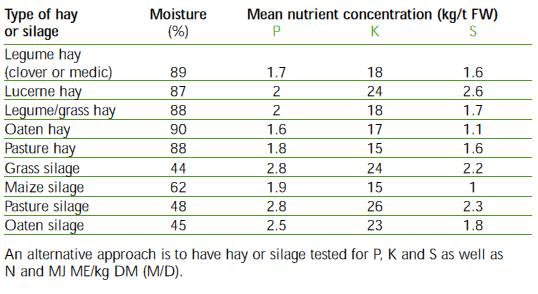
3) Consider maintenance applications of phosphorus, potassium and sulphur in paddocks regularly cut for forage conservation. The table over the page indicates typical extraction rates for phosphorus, potassium and sulphur in kg per tonne fresh weight (FW) of hay or silage. For example, if you cut and remove 10 tonnes of lucerne hay per hectare from a paddock, you will need to apply 20kg of P (phosphorus), 240kg of K (potassium) and 26kg of S (sulphur) to maintain existing nutrient levels on each hectare cut. Note the large amount of potassium removed. Producers who frequently cut forage from the same paddock should consult an agronomist or other adviser to determine the best method of maintaining potassium levels. Also be aware that nutrient composition, especially minerals, can vary considerably (in some instances more than two-fold).
4) Nitrogen (N) is found mainly in the soil organic matter fraction and as protein in plants and soil organisms. The N present in the soil occurs in two major forms:
• Organic N found in the soil organic matter and soil biota (organic N is not available to plants); and
• Mineral N found in soil as either ammonium (NH4+) or nitrate (NO3-).
Only 2 to 3% of soil N is in the mineral form and hence available to plants. Organic N is converted to mineral N (mineralisation) during the breakdown of soil organic matter by soil microbes. Nitrogen is reconverted from mineral to organic forms (immobilisation) when it is taken up in plant growth.
The amounts of N removed by sale of livestock products are modest but plants require large amounts of N for growth. Nitrogen application may be considered to boost pasture growth in some grazing situations but can be lost through rapid evaporation if application is not immediately followed by precipitation sufficient to dissolve the N into the plant root zone. A partial budget analysis is recommended when considering an application of nitrogen to assess the benefits against the costs.