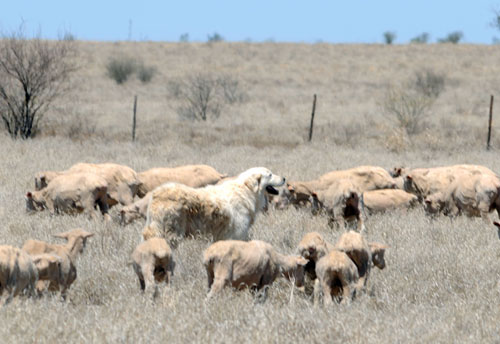
Guard dog for sheep
Livestock guard animals live with the flock, protecting the sheep from predation, without harming or interfering with the flock. It is important to remember that all types of guard animals should bond with the flock, not with humans. To be effective, they cannot be raised or treated like pets. Guard animals currently being used with sheep are:
Dogs
These dogs are reared with the flock and have proven to be extremely successful in warding off predators. There are several breeds that have, for centuries, proven their worth by placing themselves between the flock and potential danger. Some of the more common guarding breeds are Great Pyrenees, Maremma, Akbash, and Komondor. Producers interested in procuring a guard dog should do the necessary research to determine the characteristics and temperament of each breed and decide which breed best suits the shepherd’s expectations.
Donkeys
Donkeys are gaining popularity due to their relatively low cost, low maintenance requirements, natural herding instinct, and their inherent dislike for canines. It would appear that the most effective guard donkey is a jenny with a foal. Adult male donkeys may be overly aggressive towards the sheep. Although donkeys do well on grass hay and pasture, they tend to become obese on high-quality diets and may develop laminitis (founder). Donkeys’ feet should be trimmed every 3-4 months. Donkeys are a monogastric species, which means that feed is not subjected to microbial fermentation until after it has passed through the animal’s own system. Therefore, medications and mildews in feeds will be absorbed directly into the animal’s system. NEVER allow a donkey access to a medicated lamb ration, as even trace amounts of certain medications (e.g. ionophores) will be toxic.
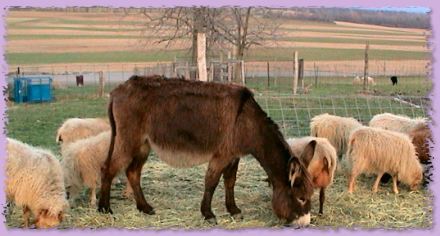
Donkey guarding sheep
Llamas
Donkey guarding sheep
The llama is very adaptable to many environments and bonds well with sheep and lambs. Likewise, the llama will eat the same feed as sheep and is not prone to foot problems associated with high quality feeds. Although females may be quite expensive, neutered males are reasonably priced and have developed as excellent reputation as a flock protector. It is a good idea to train the llama to halter and to come when called; otherwise considerable effort could be expended in a sheep and llama chase. Unlike true ruminants,
which have a four-chambered stomach, llamas have three-chambered stomachs. However, their digestive system is closer to a ruminant’s in function than it is to a monogastric species (donkey, horse). There are several llama breeders in Ontario.
Horses
Although not widely recognized, several experienced producers have had excellent results in minimizing predator attacks by pasturing horse(s) with their sheep. Apparently, draft horses are particularly effective, although the feed bill could be hard to justify if the horse were only used for predator control. As donkeys, horses are monogastrics and have similar management requirements.
Author: Ralph Stevenson, Former OSMA Director (Modified by OSMA, 2010)


