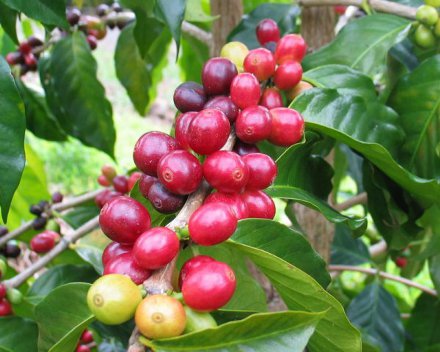
Coffee trees have to be well managed and in excellent health if they are to be successfully machine-harvested
Experience has shown that to machine-harvest coffee trees successfully, the plantation has to be in excellent health and well-managed. Trees in excellent health yield heavily, have more leaf cover to shade the cherry and extend cherry life, have better cherry recovery and suffer less damage during machine-harvesting. Trees in poor health are lower yielding and can be severely damaged during machine-harvesting.
Trees grown intensively under full sun carry large crops. Unless the trees are in perfect health all year round, the crop’s demand for nutrients may be greater than the tree can supply, leading to a decline in tree health (dieback) which affects the current and following season’s crop and reduces cherry quality and the efficiency of machine-harvesting. There is a fine balance between nutrient supply and demand in heavily bearing coffee trees. The dense foliage on healthy trees provides most of the tree’s resources, so it is critical to avoid leaf loss from disease, harvesting, water stress or nutrient stress. Any leaf loss represents a loss of photosynthesis and can lead to dieback from over-bearing.
This article discusses the management of the mature coffee tree. It begins with descriptions of the vegetative (branch) and reproductive (flower and cherry) growth cycles of coffee trees in Australia. It is important to understand these cycles so that you can time management operations such as irrigation, fertilising and pruning which are also discussed in this chapter.
GROWTH CYCLE:
A generalised pattern of branch and cherry growth for arabica coffee grown in North Queensland is shown in the graph below. The patterns are very similar in northern New South Wales except that there are 10 months between flowering and cherry ripening compared with eight months in North Queensland. This has the effect of delaying cherry ripening and harvesting until August and September.
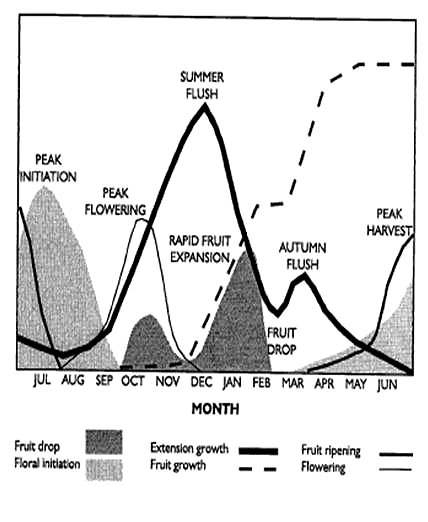
A generalised pattern of branch and cherry growth for arabica coffee grown in North Queensland
BRANCH GROWTH:
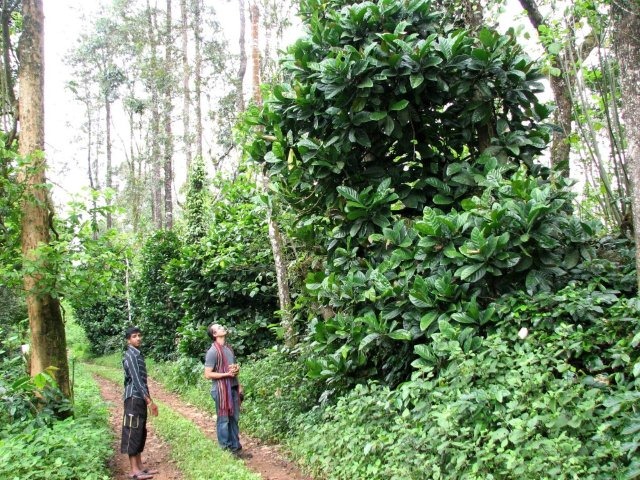
An approximately 100yr old Robusta coffee tree
Coffee trees usually have one main summer flush followed by a smaller autumn flush. The timing of these flushes is influenced by the timing of flowering. The first flush begins around the time of peak flowering, initiated by the spring rains or irrigation after the water-stressing period (to control flowering), and finishes as the cherry begins to expand. This flush accounts for about 70% of the total growth for the year and is important because it provides new foliage to support the developing crop, helping to prevent cherry shedding and tree dieback. This new growth also carries the following season’s crop. It is important to maximise growth during this period with plenty of fertiliser and water. Experiments indicate that ideal temperatures for branch growth are 23°C to 28°C. Prolonged temperatures above 30°C have been found to slow branch growth and reduce flowering. The reduction in growth in February is due to rapid cherry development competing for available resources. In coffee trees, cherry development is a stronger competitor for available resources than branch growth. Experimental data indicates that there is a rapid depletion of stored carbohydrates in the tree at this time. Plentiful irrigation and fertiliser and good leaf cover reduce this depletion and maintain trees in a healthy condition.
The second flush of growth is much smaller, lasting from one to two months, and the timing more variable. This growth appears to be related to a decline in the demand for resources by the fruit, and begins as the rapid expansion phase of cherry growth finishes. After this flush of growth, branch growth slows due to less favourable growing conditions (short days, low temperature and low relative humidity) in winter. Temperature experiments indicate branch growth is slow below 23°C. During winter there is a small amount of branch growth each month which declines further during water-stressing (practised in North Queensland for flower control).
REPRODUCTIVE GROWTH:
Floral initiation;
Floral initiation begins around April in North Queensland and May in northern New South Wales and is fastest through the cool, dry winter months of June and July. Ideal temperatures for reproductive growth are around 18°C to 23°C. Temperature experiments indicate that temperatures above 28°C can reduce flowering drastically. Research has also shown that good moisture availability, leaf cover and nutrient supply ensure maximum floral initiation. Initiation extends through to September; after this time, increasing temperatures and day length cause it to decline. Once the floral buds are initiated they start to grow and develop into flower buds (see Graph above). The flower buds do not flower straight away like most plants. Instead, they stop growing and become dormant. They start growing again after the trees have been water-stressed and rewatered (see Graph). This occurs naturally in northern New South Wales where trees become water-stressed during the dry winter months, and flower after spring rain. In North Queensland, particularly on the Atherton Tablelands, growers purposely water-stress the trees by withdrawing irrigation and then irrigating them heavily to make them flower. The trees flower about ten days after watering.
Flowering;
Due to the period of dormancy in flower bud development, flowering can occur at any time over a four month period, depending on the rainfall and irrigation pattern. Peak flowering tends to be around September to November.
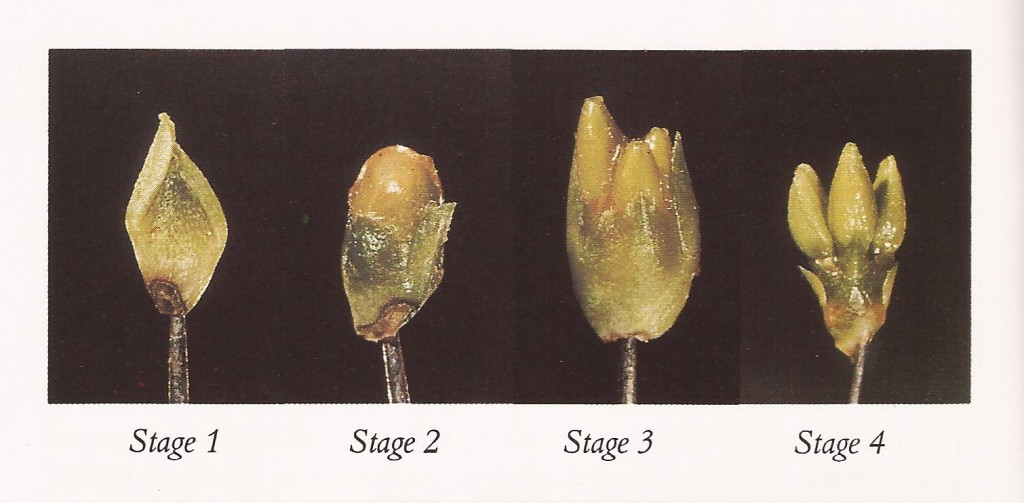
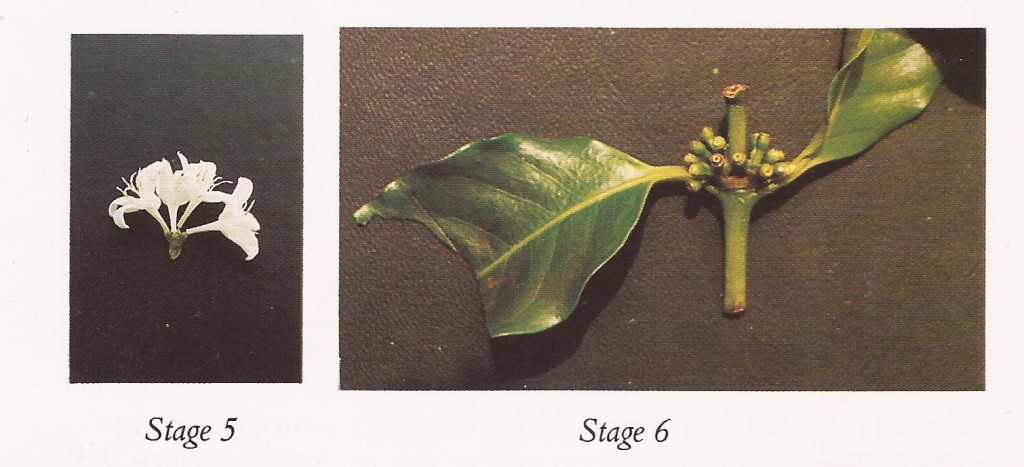
Six stages of floral bud development from initiation to cherry set. The cherry in stage six is at the pinhead stage.
Pinhead stage;
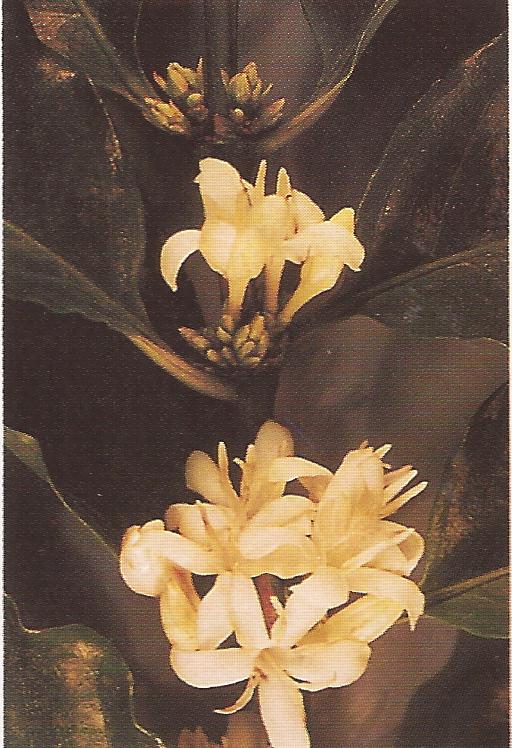
This image shows the position of the inflorescences and flowers in relation to the leaf axils on a lateral branch
Following flowering, the cherry remains small and does not grow for four to eight weeks. This period is sometimes referred to as the pinhead stage because the cherry resembles pinheads in shape and size (see Graph).
Rapid cherry growth;
Rapid cherry growth begins four to eight weeks after flowering and continues for a further 12 weeks during which time branch growth declines. This phase of cherry growth determines the maximum potential size of the coffee beans. Research has shown that water stress and poor nutrition at this time can result in reduced bean size. Bean size is important as it influences the price at which coffee is sold. Therefore you need to apply plenty of potassium and water at this time (see Nutrition.)
Cherry drop;
During cherry growth there are two peaks of cherry drop (see Graph). The first, smaller peak occurs between flowering and before the start of rapid cherry growth and may be partly related to unsuccessful pollination and fertilisation. The second and more important shedding occurs during the phase of rapid cherry growth. Cherry shedding at this time is most probably related to competition for limited nutrients and water. Good leaf cover at this time may help to reduce this competition. There is little or no shedding after rapid cherry growth is complete.
Bean filling;
Over the next 12 weeks the beans within the cherry begin to fill and there is a rapid increase in their dry weight.
Ripening;
Ripening usually begins in April in North Queensland and in June in northern New South Wales and continues for three to four months depending on how concentrated the flowering period was. The cherry takes around eight months in North Queensland and 10 months in New South Wales to ripen from flowering. For machine-harvesting it is important to concentrate the period of flowering so that most of the fruit ripens at one time and can be harvested at one time.
Source:
James Drinnan