Lupins
Author: Keith Devenish, Department of Agriculture, Northam
KEY MESSAGES
- Grain legume crop stubbles provide better quality sheep feed than cereal or canola stubbles.
- The feed value of the stubble is directly related to the amount of seed left after harvest.
- Sheep will preferentially select the seed first.
- Young sheep should be trained to recognise the seed.
- Sheep growth rates should be at least one kilogram per head per week.
- Sheep drink more water on a high protein feed.
- Grazing can be limited by the amount of ground cover available.
Introduction
Crop stubbles are the plant residues left after harvest. The major components of the stubbles of grain legumes in order of their feeding value to sheep are seed, leaf, pod, chaff and stem material. Weed residues in paddocks can also be of value as sheep feed.
Contribution to liveweight
The feed value of legume stubbles is directly related to the amount of spilt seed left after harvest. Therefore, the length of grazing depends on the availability of the seed and whether animals need to gain or lose weight. Providing there are no other limiting restrictions to animal performance, the legume crop stubbles generally have the highest summer feed value of all the crop stubbles.
Constraints to liveweight gain
There are several factors that can limit animal performance when grazing grain legume stubbles (see Sheep Health Issues). This section assumes the risk of the following problems are minimised:
- Lupinosis is the main threat on lupin stubbles. Deaths can occur, but even low levels of the toxin that produces lupinosis can limit weight gain.
- ARGT - watch for annual ryegrass toxicity if ryegrass plants are present in large numbers.
- Acidosis - grain engorgement generally has not been an issue, but theoretically could occur where large amounts of faba bean, field pea or chickpea seed are spilt.
Watering points
The most important factor influencing sheep performances during the hot summer period is the availability of good quality water. Sheep on a high protein diet can drink more than twice as much water per day as they do when grazed on other dry feed. Having a movable water point allows better utilisation of feed from large paddocks (see Farmnote 106/89 Moving water points on lupin stubbles).
Main issues
- Weaners tend to concentrate their grazing within 800 metres of water points.
- Moving the water point can increase the utilisation of the stubble material.
- A weaner grazing lupin stubble in hot conditions can drink up to nine litres of water per day.
- For water troughs, a fast delivery is as important as the water storage capacity.
- Check the quality of the water, particularly salt levels for young sheep.
- Clean water troughs every second day in hot conditions.
- Regularly inspect water troughs to make sure plenty of water is available.
Ground cover
For some grain legume stubbles the risk of wind erosion from a lack of ground cover restricts the length of grazing. A general recommendation is to remove livestock from a paddock once the amount of plant material present falls below 50 per cent ground cover.
Wind erosion.
Wind erosion.
Grazing lupin stubbles
Stubbles of Phomopsis-resistant narrow leafed lupin (Lupinus angustifolius) can provide grazing from one to five months, depending on the amount of residual seed available; the stocking rate; incidence of lupinosis; the risk of wind erosion and the amount of summer rainfall (see Farmnote 87/93 Grazing weaner sheep on Phomopsisresistant lupin stubbles).
There is a greater risk of lupinosis developing in sheep grazed on the older lupin varieties such as Danja, Yandee, Chittick and Illyarrie (see Farmnote 109/88 Grazing management to minimise lupinosis). In the absence of lupinosis, stubbles from the older varieties should produce similar sheep performances as those obtained on the phomopsis-resistant varieties. Producers should check for information on newly released varieties before assuming that stubbles are safe to graze.
Weight gains can be expected from healthy weaners grazed on lupin stubbles with adequate seed available. Modern machinery and cropping practices have increased harvesting efficiency to a point where relatively little seed is left behind and so shorter periods of grazing can be expected on current stubbles.
Suggested management of prime lambs grazed on lupin stubbles
- Train weaners to recognise lupin seed before going onto lupin stubbles.
- Ensure a plentiful supply of water on hot days, up to nine litres per head per day is needed.
- Use a stocking rate of up to ten weaners per hectare.
- Do not graze paddocks with a ground cover less than 50 per cent.
- Consider moving prime lambs when seed levels fall below 100 kilograms per hectare.
- Use movable water troughs in large paddocks.
- Grazing can be deferred until late summer but summer rain can spoil feed.
- Regularly weigh and condition score about 30 animals in each mob.
Merino Weaners
Merino Weaners
Expected weight gains
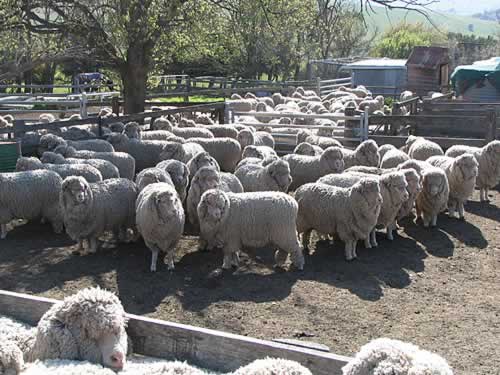
Trials with Merino weaners have shown that they can gain up to 15 kilograms during 100 days of grazing on lupin stubble. This gives a growth rate of about one-kilogram per week. Some trials have produced half this rate, possibly due to sub-clinical lupinosis inhibiting optimum growth. Figure 1 provides an example of how stocking rates can influence the length of time that weaners can graze sweet lupin stubbles.
Suggested grazing strategy for prime lambs
Lupin stubbles typically have between 150 and 350 kilograms per hectare of spilt seed per hectare after harvest. To finish prime lambs, liveweight should be at least 30 kilograms when the lambs are put onto the stubble and there should be at least 200 kilograms per hectare of seed before grazing begins. The optimum management technique may be to remove prime lambs when the amount of seed falls to about 100 kilograms per hectare (this is only a suggestion and not a blanket recommendation). This is twice the recommended level of 50 kilograms per hectare of seed when weaners often begin to lose weight and the risk of lupinosis increases due to higher stem intake. Growth rates decrease as the seed becomes limited and weaners begin to eat more stem and pod material.
Prime lambs should be moved to an ungrazed paddock of lupin stubble when feed starts to become limiting and before growth rates begin to decrease. If there is only one paddock of lupin stubble available then it might be better to ration the feed by temporarily dividing the paddock in half.
Residual grazing of stubble
After prime lambs are removed from lupin stubbles, older sheep such as shippers can then graze on the remaining material. Older shippers should still gain some weight where seed levels are between 50 and 100 kilograms per hectare. Ground cover may be the limiting factor rather than seed levels because lupins are grown predominantly on sandplain soils that are prone to wind erosion.
Seed is the most important component
Sheep selectively graze lupin seed rather than leaf or stem material. Seed intake is generally high during the first few weeks of grazing and growth rates are rapid once animals are used to the feed. Naturally, the higher the stocking rate the shorter the period of rapid growth.
Lupin seed is high in energy and lower in starch than cereal grains, making it a safer feed for sheep. Lupin seed has an average metabolisable energy of about 14 megajoules per kilogram, less than one per cent starch and about 30 per cent crude protein. However, these levels can vary considerably and it is important to be aware of this and perhaps have the seed tested by a laboratory.
Measuring seed levels
As a rough guide, an average of eight lupin seeds in a tenth of a square metre (e.g. a Hoegrass/Cropcheck square) is equivalent to 100 kilograms per hectare of lupin seed. You should average about 20 random throws across the paddock to get a reasonably accurate estimation of the amount of seed in the paddock.
Listed below is the number of seeds required in a Hoegrass/Cropcheck square (0.1 square metre) to be equivalent to 100 kilograms per hectare of seed.
Wheat/Oats 28
Barley 25
Lupins 8
Field Peas 5
Chick Peas 5
Faba beans 2
Training weaners to recognise seed
Feeding lupin seed for about ten days before sheep are put onto stubbles can train them to look for spilt seed. As a result they will eat the seed as soon as they are put onto the stubbles and should start growing immediately. Another training method is to trail feed lupins several times to the ewes before their lambs are weaned. These techniques are important for prime lamb production where time is critical for lambs to reach liveweight targets.
Case example
A trial was conducted on a Gungurru lupin stubble near Doodlakine. Merino weaners were grazed from 20 December 1992 to 16 February 1993. The weaners increased in liveweight by five kilograms during the eight-week grazing period. Their growth rate was 0.6 kilograms per week (86 grams per day) and lupin seed decreased from 251 to 136 kilograms per hectare during the period of grazing. (See Table 1.)
Lupinus Albus
Lupinus Albus
Albus lupin stubble
The management of sheep grazing Albus lupin (Lupinus albus) stubble is similar to those grazing narrow leafed lupins. However, the seed is almost three times bigger and consequently sheep select and eat the seed much more quickly. This could easily limit the grazing time of these stubbles by prime lambs to less than a month. Albus have a higher protein and energy content than narrow leafed lupins. In addition, Albus varieties such as Kiev are less prone to phomopsis infection than narrow leafed lupins.
Field pea stubble
There is considerable experience with grazing field pea (Pisum sativum) stubbles, which are high in protein and energy making them a good feed for all classes of livestock. Field pea seed is about 25 per cent crude protein and has 13 megajoules per kilogram making pea stubbles an excellent source of dry feed. As with lupins, sheep will preferentially graze the spilt seed first.
Because of the high starch content of peas, sheep are susceptible to acidosis. Introducing sheep gradually to a high starch diet can prevent this. Enterotoxaemia (pulpy kidney) can also occur when sheep are introduced to pea stubbles suddenly and young sheep are more susceptible than adult sheep (see Sheep Health Issues). The most effective preventative measure is to vaccinate against enterotoxaemia.
The risk of wind erosion is a major issue when grazing field peas. The grazing period for prime lambs is most likely to be less than four weeks (probably more like two weeks) because sheep powder up field pea stubble and it then blows away easily. Extra caution is needed to avoid wind erosion. In consequence, pea stubbles should only be grazed to use the spilt seed and then the sheep should be moved to a paddock not vulnerable to erosion (see Farmnote No 12/88 Introducing sheep to pea stubbles).
Faba bean stubble
Growth rates for sheep grazed on faba bean (Vicia faba) stubbles should be similar to lupin stubbles but the seed is larger than narrow leafed lupins and sheep are likely to target the seed first. About 20 seeds per square metre (two per Hoegrass or Cropcheck square) equate to about 80 to 100 kilograms per hectare (see Farmnote 55/96 - Faba bean production). Faba beans have one of the highest harvest indices of the grain legumes so there is only a small amount of seed left after harvest. Faba beans are about 27 per cent crude protein, have an energy content of 13 megajoules per kilogram. They are also high in starch.
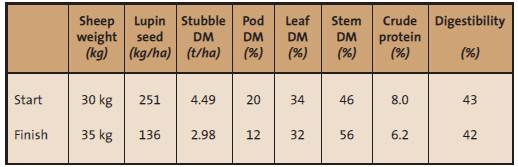
Table 1. Changes to sheep liveweights and lupin stubble components at Doodlakine
Theoretically acidosis could occur if large amounts of spilt seed remained following harvest. However, generally few problems have occurred with these stubbles. The stubble minus the seed appears to be good value so feeding additional lupin seed might be an option for prime lamb production if there is still some stubble value left. Take care not to overgraze paddocks with sandy surfaces that may be prone to wind erosion. If the harvester sample requires grading for size, the faba bean seconds are an ideal supplementary feed source.
A faba bean crop at Merredin in 1994 yielded 500 kilograms per hectare at harvest with the amount of spilt seed measured at 205 kilograms per hectare. After 19 days of grazing there were 53 kilograms per hectare of seed left.The 315 Julyborn ewe weaners (average weight about 25 kilograms) were grazed on 25 hectares of faba bean stubble and fed 20 grams per head per day of lupin seed. They increased weight at 154 grams per head per day or just over one kilogram per week. In this case a low level of ground cover was observed and it was suggested that this could lead to major problems in bigger paddocks.
Chickpea stubble
Chickpea (Cicer arietinum) stubble is a high value stock feed that should supply grazing for two to three weeks. The spilt seed is high in value but the biomass tends to be low. Hence, ground cover is the limiting factor. Often the harvested sample requires grading to meet grain size requirements and chickpea grain seconds make good feed.
Types of Lentils
Types of Lentils
Lentil stubble
The lentil (Lens culinaris) is an annual winter grain legume that is inclined to lodge at maturity. Lentils tend to produce a relatively low biomass and moderate harvest indices. The green lentil seed is twice as big as the red lentil seed. Evidence from India and Turkey suggests that lentil stubble is usually of high value as a stock feed, although lack of ground cover could limit the grazing time to two or three weeks.
Lathyrus stubble
There is very little experience with grazing Lathyrus crop stubbles as they are relatively new on a broadacre scale. Being a legume crop they should theoretically support animal grazing at similar rates to chickpeas.The seed is about half the size of a field pea. Many Lathyrus species contain a neurotoxin (ODAP). The consumption of large quantities of Lathyrus grain containing high concentrates of the neurotoxin causes some paralysis of the lower limbs known as lathyrism in humans and animals. This problem is mainly associated with Lathyrus sativus or grasspea.
The dwarf chicklings (Lathyrus cicera) have low amounts of the neurotoxin. These include varieties such as Chalus and Lath-BC. The stubble and seed of dwarf chickling is nutritious for sheep and cattle. Overseas evidence from preliminary feeding trials suggests that dwarf chickling grain contains about 27 per cent crude protein (see Farmnote 24/98 Growing dwarf chickling).
As with field pea stubbles, avoid over grazing, especially on sandy soils where erosion can be an issue. Limited grazing trials have shown that most seed is consumed in the first few weeks of grazing. These paddocks should be closely monitored for levels of seed and animals should be moved to another paddock before they begin to lose weight. Expect about two to four weeks grazing for prime lambs, depending on the amount of residual seed left after harvest.
Further reading:
Farmnote 24/98. Growing dwarf chickling. Farmnote 55/96. Faba bean production.
Farmnote 87/93. Grazing weaner sheep on Phomopsis-resistant lupin stubbles.
Farmnote 12/88. Introducing sheep to pea stubbles.
Farmnote 109/88. Grazing management to minimise lupinosis.


