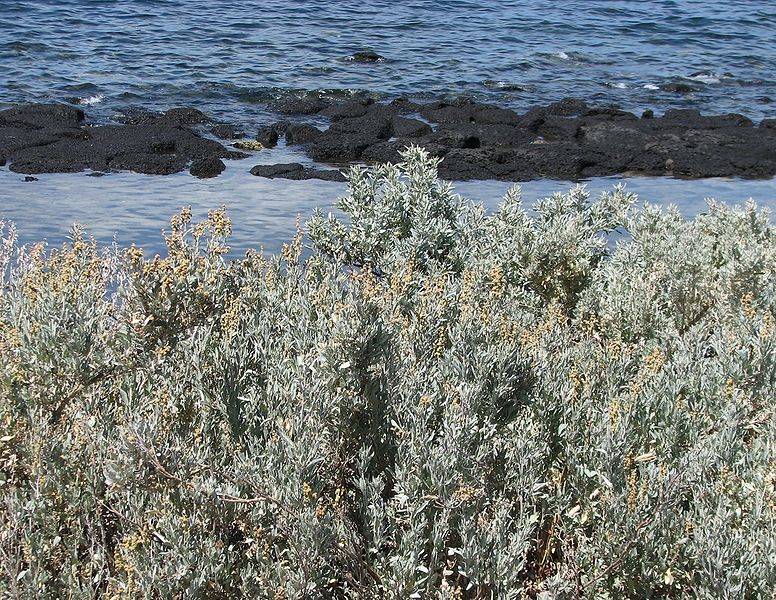
Salt bush
Salt bush
Key Points
- Animal production is directly related to the quality and quantity of the pasture the animals graze.
- Young sheep will gain weight on good, mixed saltland pastures containing annual pasture species but will usually lose weight on saltbush alone.
- Weaners will grow at up to 100 grams per day (0.7 kilograms per head per week) during summer without supplementary feeding on saltland pastures growing in areas with low salt levels and consisting of a good mix of halophytes and balansa and persian clovers.
- A good quality water supply with low salt content is required when grazing sheep on diets with high levels of salt as sheep will drink up to 7 litres per day.
Introduction
There is little information about the production of sheep meat from saltland pastures in Western Australia.
Saltland pastures are best referred to as a combination of:
- Perennial salt tolerant shrubs known as halophytes (eg. saltbush and bluebush) that have the ability to accumulate salt in their leaves; lower the water table; and alter the micro-environment to allow the establishment of other plant species, and;
- Perennial grasses and annual pasture legumes such as puccinellia, tall wheat grass, balansa and persian clovers. These perennial grasses and annual legumes provide the bulk of feed in saltland pastures and when green are preferentially grazed.
Puccinellia
Costs of establishing saltland pastures
Puccinellia
The costs associated with developing saltland pastures can be highly variable and largely depend on the amount of capital infrastructure required, such as fencing, water supplies and surface drainage, as well as the establishment costs of the new pasture species.The capital costs should be spread over the life of the saltland pasture when determining the total cost of establishing the pasture.
The capital cost of establishment is often high. However, there is little cost in the form of lost productivity, as most of this land is currently unproductive. Michael Lloyd, a farmer at Lake Grace, has estimated the costs for direct seeding saltland pasture to be 170 dollars per hectare (contract) or 55 dollars per hectare (sown by the farmer). The costs of fencing and providing water are additional.
Where to grow saltland pastures.
Saltland pastures are generally grown on land where salinity and waterlogging affect the production and profitability of salt-sensitive grain crops and pastures. The selection of species is dependent on rainfall, degree of waterlogging and level of soil salinity at each specific site. Areas of high salinity and waterlogging favour the poorer quality and more salt tolerant species such as the saltbushes.
These areas are not well suited to high-quality stock feed such as balansa and Persian clovers and the grasses; tall wheat grass and puccinellia. However, often the establishment of the more salt tolerant species will lower the water table sufficiently to allow leaching of salts and the subsequent establishment or colonisation by less salt tolerant species with higher grazing value.
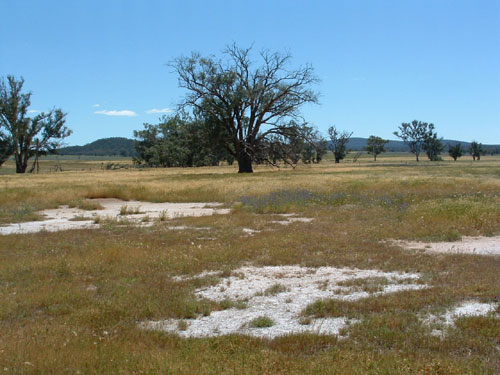
Saline Pastures
Grazing management
Saline Pastures
Saltland pastures need to be managed to protect the range of species in the stand. Where there is a mix of both perennial and annual species the requirements of each need to be considered. The balansa component of the pasture will be dependent on the availability of seed and fertiliser and may require the control of insects. Therefore, saltbush plantings will need to have row spacing wide enough to allow access for vehicles to apply fertiliser and insecticides.
Rotational grazing is recommended for the long-term persistence of perennial plants. This should be combined with reduced grazing during flowering periods of balansa and persian clover, along with a period of heavy grazing during summer and autumn to remove the bulk of dry matter and help increase the seed softening process. All this is required whilst leaving leaf on the halophytes to increase water use.
Quantity of feed and its availability
The saltbush component of saltland pastures produces relatively low levels of digestible material. A three-year trial at Katanning with four varieties of saltbush showed that saltbush had an average annual yield of leaf and fine stem material of less than 500 kilograms of dry matter per hectare. In this trial, the bulk of the feed came from the poor-quality annuals such as barley grass, and other salt tolerant natural species present, in addition to the planted perennial grasses.
The bulk of feed available from saltland pastures will usually be from late autumn through to early summer. Additional feed from the perennial grasses and perennial salt-tolerant shrubs (for example, saltbush and bluebush) may be available during the summer and autumn, but this depends on the availability of moisture.
The value of this perennial feed during summer and autumn is very high compared to that available at other times of the year. These pastures may offset the need to supplementary feed stock through the autumn, and thus enable grazing to be deferred on newly germinated annual pastures. In this way, higher stocking rates can be used across the whole farm.
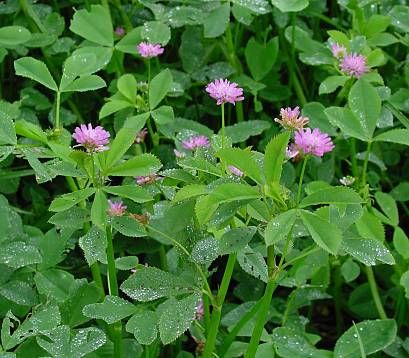
Persian Clover
Quality (energy, protein and digestibility)
Persian Clover
Grazing trials at Katanning have shown that saltbush alone is of limited value because high salt concentrations reduce the dry matter intake and digestibility of the material. The quality of this material may vary depending on the salinity of the site and the occurrence of rainfall that allows salt to be washed from the leaves.
The quality of the pastures can be improved by planting other grass and clover species in the inter-row. For example, puccinellia and tall wheat grass have higher digestibility, lower salt levels and higher animal intake than saltbush, but they are not high quality feeds. Balansa and Persian clovers have a higher quality even when dry. However, the salt content of balansa can be high and this will reduce sheep intake when it is grown on severely salt affected land.
Sheep meat production from unimproved saltland pastures (for example, halophytes and barley grass) is rarely high. At best these pastures will provide maintenance diets, certainly for young sheep, but usually these sheep lose weight on saltbush pastures. Improved saltland pastures with good balansa and Persian clover as a significant proportion of the mix will grow weaners at up to 100 grams per day (0.7 kilograms per head per week) over summer without supplementation. However, to do this the clovers need to be grown on areas with low salt levels in the soil, although these areas may be prone to winter waterlogging.
Economic returns
The returns from meat production on saltland pastures have not been well established and will vary from case to case. The best returns are likely to be obtained where substantial increases in stocking capacity are achieved through the conversion of very low performing land to land with a much higher production level and in the reduction of some supplementary feeding costs. Capital costs such as fencing and the provision of additional water points associated with the use of saltland pastures can often determine the profitability of these pastures.
Where high quality annual pasture and perennial grasses are a significant part of the pasture, returns from meat production are similar to that obtained on normal annual pastures. Michael Lloyd, a farmer at Lake Grace, estimated the gross margin for a wool enterprise based on a saltland pasture at about 75 dollars per hectare. It has been noted that there is a positive effect on the flavour of meat produced from sheep grazing saltland pastures. As a result of this effect, there have been attempts to market meat produced on saltland pastures as a high-value premium product. However, a significant and reliable market for this type of meat has yet to be developed.
Provision of good quality water
High levels of salt in saltbush pastures cause sheep to drink up to seven litres of water per day, twice the water consumption by sheep on low salt diets. This means that there needs to be a plentiful supply of good quality water when sheep are grazed on any saltland pastures.
Further reading
Barrett-Lennard, E.G. (1998). “Halophytes or plants for saltland”. Soil Guide. Department of Agriculture, Bulletin No 4646.
Barrett-Lennard, E.G. and Malcolm C.V. (1995).“Saltland Pastures in Australia – A Practical Guide”. Department of Agriculture, Bulletin No 4612.
Warren, B.E.; Casson, P.A. and Barrett-Lennard, E.G. (1995). “Value of saltbush questioned”. Journal of Agriculture, Western Australia 36: 24-27.



