 KEY POINTS
- Animal production is directly related to the quality and quantity of the pasture the animals graze.
- The estimation of ‘feed on offer’ (FOO) can be used as a guide to manage both pasture and animal production.
- For pasture, near-maximum seed production occurs when spring FOO exceeds 4000 kilograms dry matter per hectare. However, FOO of 1300 kilograms dry matter per hectare can provide enough seed to establish a good sub-clover pasture the following year.
- Near-maximum liveweight gain for sheep will occur when FOO is greater than 2000 kilograms dry matter per hectare. However, a FOO of more than 1100 kilograms dry matter per hectare will still provide some liveweight gain.
- Sheep growth is directly correlated to the digestibility of pasture feed.
- Digestibility decreases considerably as a pasture matures.
Keith Devenish, Department of Agriculture, Northam and Mike Hyder, Department of Agriculture, Albany
Introduction
Annual pastures are the most important source of feed in the Mediterranean environment of the agricultural region of Western Australia. They consist mainly of grasses, broadleaf weeds and legumes. These pastures play an important part in the farming system as a feed source for the sheep meat enterprise. Annual pastures can be divided into high value green feed and lower value dry feed.

Dry barley grass has a very low digestibility and feed value over summer.
Dry barley grass has a very low digestibility and feed value over summer.
Digestibility
Digestibility is the most important characteristic of annual pasture because this influences the amount that a sheep can eat as well as how fast it will grow. Digestibility, expressed as a percentage, provides a prediction of the proportion of the pasture consumed that is actually used by the animal. In winter and spring, the digestibility of green feed is high (70 to 80 per cent) but this value declines rapidly as pastures mature and dry off. Once digestibility falls below 50 per cent, even adult sheep will not be able to maintain their weight.
Green feed
The growth rates of young or adult sheep during winter and spring should be in the vicinity of 1.5 to 2.0 kilograms per head per week once there is ample green feed available (or until they reach their peak weight according to their age). The supply of green feed is often limited at the start of the growing season and consequently the growth rate for sheep is low. The slow growth of pastures during June and July can be attributed to low levels of light, a low leaf area index, waterlogging and frosts.
Sheep feed is usually in abundance towards the end of the growing season and during the traditional spring flush. At this time, growth rates of sheep are as close to the maximum as possible.
Both the quantity and timing of rainfall events are major factors affecting pasture production. However, soil type, fertiliser application, grazing management and pasture species can also have a big influence on pasture growth. A rule of thumb is that 20 kilograms of pasture (weighed dry) per hectare should be grown per millimetre of growing season rainfall. The length of the growing season,and hence the period of green feed, can also be influenced by the position in the landscape, the soil type and locality within each respective rainfall zone.
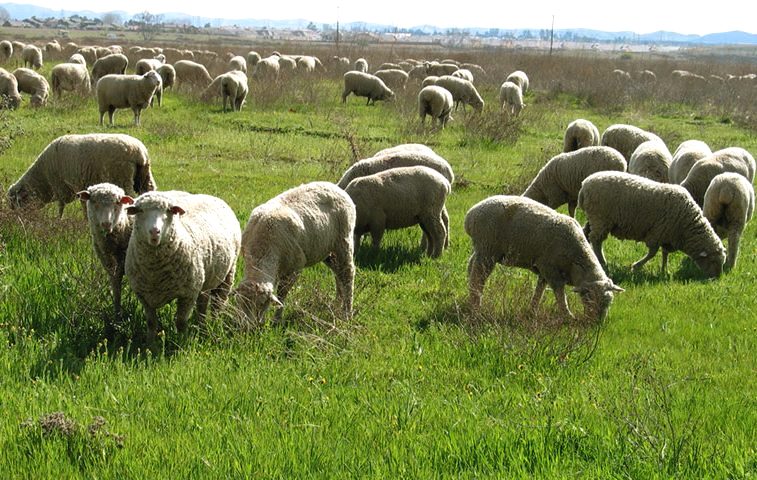
Merino ewes rearing sucker lambs on subterranean clover based annual pasture at Pingelly.
The major production of sucker lambs is usually matched to the winter and spring period by selling lambs straight off the ewes during the green feed season. These sales are usually between June and October, with southern areas producing suckers into November. Those animals not sold as suckers are then weaned and are often shorn. During this period they will require additional management as they begin to graze on dry pasture feed.
Dry feed
For young sheep, a dry annual pasture with about 50 per cent legume content can only provide growth rates of one to two kilograms per head per month for one to two months, because it is only slightly above a maintenance ration. The rate of growth for weaners can vary considerably from December to April with the digestibility of dry feed being the main influence on animal growth.
The dry residues of annual pastures like sub-clover, medic, and serradella, along with weeds such as ryegrass and capeweed, usually have a digestibility of about 55 per cent at the start of summer. This level can vary considerably and will decline over time, especially after rainfall. Dry feed with a digestibility below 55 per cent will at best only maintain liveweight and supplementary feeding with grain will be required to finish animals being produced for meat.The period of high quality pasture can be extended by spray topping pasture with a knockdown herbicide in spring.
Case example
The results from a summer grazing trial conducted at Perenjori in 1996/97 provide a good example of the limitation of dry feed for young sheep. In this trial crossbred weaner lambs in the control treatment grew at less than half a kilogram per head per week on a dry legume pasture (more than 80 per cent medic) from December to January. In this trial the quality of feed was good and had not been spoilt by summer rain. This result highlights the need to supplementary feed at this time to improve animal growth. Supplementary feeding in summer. If growth rates of lambs or weaners are to be maintained during summer on annual legume pastures, then supplementary feeding will be required. A high quality grain, such as lupins fed at 100 to 400 grams per head per day, will help produce a reasonable growth rate for meat sheep (one kilogram per head per week). Another strategy may be to feed less grain and maintain liveweight during this period until crop stubbles, such as those from lupins, become available.
Newly weaned lambs
Newly weaned lambs
Weaning lambs
For prime lamb production (after the sucker stage), the first major setback can occur if the lambs are weaned as pastures dry off. During this critical time, grain should be fed to at least maintain the weight of the weaners and eliminate the setback. Weaners should be pre-trained while still on their mothers to recognise whatever grain is fed as a supplement. This usually means trail feeding the ewes and lambs two or three times before weaning so that the lambs recognise the grain as a feed source.
Feed On Offer (FOO) an indicator for management
Grazing research has shown that estimating the amount of FOO is a useful indicator for the management of both pasture and sheep. It is expressed in kilograms of pasture dry matter per hectare. The technique of estimating FOO is a practical skill that can be readily learnt from a Woolpro or Prograze adviser (or livestock consultant) and can be used as a guide to predict sheep growth rates. Most of the work on FOO and sheep performance has been done with sub-clover based pastures.
The critical factor determining the production level of livestock grazed on pasture is the amount of pasture that animals are able to eat, otherwise known as intake.There is a range of FOO that can result in the desired intake and subsequent production for sheep. If FOO drops below a certain level, sheep are unable to consume sufficient pasture to maintain liveweight.
The Prograze manual suggests that once FOO is less than 1100 kilograms dry matter per hectare the rate of feed intake is reduced and sheep can only be expected to maintain weight or at best, make very slow weight gains (Table 1). Near-maximum feed intake for sheep occurs at around 2000 kilograms dry matter per hectare and there is no significant advantage allowing more than this amount of FOO for sheep.
Hence, as a general rule, the message is “2 tonnes of feed is all they need”.

Table 1. Prograze feed on offer (FOO) benchmarks for sheep (kg DM/ha)
Table 1. Prograze feed on offer (FOO) benchmarks for sheep (kg DM/ha)
Grazing management
Overgrazing of annual pastures in autumn can lead to a significant reduction in pasture seedling density, especially within the first 12 days after the break of season. As a result, the productivity of pastures during winter will be lower because there are fewer plants. For sub-clover pastures, grazing to a FOO of at least 1100 kilograms dry matter per hectare during spring will ensure enough seed is set for the next pasture season. Near maximum seed-set occurs when FOO exceeds 4000 kilograms dry matter per hectare.
To maximise the seed set of sub-clover, the options are to:
- defer grazing pasture at the break-of-season until FOO is at least 500 to 800 kilograms dry matter per hectare;
- maintain winter pastures between 1500 to 2500 kilograms dry matter per hectare FOO;
- de-stock pastures when dry FOO has decreased to 1000 kilograms dry matter per hectare in summer/autumn
For aerial seeded species such as medic, serradella, biserrula and other clovers (eg balansa, Persian, rose), similar management will assist in long term persistence. The most important issue is to reduce grazing pressure at the start of flowering until seed maturity. Reduced grazing pressure is mainly required when FOO levels are less than 2000 kilograms dry matter per hectare.
Seasonal variability in annual pasture growth
The pattern of feed supply in different rainfall zones is shown schematically in Figure 1. The timing of the break-of-season has a large effect on the supply and the total dry matter production in each season. The reduction in growth during June and July occurs largely as a result of a lower amount of light energy being available for photosynthesis as well as low soil temperatures. Pasture growth tends to increase during August with the availability of more light energy.
Under conservative stocking regimes, large amounts of high-quality FOO accumulate during spring. Up to 75 per cent is lost after ‘haying-off’ (senescence) due mostly to natural decay. In other words, very little is eaten by grazing animals and turned into wool or meat products. Using more of this spring “hump” by combining grazing management and conservation techniques is one way to improve the productivity of pasture systems in a Mediterranean environment.
The variation in the timing of the break-of-season results in different amounts of FOO during winter (compare the amount of FOO in Figure 2 after the break in 1993 with that in 1994). The FOOs peak at different amounts in spring and then sharply decline over the following summer and autumn periods. Often only a small percentage of the accumulated FOO at the end of spring is converted into meat or wool.
Grazing management to control insects
Redlegged Earth Mite
Redlegged earthmite (RLEM) and other pasture pests (bluegreen and cowpea aphid, lucerne flea, blue oat mite) can cause losses of up to 80 per cent of legume pasture seed if they are not controlled. This loss occurs when seedlings are killed early in the season and when flowers are damaged during spring.
Research has shown that grazing pastures to a FOO level of 1400 kilograms dry matter per hectare during spring reduces RLEM numbers considerably. The benefits from pest control in spring, whether by grazing management or correctly timed applications of insecticide (TIMERITE®, the Kondinin Group can provide information on this package), usually carry over to the following year.
Cropping
The adverse effects of cropping on pasture legume seed reserves are well documented. Seed loss after one year of cropping with relatively softer-seeded species such as sub-clover can be as high as 70 per cent while hard-seeded species such as medic and yellow serradella lose about 30 per cent of their seed reserves after one crop.
Sub-clovers are better adapted to longer pasture phases than medics. Medics and yellow serradella will persist better in intensive pasture-crop systems like the year-in year-out rotation.
Tactics for pasture management
There are a number of tactics that can be used during the season to manage the variation in the supply of pasture. These are described in the Woolpro or Prograze manuals, or alternatively you can contact your local Woolpro or Prograze adviser for more details.
Further reading
Hyder, M.W.; Thompson, A.N.; Doyle, P.T. and Tanaka, K. (1994). The effect of feed on offer during spring on liveweight change in Merino wethers of different ages. Proceedings of the Australian Society of Animal Production 20:255-8.
PROGRAZE Sustainable Grazing Manual.
WOOLPRO Reference Manual.



