Background information
The way a pasture is grazed has a major bearing on the species that survive and dominate. Grazing strategies can be developed to maintain the desirable species and optimise their growth rates. Different grazing methods can also be used in more of a tactical, or short-term way to manipulate the composition of degraded or weedy pastures, reducing the need for herbicides or costly renovation.
The way a pasture is grazed also affects how evenly nutrients in dung and urine are distributed and recycled throughout a paddock. Sheep camps can be minimised and maintenance nutrient requirements can be reduced with the appropriate grazing system.
Introduction
Understanding how the desirable species grow helps you plan a grazing system that will encourage these species to become more dominant. Likewise, knowing the weak spots in a weed’s lifecycle helps you plan grazing tactics to decrease their level in a problem paddock. For persistence, plants are most vulnerable during establishment and reproduction (flowering). For more information about matching plant growth and grazing management, see tool 7.5. For pasture assessment tips, see tool 7.6.
Establishing an effective process of grazing management is about tailoring the principles outlined in this procedure to meet your personal and business goals. There is no ‘right’ grazing management and considerable flexibility is needed to continually re-balance the needs of soil, pasture and animals.
Shoots and roots
Plants are genetically programmed to maintain a set ratio between their shoots and their roots. When leaves and stems are removed by grazing, the plant sheds root material to re-balance the ratio. So, short, continuously grazed grasses will have small root systems like those on the left of the photo in figure 7.3, while pastures that are grazed and allowed to recover look more like the plant on the right hand side.
Pasture rests
All perennial species will be more productive and persistent under grazing that includes rest periods between periods of grazing. Growth rates of annual grasses such as annual ryegrass can also be improved by rest but their persistence in a pasture obviously depends on seedset in spring, rather than survival of individual plants over summer.
Deferred grazing
Deferred grazing is a tactic where livestock are excluded from pasture areas after the autumn break to maximise germination and establishment of pasture seedlings. Sheep can be concentrated into ‘sacrifice’ paddocks or laneways and hand fed. Sacrificial paddocks should have low erosion risk and you may need to pay extra attention to animal health.
The length of deferment should be governed by pasture growth but, to be worth the cost and effort, grazing is best deferred until pasture has achieved at least 500 kg green DM/ha or, even better, 800 kg green DM/ha. Pasture residues after grazing The more green material (pasture residue) you leave after grazing the faster the regrowth, as photosynthesis is more quickly restored. During the growing season it is ideal to leave about 800 kg DM/ha (green material), but this is not always possible. If you cannot leave 800 kg/ha then place a higher priority on significant rest periods to encourage regrowth.
Seedling recruitment
Perennial ryegrass responds well to:
- Removing stock to allow the grasses to set seed in spring
- Running a big mob of stock in a paddock over summer to ensure the seeds are knocked to the ground and dead pasture is eaten off to 1,000–1,500 kg DM/ha, and
- Resting pasture after the autumn break to let new seedlings establish.
The exact tactics for other perennial grasses, including native species, are not so clear. As the soil seedbank contains few perennial grass seeds, allowing seed set will be necessary for recruitment of most perennial grasses. Trampling by sheep to encourage seed/soil contact may help, along with reduced grazing if seedlings emerge.
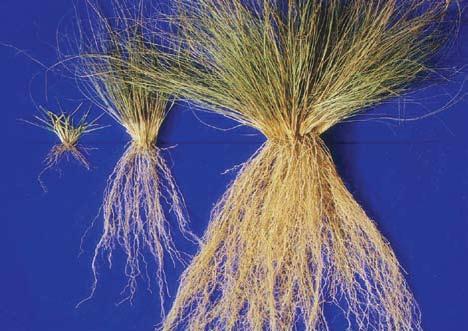
Continuously grazed grasses will have small root systems; the more pastures are allowed to recover from grazing, the larger and stronger the root system. Photo by Christine Jones
Continuously grazed grasses will have small root systems; the more pastures are allowed to recover from grazing, the larger and stronger the root system. Photo by Christine Jones
Key decisions, critical actions and benchmarks
There are three critical actions in this procedure:
- Assess your pastures to determine if your current grazing system is limiting the growth and persistence of desirable species. A number of pasture assessment techniques are described in tool 7.6. For mixed pastures (annual or perennial) based on introduced species, a good composition is: 60% desirable grasses, 30–40% clover and 0–10% weeds.
Note: for native grass-based pastures, the optimum clover content is 20% or less.
- Clarify the particular requirements of the species you have in your pasture, especially those that you want to increase or decrease and apply the appropriate grazing management as outlined in tool 7.5. Note: most pastures are quite complex mixtures of species, and individual compromises for each paddock will be required.
- Measure, manage and monitor the impact of your actions on pasture composition. Monitor and record paddock management actions and changes in pasture composition using the MLA Pasture Health Kit.
Ensure your actions, eg, changed grazing pressure, fertiliser rates, tactical herbicide use, etc, maintain or increase the proportion of desirable species in the pasture.
Read
Eight Steps to Successful Pasture Establishment: download your copy from the NSW DPI website:
http://www.agric.nsw.gov.au /reader/past-establishment
The MLA Pasture Health Kit: a field kit for producers to assess pasture health in the paddock. The kit can be ordered from MLA by:
- Calling: 1800 675 717
- Emailing: publications@mla.com.au
Ordering on-line:
- www.mla.com.au/publications
The Graziers’ Guide to Pastures (2003): sowing and managing profitable pastures in the Southern Tablelands, Central Tablelands, Monaro and the Upper South West slopes of New South Wales. Download a free copy from the NSW Department of Primary Industries website: http://www.dpi.nsw.gov.au/aboutus/resources/majorpubs/guides/graziers-guide-pastures
Perennial Pastures for Western Australia, 2007: covers all perennial options from herbaceous legumes to temperate and sub-tropical grasses, herbs, fodder shrubs and saltland pastures
Download the order form from the DAFWA website: http://www.agric.wa.gov.au/content/past/dsc_chapter_1.htm
Evergreen Farming: a WA farmer group showing that perennials can substantially increase farm profitability and also combat water-logging, salinity and erosion. Visit their website at: http://www.evergreen.asn.au/
Species for Profit: will help you choose the most appropriate species and cultivars for your specific site, for pastures, forage or cash crops. Download a copy from the Department of Primary Industries, Water & Environment (DPIWE), Tasmania at: http://www.dpiw.tas.gov.au/inter.nsf/Publications/CART-6NA5S2?open


