When you conduct a live body condition scoring, you are making an assessment of fat reserves
Condition scoring is important in all aspects of goat management, but especially so in the breeding of does. Does with condition scores of between 3 and 4 are more likely to get into kid, conceive earlier and conceive twins. Condition scores of between 3 and 4, when giving birth, allow the doe to kid more quickly, produce a healthy, active kid and produce more milk for the kid.
The body condition score of a live goat is a good indication of carcase conformation. If the live goat has a high condition score (tissue depth), the carcase will generally have more meat. The ‘expensive’ cuts will be heavier.
To determine the condition score, you feel the grid reference (GR) site of the goat. This point is located 110millimetres from the backline along the second-last long rib. The condition score relates to the tissue depth (in millimetres) at the GR site.
It is important to get practice in condition scoring and to monitor your scoring accuracy by comparing your results with the corresponding measurements for carcases.
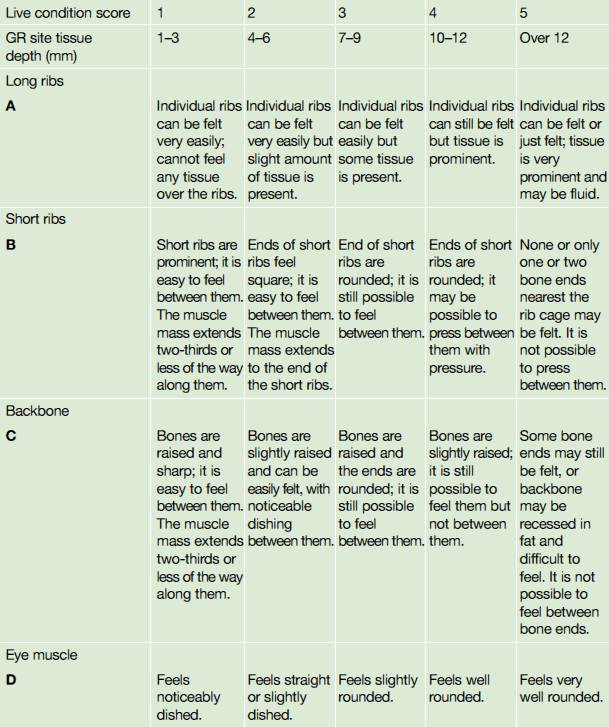
This chart describes the five different condition scores of goats, as seen from the side of a live goat and from behind a live goat. For each of the five condition scores, it also illustrates a crosssection of the eye-muscle area on a carcase.
The table also gives further information on what to feel for when condition scoring. The live condition scores assigned in Australia are from one to five. Refer to the diagram to locate the positions on the goat indicated by A, B, C and D in the first column of the table.
Condition scoring of goats.