 This article will assist you to identify and manage the following health problems that can afflict goats.
Liver Fluke, C.A.E.V. – Caprine arthritis encephalistis virus (big knee), Coccidiosis, Yersinia, Lameness, Mastitis, Urinary calculi (kidney stones), Pink eye/conjunctivitis, Mange, Scabby mouth, Milk fever (hypocalcaemia), and Grass tetany (hypomagnesaemia).
It provides details of the prevailing conditions under which each problem is likely to occur, explains how to diagnose the problem, and lists preventative management strategies.
Definitions;
Chronic – a condition which has been affecting an animal for a long time, constantly recurring.
Clinical – the form of a disease where the animal is displaying obvious symptoms.
Acute – severe form of a disease.
For information on nutritional disorders such as bloat, grain poisoning and vitamin and mineral deficiencies, see article Goat Nutrition.
(The information presented here should only be used as a guide. For specific diagnosis, treatment and management advice speak to a veterinarian.)
Liver fluke
Conditions when likely to occur:

liver fluke
• Previous history of liver fluke on the property.
• There are many farms where infection is not recognised, yet it is causing production losses. A blood test is required to detect antibodies in combination with faecal egg counts.
• Presence of fluke snail (Lymnaea tomentosa) on the property.
• Liver fluke reside in wet areas. Grazing access to springs, swampy areas, water courses, coastal areas and irrigated pastures presents a risk.
• Acute fluke disease usually occurs from early summer to late autumn.
• Chronic fluke disease can occur any time, but typically late summer to winter.
• If no effective control program is in place, clinical disease is more likely. In this case, animals may not show any obvious symptoms. Deaths may occur,and production will suffer.
Diagnosis:
• History of fluke on the property – identification of problem paddock(s).
• Clinical signs: bottle jaw, scouring, weight loss. General ill-thrift, which may include reduced production and uality of milk, lower growth rates and lower feed-conversion rates in growing goats.
• Autopsy: fluke in liver, haemorrhagic tracts in the liver caused by migration of immature flukes.
• Blood biochemistry: Liver enzyme – evidence of immature fluke causing damage to liver.
• Faecal egg counts indicate presence of adult fluke – in young animals this occurs at least 12 weeks after fluke are picked up from forage.
• Abattoir surveillance and feedback on the prevalence of liver fluke.
Preventative management strategies:
• Chronic fluke: Strategic drenching with triclabendazole in late autumn and early winter to kill all fluke picked up over summer and autumn. Early spring treatment to remove adult infections missed by the autumn/winter treatment. This will prevent contamination of snail habitats for the next year.
• Acute fluke: Early drenching with triclabendazole may be required.
• New stock: Drench with triclabendazole if risk assessment indicates likely infection.
Caprine arthritis encephalitis virus C.A.E.V.– (big knee)
 CAEV is a nationally notifiable disease in Australia; see article Goat Industry Obligations.
Conditions when likely to occur:
• Widespread disease of dairy goats.
• All goats can become infected if fed on infected goats’ milk.
• Transfer is from infected doe to kid through colostrum and milk.
Diagnosis:
• Clinical signs: In kids 1-4 months of age – initially the kid will have a defective gait which develops into a marked hind-limb paralysis, and leads to death.
• The big knee or arthritic form starts as a swelling around the knee joint. Further damage causes swelling and pain leading to lameness. The goat will display a proppy gait.
• Blood testing is available.
Preventative management strategies:
• There is no known treatment for this infection.
• Where CAEV has been diagnosed in a herd, separate kids and does at birth. Do not allow kids to suckle from their mother. Raise them on cows’ colostrums/artificial colostrum and milk.
• The kids must be kept absolutely separate from adult goats. Double fencing is recommended. Planning and careful scrutiny are required to avoid contact with infected animals.
• The disease is mostly found in dairy goats, but all breeds are susceptible.
• Source goats from reputable suppliers, whose CAEV status is declared. Most dairy goat studs are on a CAEV control program and regularly blood test their stock.
Coccidiosis
Conditions when likely to occur:
 • Most common in young goats.
• Can occur during periods of stress, most commonly at six weeks of age and weaning.
• Goats can develop immunity with age. However, this can breakdown under stress.
• Close confinement of does and kids in warm damp conditions will encourage the spread of the disease.
• Goats become infected by consuming coccidial eggs while grazing. Does shed very large numbers of eggs in dung after kidding.
Diagnosis:
• Clinical signs: bleeding into the gut. Anaemia evidenced by pale membranes in the eyes and mouth, pale skin and weakness.
• Foul-smelling, dark, profuse scouring, with or without blood in the faeces.
• Often confused with worm burden, but does not respond to worm drench.
• A veterinarian would identify the disease by examining dung samples.
Preventative management strategies:
• Most adult goats have some coccidia present in their gut which have the potential to cause infection.
• Avoid subjecting goats (especially kids) to stressful situations or damp confined areas.
• If there is a high risk of coccidiosis, feed does prior to and immediately after kidding, with coccidiostats. This should be reinforced at weaning by feeding kids with supplements containing coccidiostats.
• If a disease outbreak occurs, treat all kids with a product recommended by your veterinarian.
• If you suspect worms, but animals continue to scour after drenching, consult a veterinarian for an accurate diagnosis of the problem. Examination of dung samples by a veterinarian will enable differentiation between worm resistance, drench ineffectiveness and coccidiosis.
Yersinia
Conditions when likely to occur:
 • Tends to occur in late autumn and winter.
• Birds and rodents are considered reservoirs of infection.
• Has been linked to stress caused by shearing, transport, inadequate feeding, cold wet weather and inadequate shelter.
• Young goats, one to six months, are most at risk, but all ages are susceptible.
Diagnosis:
• Characterised by foul-smelling green or dark brown diarrhoea, depression, lack of interest in food and high temperature.
• Autopsy: difficult to diagnose, gut lesions with intestinal micro-abscesses.
• With early diagnosis, infected goats respond well to antibiotic injections.
Preventative management strategies:
Provide shelter and adequate nutrition in late autumn and winter. It is unlikely to occur in mature, well-fed, nonstressed goats, which have adequate shelter.
Lameness
Examples:
Footrot, foot abscess, bruised sole, wounds, Laminitis.
Conditions when likely to occur:
• Footrot spreads in warm, damp conditions in autumn and spring and in irrigation areas. High stocking rates and frequent yarding will aid the spread of footrot.
• Foot abscess usually follows injury to the foot, eg penetration by grass seeds.
• Bruised sole can be caused by rocks and other hard, protruding objects.
• Wounds can be caused by wire fences, stakes, tree branches, etc.
• Laminitis can result from over-feeding on grain, or changing the diet to a lush type of herbage.
• Bone fractures: kids and aged goats are more prone to fractures.
Diagnosis:
Footrot
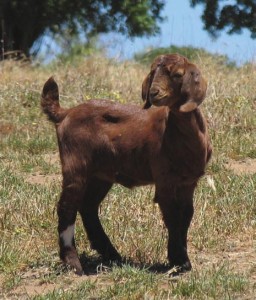 • Usually affects more than one foot.
• No swelling.
• No pus discharge, but a black-grey slime-like substance may be present.
• Heat may be present in some cases.
• Lesions have a putrid odour and may be fly blown.
• Spreads rapidly throughout all ages including kids, in damp, warm conditions.
• No break in the coronet skin, but separation of the inner sensitive horn and outer hard horn.
Foot abscess
• Usually only infects a few goats rather than the herd.
• Swelling – usually spreading the toes.
• Cream-white pus discharge, hot to touch, slight odour.
• Abscess usually breaks out at the coronet or in the interdigital skin.
Bruised sole
Animal will display lameness. No sign of pain in the leg, only in the sole of the foot.
Wounds
Obvious physical damage. Wounds require cleaning and, if severe, may require an antibiotic injection.
Laminitis
• Identified as redness and pain when pressed around the coronet, swelling may cause the coronet to bulge out.
Preventative management strategies: Footrot
 • Footrot in goats is the same disease as in sheep and research has shown that it can be transferred from goats to sheep and from sheep to goats. If running a mixed enterprise, control and treatment strategies must be coordinated across species.
• Avoid predisposing conditions for Footrot (this will also help to prevent other foot conditions):
- Wet, muddy and badly drained pastures.
- Wet muddy yards.
- Overgrown hooves.
- Warm, moist environment.
- Overcrowded conditions.
- Introduction of infected goats.
- Infected goats should be isolated and treated separately.
• Vaccinating the herd as a preventative is an option, but should be discussed with a veterinarian before proceeding.
Mastitis
Conditions when likely to occur:
• Milk production places a lot of physiological stress on the doe and her udder.
• Infection is likely to result from poor hygiene (mud, manure and urine), and lack of care for the udder, or physical damage to the udder.
• Dairy goats can also be infected if the drying-off process at the end of lactation is mismanaged.
• Mastitis can occur in extensive situations (non-dairy) as well.
Diagnosis:
• Clinical signs: Swollen hard udder with watery or flaky milk, associated lymph nodes may be swollen.
• Detection: measure cell counts (leucocytes) of the milk.
• Control using teat dipping and by maintaining hygienic conditions.
• Responds to antibiotic treatment.
Preventative management strategies:
• Hygiene is very important:
- Avoid crowded muddy conditions.
- Provide clean pasture for kidding.
- Milk newly kidded does first.
- Avoid transfer of infection between udders on cups, cloths or hands.
- Teat dip or spray with a disinfectant product after milking.
 • Cell count regularly.
• Record production and investigate changes.
• Avoid injury to udders by:
- Removing sharp objects in paddocks, yards and sheds.
- Disbudding or dehorning.
- Allow adequate feeding space to avoid fighting.
- Trim feet.
• Cull if infection persists or frequently reappears.
Urinary calculi (kidney stones)
Conditions when likely to occur:
• In bucks and wethers.
• Mineral imbalance of calcium and phosphorus in the diet: eg. drinking highly mineralised water.
• Reduced water intake due to taste or temperature.
Diagnosis:
• Signs develop when the urethra is damaged and partially blocked.
• Frequent attempts to urinate. May dribble urine if blockage is only partial.
• Off its feed and withdrawn from the herd.
• Kicking at the abdomen in obvious discomfort.
• If the bladder or urethra bursts the animal will eventually die.
Preventative management strategies:
• Encourage stock to drink more water.
• Use ammonium chloride in the ration as a preventative.
• Formulate rations specifically for goats – cattle rations are not suitable.
Pink eye/conjunctivitis
Conditions when likely to occur:
• Damage to the eye while grazing tall grass, among seed heads or eating hay.
• Damage caused by dirt and dust.
Diagnosis:
 • Eye usually closed and weeping.
• Eye has a white appearance, progressing to a pink colour and rupture.
Treatment:
Treat with appropriate antibiotics after consultation with a veterinarian.
Preventative management strategies:
• Avoid grazing tall abrasive feed and seedy hay.
• Avoid walking stock in dusty conditions. Similarly, discourage stock from congregating in dusty conditions, especially at weaning.
Mange
This condition is uncommon in goats
Conditions when likely to occur:
Stress may pre dispose young animals to infection: eg. inadequate nutrition and trace element deficiencies.
Diagnosis:
• Small lumps under the skin, usually around the head, neck, shoulders and back. These lumps can be felt more easily than they can be seen.
• Intense itching.
• Skin scrapings may reveal the parasite. A microscope will be required to view the mites.
Preventative management strategies:
• Ensure that kids receive colostrum at birth and maintain good health. The reason for this is that kids with an immune deficiency are more prone to infection.
• Separate infected does from the kids.
Scabby mouth
Conditions when likely to occur:
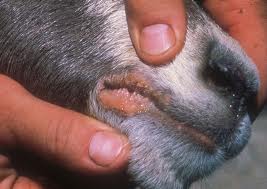
mouth lesion on goat
• The condition is the same as that which occurs in sheep.
• If there is a problem, it can occur on an annual basis. Tends to affect kids.
• Puncture wounds from grazing grass seeds.
Diagnosis:
Lesions on the lips, muzzle and coronet.
Preventative management strategies:
• Vaccination.
• Avoid any stress to young stock.
Milk fever (hypocalcaemia)
Conditions when likely to occur:
Does that are just about to or have just given birth, are at risk because blood calcium levels may drop as colostrum is produced.
Diagnosis:
• Muscles trembling. Eventually the animal will be unable to stand.
• Lying down with head turned back on to the side.
• Cold extremities.
Treatment:
Injection with calcium borogluconate under the skin.
Preventative management strategies:
• Provide pregnant does with feeds that are low in calcium, such as grass hay, to encourage the mobilisation of calcium from the skeleton.
• Avoid feed such as lucerne and licks that are high in calcium, up to a month before kidding.
• After kidding, give does access to high calcium diets such as lucerne or clover hay.
• Avoid any practices that will put does off feed around the time of kidding.
Grass tetany (hypomagnesaemia)
Conditions when likely to occur:
 • Not common in goats.
• Associated with lactating does given access to lush pasture that is low in legumes and other magnesiumcontaining plants.
• Transportation can cause stress and onset of the condition.
Diagnosis:
• Staggering gait.
• Lying on the side.
• Twitching muscles and ears, movement of the eyeballs.
• Convulsions and foaming at the mouth.
• Coma and death.
Preventative management strategies:
• Avoid feeding lush pasture to does if they are unaccustomed to it.
• Avoid stress or change, such as a period without food.
• Supplement at-risk does with Epsom salts or another magnesium source.


