 Nutrition is about understanding what and how much to feed your animals. To plan your feeding program, you need to define three key things:
1. Know what product you want to produce.
2. Know the nutrient requirements of your stock. These will vary with; physiological state, age, performance level, class of animal, and climatic conditions – temperature, windchill and frost.
3. Know your feed resource and how it grows; feed quality and quantity, of the regeneration time of specific plants (required rest periods) and the maximum and minimum heights/quantities of plant material to optimise plant and animal performance.
Know what product you want to produce.
Describe the type of goat that you are aiming to turn-off the property, including; liveweight targets, expected growth rates, and condition score targets.
 Other profit drivers that can be influenced by nutrition are:
-
Fertility; the incidence of multiple births increases with liveweight of the doe; a rising plane of nutrition prior to the commencement of joining will increase ovulation rates.
-
Maintenance of pregnancy, especially in the last 6 weeks. Goats can abort their kids to save themselves if put under stress from lack of feed. When you have decided all the above, you can commence your annual feeding program plan.
- Birthweight; the nutrition provided to a doe in late pregnancy will have a strong influence on the birthweight of her kid(s).
- There are severe penalties for over-fat livestock. Feed on offer to animals destined for slaughter should be carefully managed to ensure that market specifications are met.
- Kid survival; the mortality of newborn kids is directly affected by birthweight and milk supply, both of which are influenced by the nutrition of the doe.
Know the nutrient requirements of your stock.
In addition to maintenance, nutrients are required for growth, activity, pregnancy, lactation and changes in body condition. Extremes of weather can also increase nutrient demand as the animal tries to deal with excessive heat or cold.
The basic dietary components are:
- Water.
- Energy.
- Protein.
- Fibre/roughage.
- Vitamins.
- Minerals.
Like all livestock, goats need quality feed to perform well.
Water
Both quantity and quality of water have an impact on stock performance. The amount of water a goat needs to drink depends on:
- Physiological state; lactating, dry.
- Production levels; for a dairy goat as milk production increases, so too does water requirement.
- Activity levels.
- Environmental conditions.
- Diet; dry feeds and salty feeds increase water requirements.
- Water quality; as salt levels increase stock may require more water.
- Availability of shade and shelter.
Water requirements and salinity tolerances.
* The above requirements for water consumption could double if the temperature exceeds 40ºC. * * When fed diets with salty plant material such as saltbush (Atriplex spp), blue bush (Maireana spp) or copper burr (Scerolaena spp) the maximum salinity tolerances should be reduced by 30%.
The figures in the table above are for goats on a dry feed diet (dry pasture, grain or hay). Actual stock water intake varies as the moisture content of the pasture increases, stock then get more of their daily water requirement simply from the food they eat, and hence require less actual drinking water. For example in winter, when conditions are damp and pasture is lush (often up to 85% moisture) stock can get a large proportion, if not all, of their water requirement from the pasture they eat. Whereas, in mid-summer when the atmosphere is dry and pastures are dry (35% or less moisture content), stock will need to drink more frequently and greater volumes of water to meet their needs.
Poor water quality can have a negative impact on water intake and stock performance. Physical, chemical and biological factors affect water quality.
- Physical – sediment/turbidity.
- Chemical – salinity, mineral content, acidity/alkalinity, chemical residue.
- Biological – algae and bacterial.
 Poor water quality will often reduce water intake levels, which in turn reduces stock performance. Chemical imbalances can be toxic. Minor toxicities will reduce stock performance and, in the extreme, can lead to illness and even death. Similarly, biological agents can produce harmful toxins eg blue green algae. In some cases, diseases can also be carried in water and spread on consumption.
If unsure of the quality of your water supply, have the water tested. Many water authorities and government depts. of agriculture have some capacity to test water quality. Alternatively there are private companies which specialise in the provision of water testing services.
Energy and protein
The nutrients required in the largest quantities are energy and protein. The energy component that ruminants use is referred to as metabolisable energy (ME), and is measured in terms of megajoules (MJ). You will often see this written as megajoules of metabolisable energy (MJME). The main protein component that is of interest is crude protein. It is measured in grams, but is also often referred to in terms of a percentage (%CP).
One of the advantages of the Australian goat production system is that it is foragebased. Green pasture and shrubs are generally well-balanced in terms of their energy, protein, fibre, vitamin and mineral contents. The limiting factor is more likely to be the quantity available, rather than the nutrient balance.
Energy and protein requirement tables.
Information for these tables was sourced from: McGregor, B. (2003). Nutrition of goats during drought. Rural Industries Research and Development Corporation. Greenwood, P. (1992). Dairy Goats: Nutrition. Agfact 7.5.5. New South Wales Agriculture.
Maintenance requirements.
NB: the above figures are for goats in confined areas ie. minimal activity.
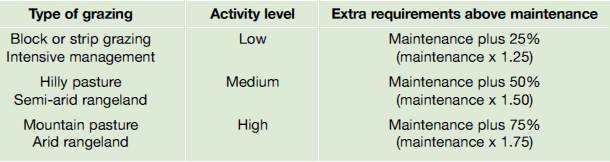
Activity requirements.
Pregnancy requirements.

Milk Production requirements.
Assuming an average lactation length of 12 weeks, with a doe producing an average of 1.5 kg milk/day with a milk solids test of 9.5%. If you are a dairy producer, you may require figures for a range of production scenarios. The article Goats - further information sources lists some useful references that are dairy-specific.
Growth requirements.
Severe weather requirements.
If conditions are cold, wet and windy, extra energy will be required by the goat to keep warm. Under such circumstances, energy allowances should be doubled.
To match the energy and protein requirements with appropriate feeds refer to the article Nutritive Value of common goat feeds. When formulating a ration it is important to consider how much a goat can physically consume. Maximum intake is related to body weight. A goat can physically only eat about 3.5% of its body weight each day. The actual amount largely depends on the quality of the feed offered. Example: to provide the nutrients required to maximise the performance of young kids it is recommended that the quality of the feed ration be at least 10MJME/kg DM and 16% crude protein. If the feed is of lower quality, the kids physically cannot eat enough to meet their needs.
If you are more familiar with dry sheep equivalents (dse) figures, you may find the article Dry Sheep Equivalents - DSE - for goats useful. NB: 1 dse requires 7.6MJME/day.
 Fibre/roughage.
Fibre is particularly important in the diet of lactating does, does in late pregnancy and young kids (prior to and post weaning). It is also important to supply roughage if feeding a high starch diet eg grains.
In a lactating doe, one of the by-products of the fibre digestion, acetic acid, promotes the production of milk fat (butterfat). Fibre/roughage should make up at least 30% of the doe’s diet during lactation.
Does late in their pregnancy require roughage in the diet to promote the mobilisation of the body’s reserves of calcium in preparation for lactation, when the demand for calcium often outweighs that which is able to be supplied in the diet.
For young kids approaching weaning and after weaning, fibre is essential to aid rumen development.
High grain diets, such as those fed during periods of feed shortage, can cause digestive upsets. When high-starch feeds such as grains are digested, acids are produced as a by-product. Excessive acidity in the rumen can cause problems such as acidosis or ‘grain poisoning’.
Chewing fibrous material stimulates the production of saliva which contains natural buffering agents, thus combating rising acidity levels. It is recommended that the ratio of concentrates (grain or pellets) to roughage should not exceed 2:1.66 .
Fibre is slow to break down in the rumen. The breakdown of fibre does supply some energy. Too much fibre in the diet can actually restrict intake, which can be undesirable if the animal has high energy requirements, such as for growth, lactation or gaining condition. The key is to provide a balanced diet.
Vitamins and minerals.
In comparison to energy, protein and fibre, vitamins and minerals are usually only required in relatively small amounts. If goats are being fully fed on high-quality green pasture and browse, their requirements for vitamins and minerals are probably being sufficiently met. Given a choice of feeds, goats will seek out what they lack.
However, there are some circumstances where extra supplementation may be required, such as if quality forage is in short supply, large quantities of supplementary feeds are being used, or where there are deficiencies in the plant material being fed. In some cases, excessive levels of particular vitamins and minerals can cause toxicities.
How do you know if your enterprise is affected by vitamin and mineral deficiencies/toxicities?
- Familiarise yourself with the symptoms and monitor stock performance. Information about mineral deficiencies can be found in the article Goats - Nutritional Disorders.
- Seek advice from a veterinarian or animal nutritionist. Blood tests may provide some indication of deficiencies and toxicities.
- Soil and/or plant tissue tests can provide additional information about the mineral status of the feedbase. Seek an independent analysis of the results.
- Local knowledge can be very useful, as mineral deficiencies are often very specific to a particular location, related to soil type and particular types of plants. See article Trace Element deficiencies, Australia.
- Goats attacking trees may be looking for a mineral that is lacking in the pasture at the time.
If vitamin and mineral supplements are required there are many forms in which they can be supplied eg licks, injection, drenches, rumen boluses and pellet or powder form. Seek further advice from a veterinarian or nutritionist on the most appropriate form for your circumstance.
Changing diets.
When changing diets, there is often an adjustment period, during which time, some weight loss may occur. If managed correctly, this weight loss will be quickly recovered once the goat has fully adjusted to the new feed source. It may take some time for the goats to become accustomed to the taste, smell and texture of new foods.
The rumen microbes also need time to adapt to dietary changes, because it is these microbes that facilitate the digestive process. Some microbes are quite specific in the type of foods that they break down eg some break down sugars, some use starches, others are cellulose-specific.
Different microbes also have different tolerances in terms of acidity levels in the rumen – acid is a by-product of the digestion of carbohydrates. Therefore, the make up of the microbial population fluctuates depending on the rumen conditions and the feed source. When the diet changes, there can be a reduction in the efficiency of digestion, whilst the relative numbers of the different types of microbes adjust to suit the feed source.
When introducing new feeds to the diet, it is recommended that the changes are made gradually to ease the adjustment process. This means starting with small quantities of the new feed and slowly building up the amounts toward the desired intake. This process can take 2-4 weeks depending on the types of feeds being used. The higher the starch content and the lower the fibre, the slower the introduction required.
With high-starch feeds, such as grains and pellets, you may also consider incorporating buffering agents into the diet. The byproducts of starch digestion are acidic. Buffering agents act to balance the acid production and maintain appropriate pH levels in the rumen.
Your management of dietary change is critical. The costs of getting it wrong can be reduced intake, reduced production levels and/or health problems, such as acidosis or grain poisoning. For more information on nutritional disorders refer to the article Goats - Nutritional Disorders. For information on introducing goats to feedlot diets, refer to article Feedlotting Goats.
 Buying supplements.
When buying supplements be clear about the type of nutrient(s) that you are trying to source. You need to know your most limiting factor. Are you sourcing either energy, protein, fibre or a combination of these ingredients?
The next step is to understand the feed quality of the product that you are buying. The article Nutritive Value of common goat feeds can provide you with some information about the average nutritive value of some of the more common goat feeds. However, within a particular type of feed there can be wide variation between different sources, so the only way to get an accurate figure is to request a feed analysis on the feed that you are purchasing. Many fodder suppliers are now routinely supplying this information with their products.
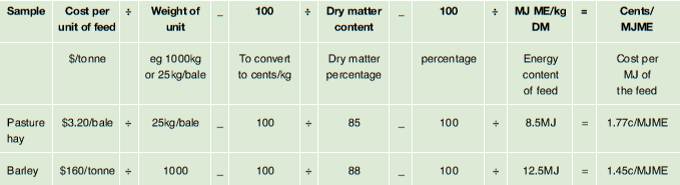
In terms of getting value for money, buy the product that supplies the nutrient you require at the lowest price. Products with differing nutrient levels and prices can be compared by calculating the price in cents per unit of the nutrient. For example, if you are buying an energy supplement, calculate price in cents per megajoule. If you want protein, calculate in cents per gram of protein. All calculations should be done on a drymatter basis. The following table shows how to do this calculation for energy supplements.
Comparing the cost of energy supplements – calculating the cost in cents/MJ of various feeds
It is advisable to request a Commodity Vendor Declaration or relevant documentation when buying feed to prevent chemical residue contamination. For more information on stockfeed declaration forms refer to the Quality Assurance section in the article Goat Industry Obligations.


