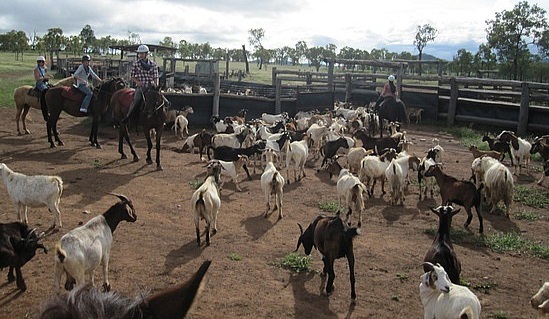
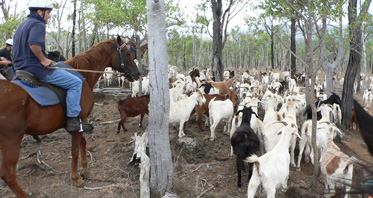
 Mustering and moving stock from the paddock to the yards must be achieved with minimum stress on the stock and the operator. Animal and operator health and welfare are the prime concerns; however, this operation can have an impact on animal performance and meat quality.
The main principles of stock handling are understanding the flight zone, the point of balance of the animal, and the behaviour of the animal. These factors can be used to advantage to help move stock from a large open area into yards. Move animals in a calm and orderly manner and minimise noise and pressure. Moving animals in yards requires the same principles and well designed yards to assist the flow through gates, race and draft.
Reduce stress.
Goats will be stressed by:
• Confinement
• Exposing them to different stockhandlers
 • Strange noises
• Smells
• Fighting
• Overly forceful, loud or agressive dogs
• Cold/hot weather, change in the weather
• Handling/management procedures
• Time off feed and change in feed
• Time off water and change of water
• Transportation
All of these stressors can be experienced on the farm but they become even more stressed as they move down the marketing chain eg transporting long distances, saleyards and abattoirs.
The end result of stress is shown as bruising, losses in carcase weight and reduced carcase quality. Dark cutting meat is often the result of stress on the live animal.
Stress due to mustering has been reduced by using the Total Grazing Management (TGM) mustering system. More information on this system is on the Western Australian Department of Agriculture web site (see address in the article Goats - further information sources ).
“The goats should not be in the trapping yard for more than 48 hours. They should be drafted and the sale goats removed to the main holding and feeding area.” Will Scott, Mt Magnet, Western Australia.
For information on feedlotting goats, refer to the article Goat Nutrition.
This topic has been covered in a number of publications by Temple Grandin, Livestock Handling Systems. Inc, Colorado State University, and a number of publications are available. See the article Goats - further information sources for the titles and the web address for more information.



