 There are a number of potential husbandry activities that can be undertaken in a goat enterprise, but they may not all be relevant to your goat enterprise. To give you an understanding of what might be involved, this article is divided into two parts:
Extensive Grazing Husbandry Activities – an example is provided of a goat husbandry annual cycle for an extensive goat enterprise. This example takes a very minimal, but achievable approach to animal husbandry.
Intensive Grazing Husbandry Activities – an example is given of a goat husbandry annual cycle for an intensive goat enterprise, including a comprehensive list of activities and issues to consider.
You may find that the husbandry activities required for your goat enterprise fall somewhere between the two examples presented; so tailor your annual cycle to suit the needs of your enterprise, considering practicalities such as;
• Matching husbandry activities with the pattern of your annual pasture/fodder supply.
• Spreading activities to suit your labour supply.
• Achieving balance with other enterprises on the property and other commitments in your life. For example, avoid timing clashes between labour-intensive activities.
• Ensuring that husbandry activities are timed with due consideration for animal health and welfare. For example, avoid mustering heavily pregnant animals and does with newborn kids.
Physiological facts.
In the annual cycle of goat husbandry, many of the management issues have a physiological basis. This table highlights some of the basic facts of goat physiology.
 Goat handling.
Successful handling of goats requires an understanding of the behavioural patterns of the animal. Goats are naturally intelligent, inquisitive, agile, alert and of nervous disposition. It is advisable to minimise the stress on both goats and handlers.The following is a comprehensive list of behavioural characteristics and management tips for both intensive and extensive enterprises. Bear this in mind as you read this section and select those points that have relevance and practicality for your enterprise.
Capitalise on the goat’s intelligence. They are quick learners and respond well to routines.
Goats will tend to flock together, so it is easier to move stock as a mob rather than separating out individuals.
Goats will tend to follow. A quiet old doe or wether that is familiar with handling routines can be useful as a lead animal when moving young goats.
Do not rush goats; give them time to assess a situation. For example, at a gate, it is often better to wait a few minutes and allow the lead goat to find the opening and walk through, taking the others with it, rather than trying to force an unwilling mob.
Move the herd by controlling the lead animals. “Only move as fast as the slowest goat in the mob.” Will Scott, Mt Magnet WA
Avoid overcrowding in confined spaces. In yards, races and on trucks, goats will tend to crowd and pack together which can cause deaths from smothering. “If the yard looks full, then there are already too many goats in it – take out 50%.” Scott Morton, Cassilis, NSW.
Well-designed yards aid stock flow and prevent smothering. See article Goat Industry Infrastructure.
Quiet handling is essential. Do not put undue pressure on goats near fences, in laneways, yards or handling facilities. If put under pressure, goats will jump or climb to escape from the perceived threat.
Goats squeal when distressed, so it is advisable to wear ear plugs when handling goats especially when in confined spaces, such as at shearing.
In extreme weather conditions, avoid working with or transporting goats .
Changes to diet, water supply and handling routines can be very stressful, increasing the risk of weight loss and dehydration, and susceptibility to illness/disease. Any changes need to be carefully planned and, where possible, introduced gradually. For example, if stock are going to be moved into a feedlot prior to processing, the new diet needs to be gradually introduced prior to transportation to the feedlot. For more information on feedlotting goats, refer to the article Goat Nutrition.
When relocating goats, unload them at a water point or push/lead them to the water.
Goats not familiar with people need a bigger flight zone than domestic animals. “Low Stress Stock Handling” courses are available.
There are a range of mustering techniques that can be used in extensive operations, such as aerial mustering, vehicle mustering and water point trapping. For more information on mustering refer to the article Goat Mustering.
Behave in a calm and controlled manner – no sudden movements or loud noises. If using dogs, ensure that they are quiet and are not overly forceful in the way they move stock. Dogs should be introduced to goats slowly.
Speaking to goats while you work with them can have a calming effect.
Low stress handling has productivity benefits for your farming enterprise. Reducing stress will deliver benefits in terms of goat health and production on the farm, and better meat quality to the customer. Goats that experience high levels of stress prior to slaughter will have tougher, darker meat, which is often undesirable if targeting high-return markets that are focused on product quality. Pre-slaughter stress can lead to an increased incidence of salmonella.
Exensive Grazing Enterprise.
The annual cycle of goat husbandry comprises six distinct phases. For each phase key issues of concern are identified, their relevance explained and an appropriate management response outlined.
Extensive System - Birth
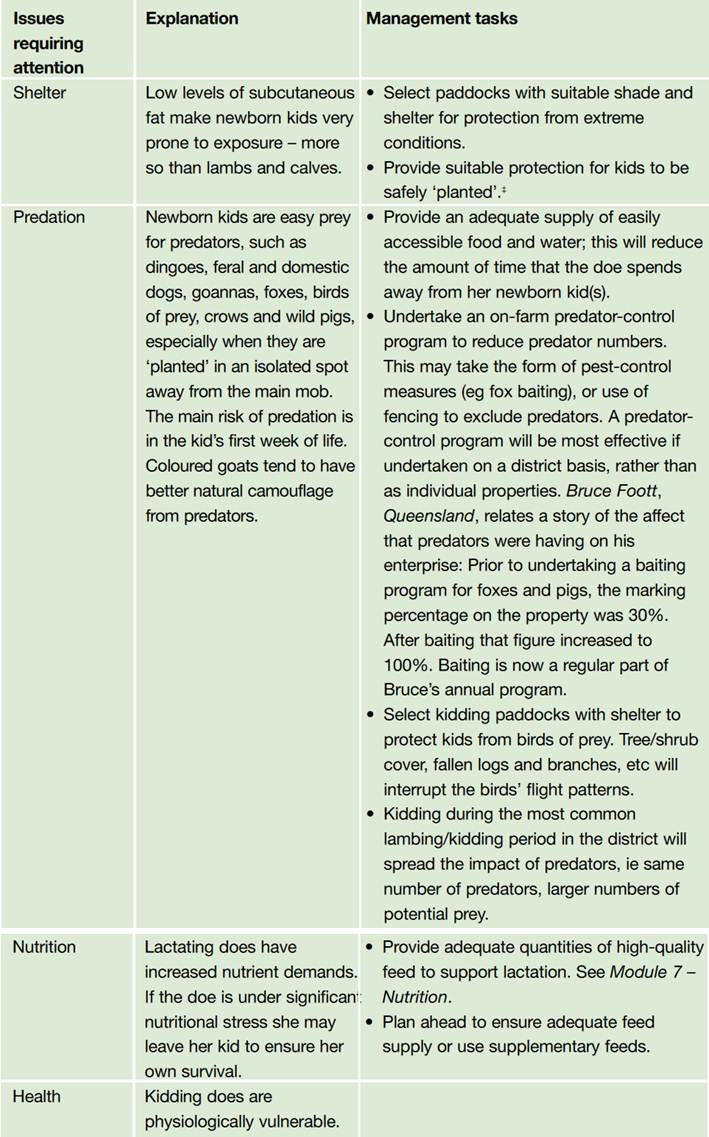 ‡ Planting – one of the natural instincts of a doe is to ‘plant’ her kids for the first few days after giving birth. The intent of the doe is to keep her newborn kid hidden and protected, away from the mob. The doe will then move off to seek food, returning regularly to feed her kid(s). The ‘planting’ site will be in a location which offers some privacy eg behind a log, in amongst tussocks, etc.
NB; Module 7 is the article Goat Nutrition
Extensive System - Lactating Does
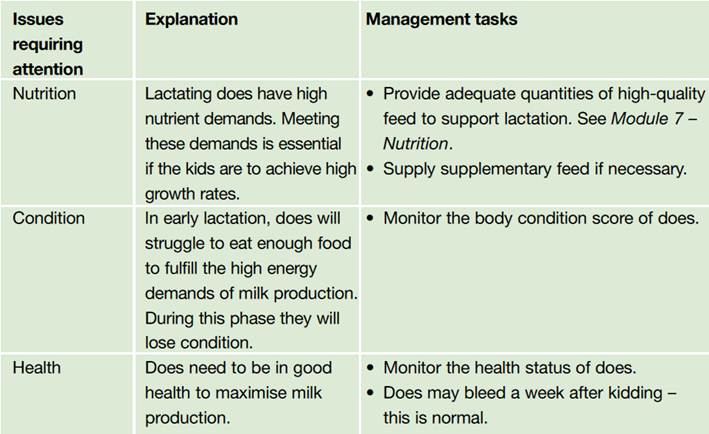
NB; Module 7 is the article Goat Nutrition
Extensive System - Young Kids
NB; Module 6 - Husbandry Toolkit 6 page 16 is the article Goat Growth rate and Mature weight tables
Extensive System - Weaning
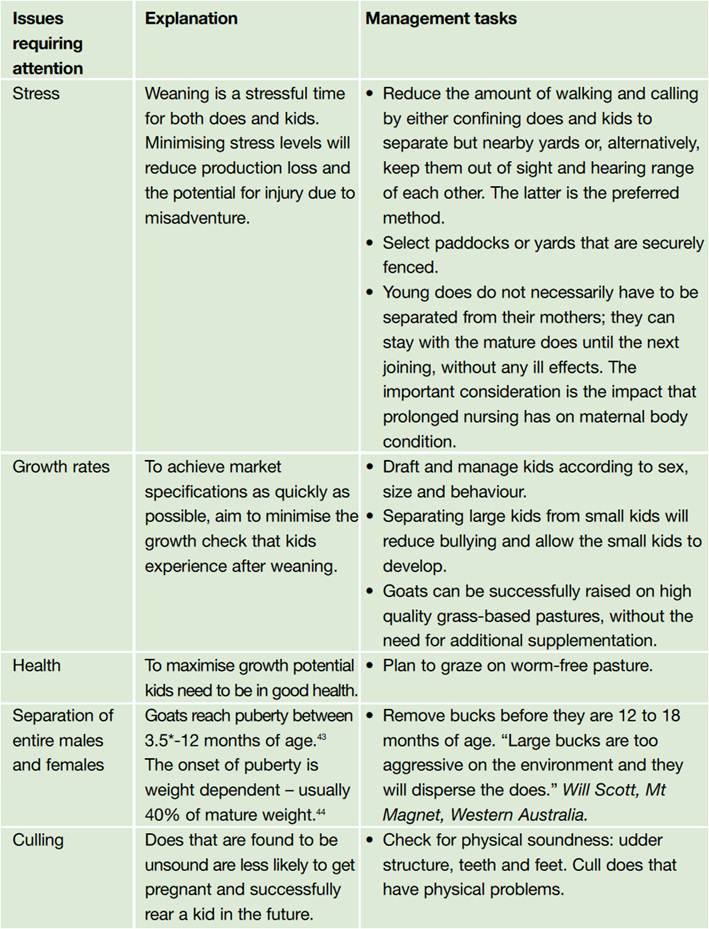
* Boer goats, dairy breeds and rangeland goats are particularly virile and can be potentially fertile from 3.5 months of age.
Extensive System - Growing Kids
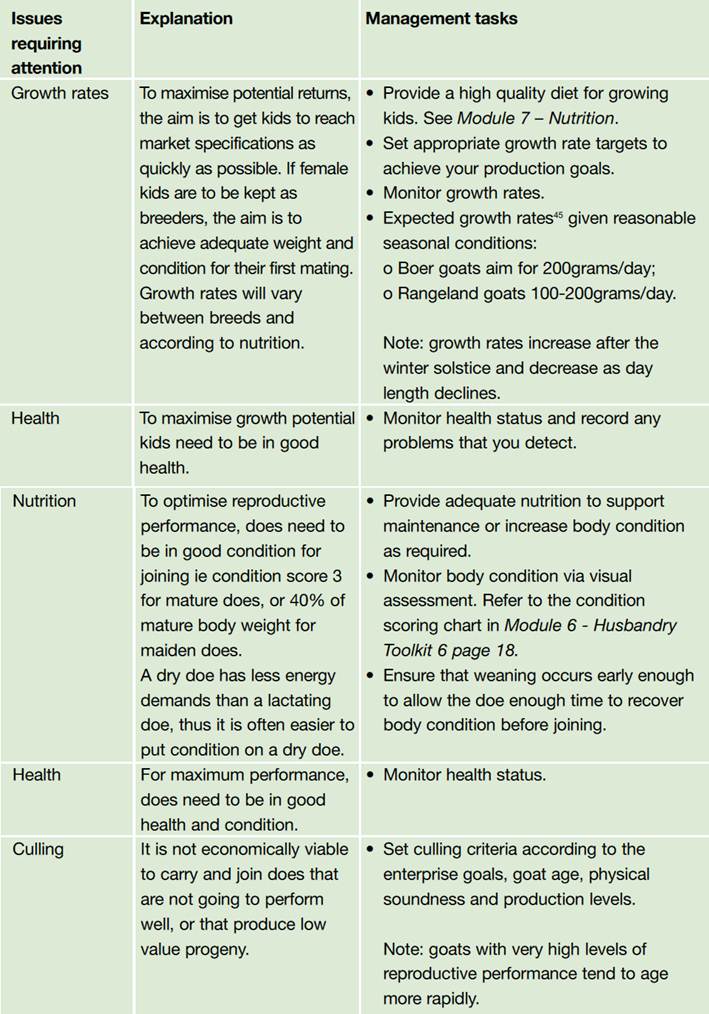
NB; Module 7 is the article Goat Nutrition,
Module 6 - Husbandry Toolkit 6 page 18 is the article Goats live body condition scoring.
Extensive System - Joining
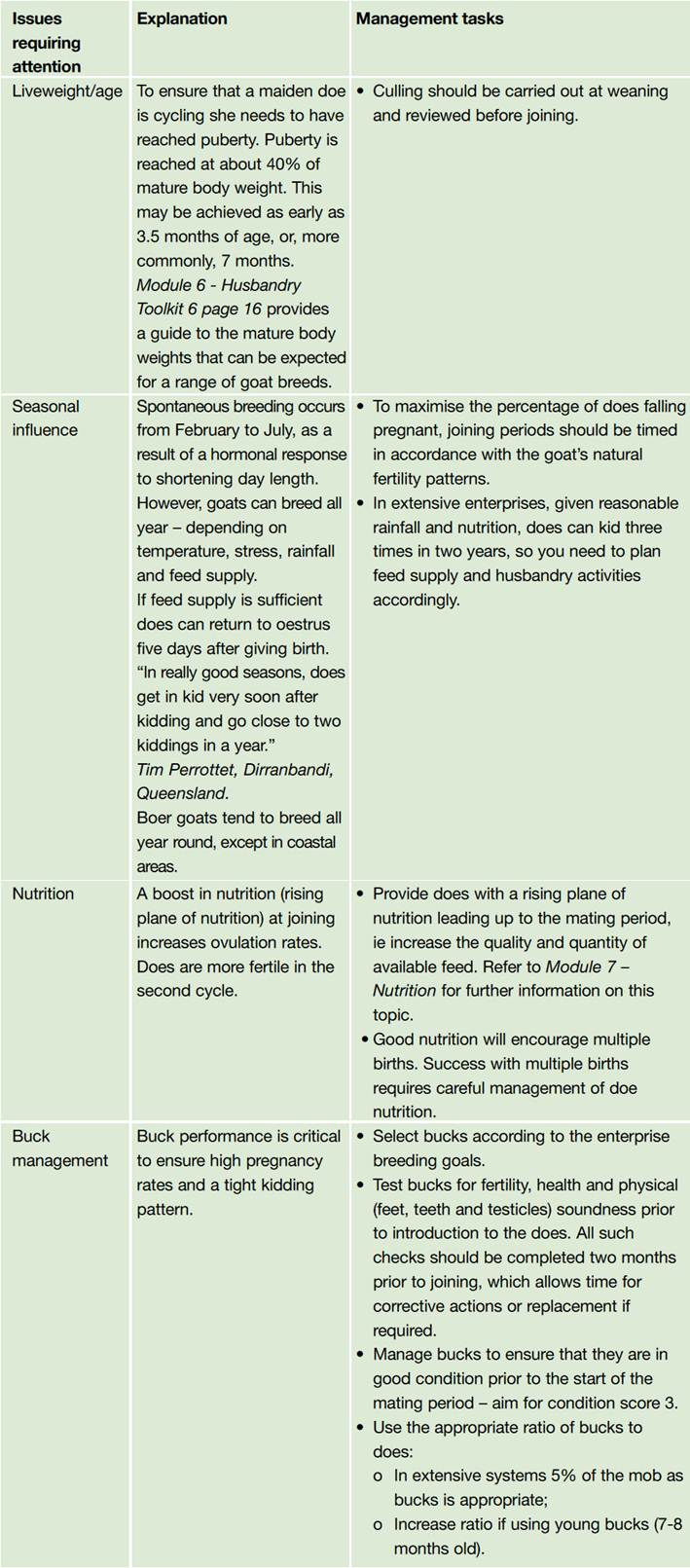 NB; Module 6 - Husbandry Toolkit 6 page 16 is the article Goat Growth rate and Mature weight tables,
Module 7 - Nutrition is the article Goat Nutrition
Extensive System - Pregnancy
NB; Module 7 - Nutrition is the article Goat Nutrition
Intensive Grazing Enterprise.
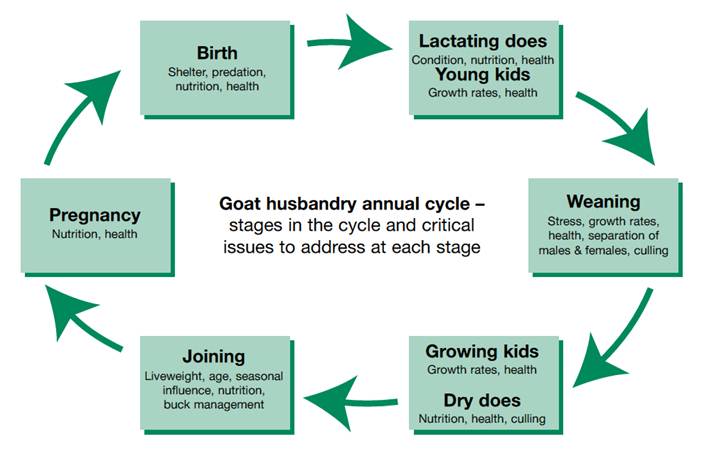
The annual cycle of goat husbandry comprises six distinct phases as outlined above. In the following text each of these phases will be explored in some depth, identifying the key issues of concern, explaining their relevance, and outlining the appropriate management responses for an intensive grazing enterprise.
Intensive System - Birth
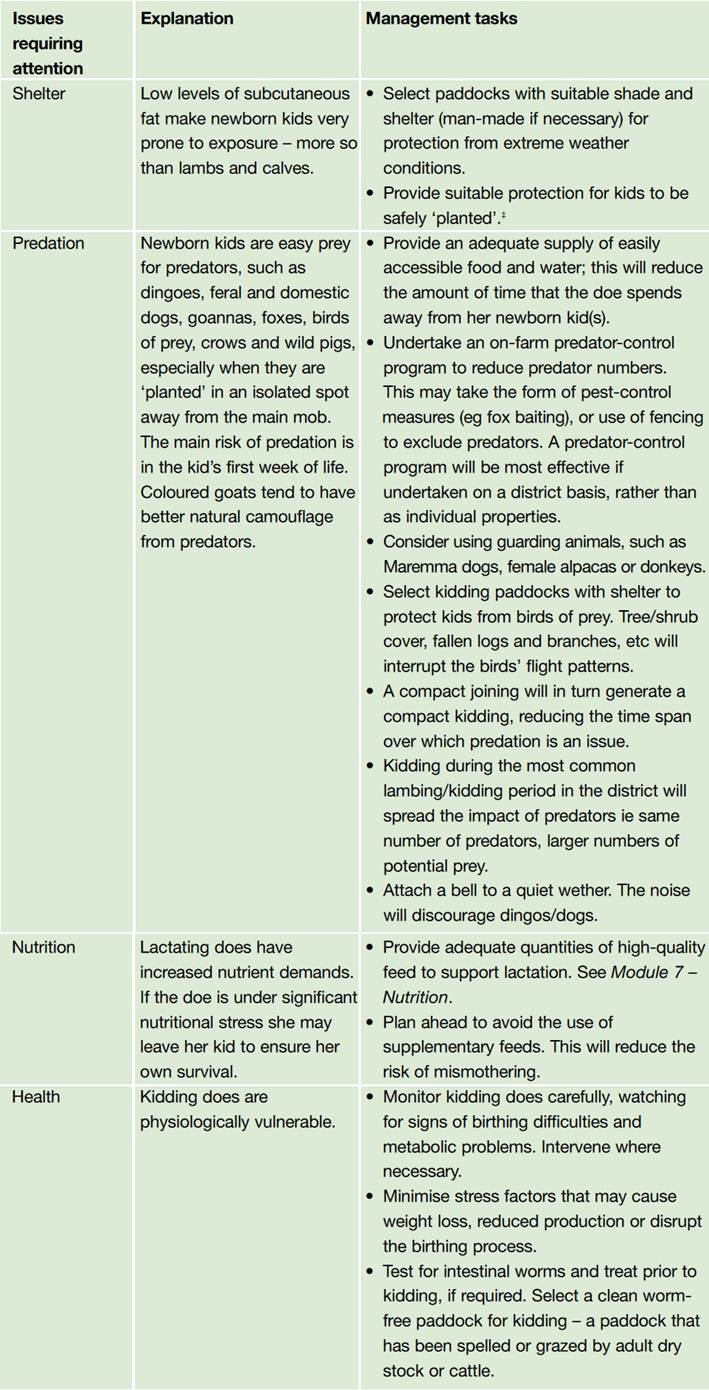 NB; Module 7 is the article Goat Nutrition.
Intensive System - Lactating Does
NB; Module 7 is the article Goat Nutrition, Module 6 - Husbandry Toolkit 6 page 3 is the article Goats Common Health Problems, Module 6 - Husbandry Toolkit 6 page 16 is the article Goats Growth rate and Mature weight tables, Module 6 - Husbandry Toolkit 6page 17 is the article Is Marking of Male Kids a necessity for your goat enterprise?, Module 6 - Husbandry Toolkit 6 page 12 is the article Goats - Vaccinating against diseases.
Intensive System - Weaning
* A nurse doe is an older, quiet doe that is well accustomed to handling routines. Such an animal can be used to lead kids to feed, through gates and yards.
* Boer goats, dairy breeds and rangeland goats are particularly virile and can be potentially fertile from 3.5 months of age.
NB; Module 7 is the article Goat Nutrition, Module 6 - Husbandry Toolkit 6 page 3 is the article Goats Common Health Problems, Module 6 - Husbandry Toolkit 6 page 16 is the article Goats Growth rate and Mature weight tables, Module 6 - Husbandry Toolkit 6page 17 is the article Is Marking of Male Kids a necessity for your goat enterprise?, Module 6 - Husbandry Toolkit 6 page 12 is the article Goats - Vaccinating against diseases.
Intensive System - Growing Kids.
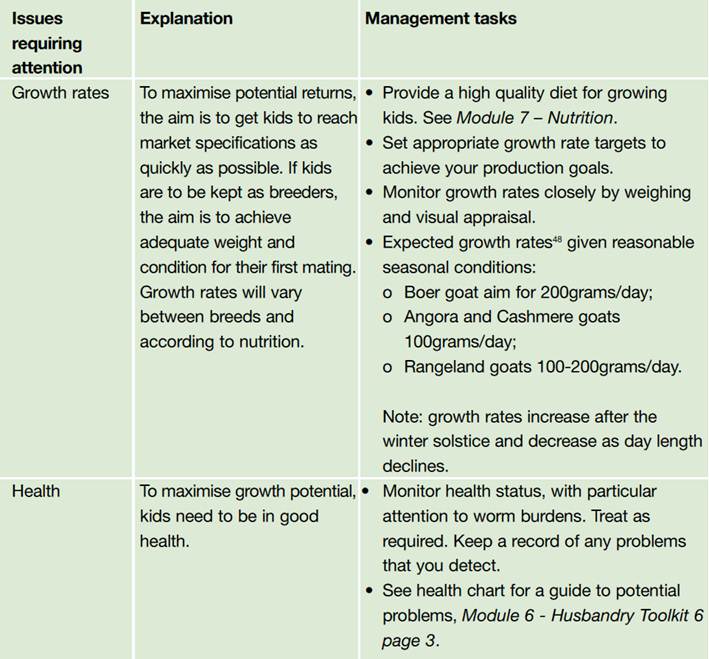 NB; Module 7 is the article Goat Nutrition, Module 6 - Husbandry Toolkit 6 page 3 is the article Goats Common Health Problems.
Intensive System - Dry Does.
NB; Module 6 - Husbandry Toolkit 6 page 18 is article Goats live body condition scoring, Module 6 - Husbandry Toolkit 6 page 3 is article Goats Common Health Problems.
Intensive System - Joining.
For further information to assist you in making decisions about age of first joining, time of year to join and buck management refer to the article Goat Joining Options.
NB; Module 6 - Husbandry Toolkit 6 page 16 is the article Goats Growth rates and Mature weight tables, Module 6 - HusbandryToolkit 6 page 21 is the article Goat Joining Options, Module 1 is the article Property Planning for a Goat Enterprise, Module 7 is the article Goat Nutrition.
Intensive System - Pregnancy.
NB; Module 7 is the article Goat Nutrition, Module 6 - Husbandry Toolkit 6 page 3 is the article Goats’ Common Health Problems.



