 This article and the article ‘Coffee Processing Hazards’ provide a hazard analysis of coffee processing. Both articles describe the effects of each hazard on product quality and suggest remedial actions. In all cases, keeping processing hatches segregated ensures that any quality problems are contained within affected batches. If possible, keep fermentation and drying batches separate as well. You need to monitor the quality of all grades produced in the factory on a daily basis. By analysing batches as soon as practicable you can identify and remedy processing problems early in the season or as soon as they become apparent. By mixing contaminated and uncontaminated batches, faults in liquor quality can potentially downgrade the quality of large amounts of product. Respective grades from different processing batches should be combined only when the quality of each has been assured. This is particularly important for prime grades.
Inadequate washing after fermentation
Inadequate washing leads to overfermentation problems if drying is not efficient, it browns and stains parchment and also downgrades liquor quality through overfermentation faults.
Action to avoid problems caused by inadequate washing after fermentation
- Ensure that washing is thorough.
- Ensure that fermentation is completed.
- Minimise pulp contamination
Chloroanisole contamination
Chloroanisole contamination is a serious fault. It is attributed to the presence of chemical compounds (typically tri-, tetra- and penta-chloroanisoles)which are detectable in the coffee liquor at extremely low thresholds (a few parts per billion). It is often associated with overmature cherry but the exact mechanism of contamination is not well understood nor is it known whether contamination originates in the plantation or during processing.
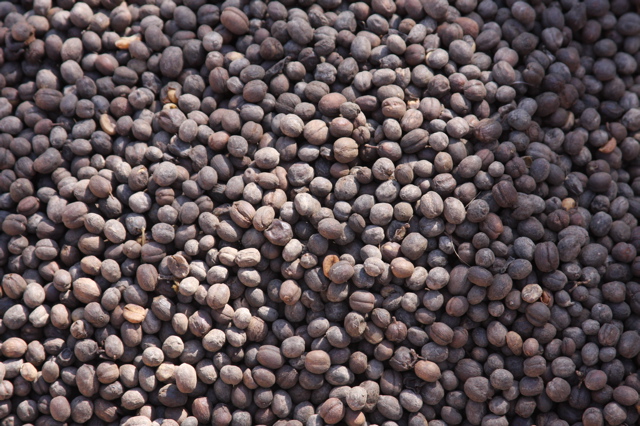
mbuni coffee
Contamination is irregular, unpredictable and downgrades liquor quality, giving dirty, phenolic and mouldy flavours. Chloroanisole contamination downgrades prime batches even at very low contamination levels and likewise causes downgrade to overmature product batches.
Action for avoiding chloroanisole contamination
- Improve drying methods, management and/or equipment.
- Ensure good hygiene (i.e. clean processing equipment between batches even if only several hours elapse).
- Ensure effective separation of overmature product from prime product by floating, size grading or aspiration.
- Be particularly wary of overmature and tree-dried cherry with mould development (e.g. tree-dried cherry carried over on the tree from the previous season).
- Discard contaminated batches.
Overdrying
Overdrying causes parchment shrinkage and cracking because drying is too rapid. Overdrying downgrades liquor quality (less acidity) if dried at temperatures above 65°C while moisture content is above 14%. It increases risk of bean breakage during hulling, reduces final product weight and downgrades appearance (more pales).
Action to avoid an overdrying of beans
- Dry bean to the correct stage; bean should not be too hard or shatter when bitten; if in doubt, use a moisture meter.
- Reduce drying temperature.
- Reduce drying rate.
- Investigate alternative drying procedures (e.g. rest periods, staged drying).
- Ensure that drying is even.
- Allow overdry bean to absorb moisture during storage (equilibrate).
Underdrying
Underdrying increases the risk of fungus or mould development and sweating (moisture migration) during storage reduces huller efficiency and may cause huller blockages. Underdrying also increases green bean damage in huller via bruising, flattening and overheating (increases defects), causes uneven roasting and stains bean if bean is re-wetted during drying because of oxidation of water soluble extracts.
Action to avoid beans being underdried
- Dry bean to the correct stage (11% moisture content dry basis); bean should not yield when bitten (i.e. not be chewy); if in doubt, use a moisture meter.
- Increase drying capacity.
- Improve drying effectiveness.
- Investigate alternative drying procedures (e.g. staged drying and in-storage drying).
- Spread coffee being sun-dried in a layer less than 25 mm thick and turn at least twice per day.
- Avoid sun-drying on plastic.
- Cover sun-drying coffee during wet weather/dewfall.
- Improve washing and pulp removal procedures to improve drying efficiency.
- Ensure that drying is even.
Stagnant water
Stagnant water increases risk of microbial attack, downgrades liquor quality, giving objectionable flavours similar to overfermentation and also downgrades appearance.
Action for avoiding stagnant water
- Use fresh, good quality water for fermentation and washing.
- Avoid standing coffee in stagnant or dirty water.
- Add at least 10% fresh make-up water if recirculating water during pulping and separating operations.
Delayed processing
Delayed processing discolours beans because cherry continues to respire after harvest, causing heat build-up and subsequent discolouring. It also causes fermentation to begin within the cherry, downgrades liquor quality due to overfermentation and downgrades green bean appearance due to browning.
Action to avoid problems associated with delayed processing
- Begin processing as soon as possible during or after harvesting (within eight hours).
- Increase processing capacity if necessary.
- Stop harvesting until factory catches up.
- Keep harvested cherry in the shade.
- Provide mechanical or evaporative cooling for harvested cherry which can be stored successfully for three or four days under coolroom conditions (nominally less than 10°C).
- Store cherry in water if necessary
- Process suspect batches separately
Semi-wet overmature cherry
Semi-wet overmature cherry increases risk of mould or fungal development during drying and increases need for well-managed drying.
Action for avoiding semi-wet overmature cherry
- Dry-separate by size grading and aspiration if there are significant quantities of this product and avoid float separation.
- Discard tins product if there is only a small quantity or you are unable to dry it properly.

coffee cup and beans
Conversion Ratios
1,000 kg prime red cherry = 200 kg dry parchment.
1,000 kg prime red cherry = 160 kg green bean.
1,000 kg immature cherry = 200 kg green bean.
1,000 kg overmature cherry (tree-dried) = 330 kg green bean.
1,000 kg prime red cherry = 0.5 m3 wet parchment.
1,000 kg prime red cherry requires 0.6 m3 for fermentation.
1,000 kg prime red cherry requires 20 m’ of sun-drying area at 25 mm depth.
Prime red cherry has 60-65% moisture content.
Washed, wet parchment has 50-55% moisture content after the surface water has drained off.
Ratio of dried coffee cherry (dry-processed) to green bean: multiply the net weight of dry cherry by 0.4.
Ratio of dried parchment coffee to green bean: multiply the net weight of dry parchment by 0.8.
Ratio of green bean to roasted coffee: multiply the net weight of green bean by 0.84.
Source
Craig Lemin