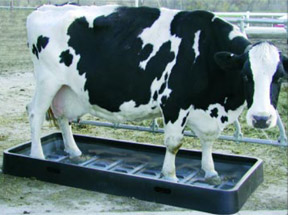
 Foot-bath site
The foot-bath should be easy accessible, and near to an area where cattle can be collected together. There must also be a collecting site after the foot-bath where the cattle can stand before going back into housing.
On many farms the best site will be near the parlour so that cows can be channelled through the foot-bath after milking. This is particularly valuable if routine daily foot-bathing is used, as collecting the cattle would otherwise add significantly to the cost of treatment.
Foot-bath design
The length should be at least 2m. Longer foot-baths are probably more effective, but cost more to fill. The width is less important; the foot-bath should be wide enough for largest cow in the herd to stand in easily.
The material from which the foot-bath is made has little impact on its utility, provided it is easily cleaned. The choice is thus an economic one, based on initial cost and likely longevity.
Foot-bathing procedure
Cattle must have clean feet when they enter the treatment bath. No foot-bath product will penetrate muck. The best method of ensuring clean feet is to hose the feet before bathing. This is particularly important for cows with digital dermatitis.
If the feet are relatively clean then a pre-wash foot-bath can be used, perhaps in combination with walking cows through straw.
The treatment foot-bath must be clean before use. Organic material significantly reduces the effectiveness of most products used in foot-baths. The foot-bath should then be filled to a depth of at least 130 mm (5 ins). The product used should be mixed in during this filling process.
Padded foot-baths are now commercially available which contain a foam sponge that is filled with foot-bath solution. When cows stand on the foam, it is depressed and releases the solution. These foot-baths require significantly less solution than traditional baths (however for herds with severe digital dermatitis the height the solution reaches may not be sufficient). Additionally, contamination of these foot-baths is easy to remove.
An alternative to the pad is to use straw in the foot-bath. Wedges of straw are put into the foot-bath before the solution is added. The cows’ feet will sink and be covered by the solution. The straw also significantly reduces the risk of faecal contamination and will clean the feet as well, aiding product penetration.
Cows should stand in the foot-bath for at least 20 seconds and then walk out onto a clean area of dry concrete so that the feet can dry before being returned to the house or field
Which product?
The product used depends on the reason for foot-bathing. Antibiotic foot-baths should be used only to treat digital dermatitis and then under veterinary supervision. Other commonly used products include zinc and copper sulphate, formalin and disinfectants. The choice of product is best made on an individual farm basis. If you find a product that works stick to it, change if you’re having a problem. The most important thing is not to use a product that is inactivated in the presence of organic material, such as many peroxide-based disinfectants.
Whatever product you use, regular topping-up is essential to ensure that the depth is maintained. Regular changing of the foot-bath is also crucial if it looks like muck it is!. There is only limited data as to how many cows can go through a foot-bath before it needs changing and a lot of it is contradictory. For formalin alone, the estimates range from 80 to 800 cows. Current best advice is that 400 cows is probably the maximum for a 200L foot-bath. Additionally, changing the foot-bath at least daily, no matter how many cows have been through it, is recommended on farms with digital dermatitis problems.



