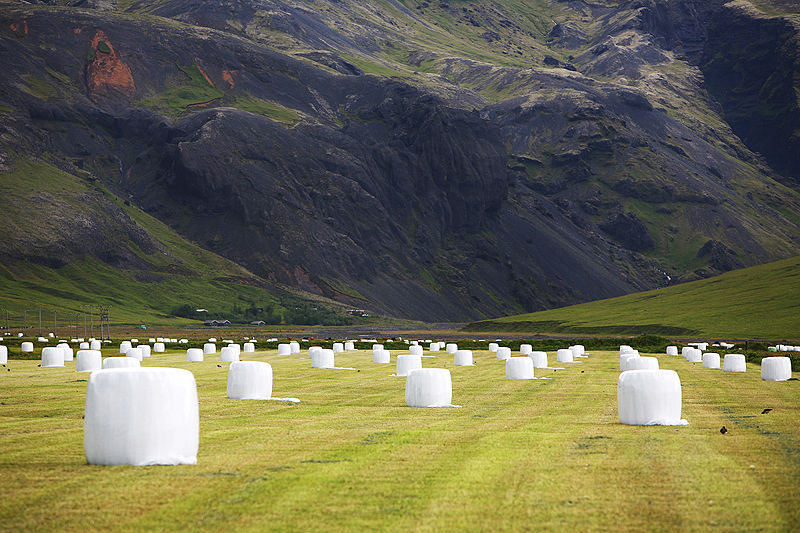
Hay Bales
KEY MESSAGES
Hay Bales
Fodder is the term that is usually applied to conserved roughages, but it may also refer to standing green crops (“fodder crops”) or pastures.
- Silage, hay and straw are the most familiar fodders, however hay-frozen pasture or crop and windrowed pasture can also be used as fodders.
- Rarely does any fodder, alone, provide a complete diet suitable for growing or finishing sheep for slaughter.
- The nutritive value of different fodders is highly variable and difficult to estimate. Therefore, a laboratory analysis is recommended when planning a feeding program using fodders.
Fodder is not a complete ration
Fodder provides some nutrients for sheep and also has an important role in maintaining normal rumen function. Fodder alone, however, is rarely sufficient for prime lamb production. For older sheep, some high-quality fodders can provide a maintenance or slow-gain diet. More commonly, some grain or other concentrate is required in addition to the fodder. The higher the nutritive value (or quality) of the fodder, the more grain it can replace in a sheep’s diet.
When given a choice, and fed ad libitum, sheep will generally consume a mixture comprising 15 to 40 per cent roughage and 60 to 85 per cent concentrate (grains). The precise proportions eaten will vary according to the palatability and nutritive value of the different feeds. Each day a sheep will consume a total weight of feed (concentrate plus roughage) equal to approximately two to four per cent of its body weight.
Without chemical treatment, the quality of conserved fodder can only, at best, match that of the parent material. Therefore, whatever the fodder, the choice of the base plant material and the time of cutting, are the critical factors that determine the final nutritive value of the fodder.
The cost of fodder
Fodder can be relatively expensive, especially on a cost per unit of protein or energy basis. In addition to the cost of growing it, there are costs with harvesting, storing and feeding it out. Insect and vermin control, further treatment, processing or mixing and wastage all add to the cost of a conserved fodder by the time it is actually consumed by an animal. When calculating the cost of fodder, and when comparing the cost of different fodder options, the best measure to use is the energy content of the fodder per kilogram of dry matter. This is expressed as megajoules of metabolisable energy per kilogram dry matter.
Silage Spreader
Possible problems with fodder
Silage Spreader
Some of the problems associated with fodder are obvious and well-known, while others may be unexpected:
- Bulk and weight - Special equipment may be required for handling fodder, and large structures for its storage. There may be occupational health and safety hazards in lifting bales.
- Cost - Fodder may be an expensive source of energy if energy is the primary need.
- Wastage - is generally high (30 to 80 per cent) in feeding out fodder, unless special measures are taken.
- Weeds - such as rye grass, barley grass, Paterson’s curse and radish are readily spread in hay. The risk of weed introduction in silage is much less.
- Diseases - Hay made from lupins,(especially blue lupins) may cause lupinosis.Hay may contain toxic rye grass seedheads that can cause annual rye grass toxicity (ARGT). The fungi in mouldy hay can cause abortions, feed refusal or respiratory problems in stock. Mites, dust and possibly fungi in hay can cause respiratory problems in humans (farmer’s lung). Silage that has not been adequately fermented, or has been exposed to the air, may contain Listeria bacteria that can cause abortions or encephalitis (circling disease).
Test fodder for nutritive value
For most types of conserved fodder the nutritive value, in terms of protein and metabolisable energy, is highly variable and not easy to estimate. The data recorded in Table 1 show the wide variation in the nutritive value of a number of different types of fodders fed to sheep in Western Australia.
Ideally, samples of each different batch of fodder should be submitted for a laboratory analysis.This is especially important when purchasing large quantities of conserved fodders. Some vendors will supply this information for their produce.
If fodder is unable to be tested in a laboratory it should at least be closely inspected. Check its smell, colour and density, look for weeds and any sign of moulds. In pasture hay check the proportion of legumes to grasses. Sheep are very selective feeders and may refuse mould, insect or vermin affected feed. If a hay or straw contains annual rye grass and comes from a district where ARGT is known to occur, a sample of the rye grass should be tested1 to determine its safety for stock.
Silage
Compared with hay, there can be a number of advantages in making silage:
- Silage will generally be of higher nutritive value than the corresponding hay. This is because silage is normally made at an earlier stage of plant growth, when its digestibility, protein and metabolisable energy levels are higher.
- The plant re-growth that may occur after cutting silage provides a valuable grazing bonus by extending the growing season of a pasture or crop.
- This regrowth forage, having not been grazed, should be free of worms and will provide valuable feed for grazing by weaned lambs.
- Early cutting of pasture for silage favours clover growth and removes excess forage that often shelters pasture pests such as the red-legged earth mite.
Table 1. The dry matter, energy, protein and fibre content (dry matter basis) of green fodders fed to sheep. The average across the range of values is shown in brackets.
Farmers interested in conserving silage may be concerned about the cost of the machinery required to make it and feed it out, and also the time required and possible wastage during feeding out. If no more than 200 tonnes of silage dry matter is to be made, a contractor is likely to be the least-cost choice. There are contractors equipped for, and experienced in, silage making in most areas of Western Australia. Feeding out also need not be a problem because various simple systems can be devised, including a selffeeding system from the face of a stack of chopped silage.
Silage made from pasture or cereal crops can be quite high in nutritive value, but it will not provide a complete diet for finishing sheep. Silage made from a mixture of a cereal and a legume, such as vetch, peas, a clover or a medic, may, however, have a high enough nutritive value to allow growth of lambs without the need for grain supplementation. The variability in the nutritive value of silages is shown in the values in Table 2.
Silage can be conserved in wrapped round bales, pits or above ground stacks. Baled and wrapped silage is likely to be the most expensive option, but it is preferred by the majority of farmers because of the ease of feeding-out and the convenience of using bales. Whatever method is used to make silage, it is important to ensure adequate compression and exclusion of air.
The performance of lambs fed bale silage can be quite good if the forage is wilted to a dry matter content of around 50 per cent before baling, especially if the parent forage has a good percentage of legume. Being of lower moisture content, this will reduce the cost of storing nutrients as bale silage.
Table 2. The dry matter, energy, protein and fibre content (dry matter basis) of silages. The average across the range of values is shown in brackets.
Urea treated cereal silage
Table 2. The dry matter, energy, protein and fibre content (dry matter basis) of silages. The average across the range of values is shown in brackets.
In Western Australia, most silage is made without additives, but urea treatment of cereal crops is a technique that may be of interest to wheatbelt farmers. For urea treated silage, the cereal crop is harvested at the medium to hard dough stage, when the dry matter content is 60 to 70 per cent. This is in contrast to the usual highmoisture silages that are harvested at around 30 to 35 per cent dry matter. The urea can be applied dry by thorough mixing with the chopped crop material or it can be applied at baling. If the cereal crop is above 70 percent dry matter it may be best to apply the urea as a solution. The urea treatment procedure should improve the digestibility and nitrogen levels compared with conventional fermented silage. It may also be a useful way to salvage frosted wheat or barley crops.


