Origin:

Fireweed (Bassia scoparia) (Kochia scoparia) Weed.
This species is native to eastern Europe (i.e. Belarus, Ukraine and Russia) and Asia (i.e. Cyprus, Iran, Turkey, Armenia, Azerbaijan, Kazakhstan, Kyrgyzstan, Tajikistan, Turkmenistan, Uzbekistan, Nepal, Pakistan, China, Korea and Japan).
Naturalised Distribution:
Not yet widely naturalised in Australia, and mostly confined to the south-western regions of Western Australia. Also recorded in some parts of South Australia and Tasmania.
It has also become naturalised throughout most of Europe as well as in Argentina, Canada, USA, Africa and New Zealand.
Cultivation:
This species was deliberately introduced into Australia and used to rehabilitate salt-affected agricultural land in south-western Western Australia (i.e. it was grown for forage and as a soil stabiliser). However, it soon spread out of control and it is no longer cultivated for this purpose.
Another form known as summer cypress (Bassia scoparia Trichophylla ) is sometimes also cultivated as a garden ornamental in the temperate regions of Australia, because of its attractive bright red autumn foliage.
Habitat:
A potential weed of cropping areas, roadsides, tracks, pastures, fencelines, firebreaks, rangelands, railway lines, eroded banks, gardens, waste areas and disturbed sites in temperate and semi-arid regions.
Distinguishing Features:
- A short-lived, upright, small shrub or herbaceous plant growing 25-200 cm tall.
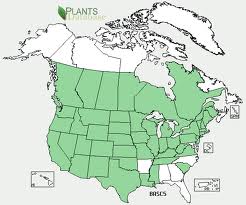
Fireweed (Bassia scoparia) (Kochia scoparia) Distribution in North America shown in green.
- Its stems, leaves and flowers are initially green in colour, but they often turn yellow, orange, red or brown as they mature.
- Its small leaves (up to 6 cm long and 2-8 mm wide) are very narrow or lance-shaped and somewhat hairy.
- Its tiny flowers (about 3 mm across) are clustered near the tips of the branches and do not have any obvious petals.
- Mature plants break off and are blown around by the wind like a ‘tumbleweed’.
Habit:
An upright (i.e. erect), summer-growing, short-lived (i.e. annual) plant growing from 25-200 cm tall.
Stems and Leaves:
The stems and leaves are initially green in colour, however they often turn yellow, orange, red or brown in colour as they mature. Stems and branches are somewhat hairy (i.e. pubescent).
The alternately arranged leaves are very narrow (i.e. linear) or lance-shaped (i.e. lanceolate). They are borne on short stalks (i.e. petioles) towards the base of the plant and are stalkless (i.e. sessile) towards the tips of the stems. These leaves (2-6 cm long and 2-8 mm wide) are are somewhat hairy (particularly on their undersides and along their edges) and have entire margins with a pointed tip (i.e. acute apex).
Flowers and Fruit:
The flowers are inconspicuous (about 3 mm across) and groups of 1-6 flowers are clustered in the leaf forks near the tips of the branches (i.e. they are borne axillary clusters). Large numbers of these tiny clusters of flowers are produced and they are arranged into larger spike-like clusters (i.e. sparse spiciform panicles). The flowers are initially green and generally change colour as they mature (i.e. like the leaves). These flowers do not have true petals, but instead have five persistent ‘perianth segments’, five stamens and a very short style topped with two stigmas. Flowering occurs mostly during late summer and early autumn (i.e. from February to April), though plants can flower at any time of the year if conditions are suitable.
The small fruit (i.e. achene) has five small structures (i.e. the old perianth segments) that enclose the seed, and this gives the fruit a star-shaped

Close up of the Fireweed (Bassia scoparia) (Kochia scoparia) Weed.
appearance. The seeds (1.5-2 mm long and 1-1.5 mm wide) are egg-shaped (i.e. ovoid) and either brown, dark reddish brown or black in colour.
Reproduction and Dispersal:
This plant reproduces by seed. When the plant reaches maturity it usually breaks off at the base of the stem and rolls along in the wind like a ‘tumbleweed’, thereby dispersing its seed over large areas. Seeds may also be dispersed in contaminated agricultural produce (e.g. crop and pasture seeds). For example, on several occasions kochia (Bassia scoparia) has been accidentally introduced into Tasmania in contaminated carrot seed imported from the USA.
Impacts:
Kochia (Bassia scoparia) is on the Alert List for Environmental Weeds, a list of 28 invasive plants that have the potential to threaten biodiversity and cause other environmental damage in Australia. It was included on this list because of its rapid spread from deliberate plantings in Western Australia, and because of its history of invasiveness overseas (e.g. it is one of the fastest spreading of all invasive plants in the USA). It can also alter fire regimes in natural ecosystems and form dense infestations that reduce the abundance of native plants.
Other Impacts:
Although palatable to livestock, kochia (Bassia scoparia) may be toxic in large quantities. It also has the potential to cause damage to agricultural production, by invading crops and replacing more useful pasture species in areas that are not salt-affected. Because it thrives in warm, low rainfall, environments it is seen as a major threat to the cereal-growing regions of the southern mainland states of Australia.
Sourced From:


