When feeding dairy goats, keep these objectives in mind:
- Feed a young animal enough energy for growth, and feed a mature animal enough energy to maintain a fairly constant body weight;
- Provide enough protein, minerals and vitamins in a balanced feeding program to maintain a healthy animal; and
- Offer does enough extra food during gestation and lactation for fetus development and milk production.
Optimum growth, good health and high milk production are the results of sound feeding practices. Dairy goats are not unique in their body requirements; they will respond to good nutritional practices.
Digestible fiber is especially important in dairy goat diets. Too much grain in relation to forage does not foster good ruminant action and is a costly feeding practice.
When feeding, keep minerals and trace mineral salt separate. Always feed them separately. Feed hay in a rack that will not permit wasting. One recommended type of feeder is a keyhole feeder. Do not overlook forage testing as an economical way to feed the correct ration to your herd.
Feeding kids and yearlings
Kids are born with no natural protection from disease. The first milk (colostrum) from the mother offers protection and gets the digestive system working. To be most effective, it must be fed before disease-producing organisms enter the mouth and digestive tract.
Wash the fresh doe’s udders and teats with warm water. Hand milk half a cup of colostrum and feed it to the kid within 15 minutes of birth. This is the best way to ensure that the newborn receives some milk and to provide it with the most protection from organisms present on the skin of the doe. Complete the first milking and store the colostrum for later feedings if you elect to hand feed. Otherwise, permit the kid to nurse at its convenience following the first hand feeding.
Clean the feeding utensils immediately after each use. Use the same cleaning procedures you follow for washing milk-handling equipment or your dinner dishes.
Table 1 is a practical milk feeding schedule. Warm the milk to 100 degrees Fahrenheit. Provide extra water at two weeks of age.
Table 1
Milk feeding schedule.
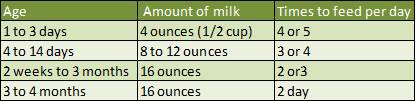
Milk replacer may be fed from the fourth day; it should contain at least 20 percent protein, 20 percent fat and be free of vegetable products. A lamb or high-quality calf milk replacer is recommended. Provide hay and grain at one to two weeks of age. Wean from milk when grain intake reaches 1/4-pound daily and kids are readily consuming hay.
If diarrhea is a problem, try the following mixture:
- Beef consommé 1 can
- Fruit pectin (Sur-Jel) 1 package
- Lite salt 1 teaspoon
- Baking soda 2 teaspoons
- Water to 2 quarts
Make sure the solution is thoroughly mixed. Mix a fresh mixture daily and feed in place of milk.
Double the rate you were feeding. Feed as soon as you notice diarrhea. Use for 1-1/2 or 2 days, then return to the regular milk diet.
After four to six months of age, the kids may be fed a ration similar to that of the milking herd.
Good hay and 1/2 pound of grain per day should provide an ample growth rate. Poor hay may require 1 to 1-1/2 pounds of grain daily.
Feeding the milking herd
If milk production is important, feed maximum amounts of high quality hay balanced with a grain ration containing enough protein, minerals and vitamins to support production and animal health (Table 2). Grass or legume hays are equally acceptable. As the percentage of legumes is increased, the need for protein in the grain mix is reduced.
Table 2
To determine the amount of grain to feed, consider level of milk production, amount and quality of forages consumed, appetite and state of fleshing. Thin, high-producing does should have access to all the hay they can eat plus grain to the limit of their appetite. Does in mid-lactation that are in good flesh should have all the hay they will eat plus 1 pound of grain for each 3 pounds milk produced. Late lactation does may not need more than 1 pound of grain for each 5 pounds of milk.
Feed a grain ration formulated for a milk-producing ruminant (dairy cows). Rolled or cracked grain is more palatable than ground grain. Because of palatability problems, urea is not recommended. Some commercial cow feeds may contain byproduct ingredients unpalatable to goats. Wet molasses is more palatable than dry molasses. Beer or citrus pulp is a valuable source of fiber, especially if the available hay is of low quality. Table 3 lists some palatable and nutritious rations your local miller could mix.
Table 3
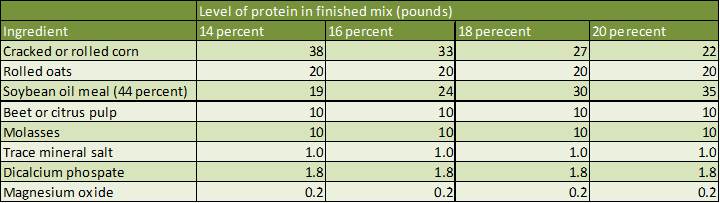
Add a vitamin premix that will provide 1,000 units of vitamin A, 500 units of vitamin D and 3 units of vitamin E per pound of grain.
Weeds and browse are not a necessary part of a goat’s diet. Good pasture is a valuable source of summer feed. Vegetable tops and parings may be used as an “extra;” do not depend on them as a sole source of forage.
Water is critical to good health and high milk production. A clean water source should be available at all times. If the water is warmed during cold weather, goats will consume more.
Feeding dry does
If the doe is not thin, reduce the amount of grain to 1/2 to 1 pound per day. Feed her all the forage she will eat. Hay fed during the dry period may be of lower quality, but if so, the grain ration should contain additional protein.
Browse, leaves and weeds are often useful to recondition the stomach. If the dry ration differs from the milking ration, be sure to change to the milking forage and grain ration two weeks before the doe freshens.
Feeding the buck
For convenience, you may feed the buck the same grain fed the milking herd. Most bucks do not need more than a pound of grain per day plus forages. Don’t let them grow fat. Adjust grain upward or downward accordingly. Always feed full forage.
..
..



