 Research on the diets of wild alligators show that diets change as animals grow; but, in general, alligators consume a diet high in protein and low in fat. Early alligator producers fed diets high in fish flesh.
Research later showed that medium to large alligators eat mostly higher protein prey (i.e., birds and mammals).
Most alligator farms were, therefore, equipped with large walk-in freezers to store large quantities of meat. Meat sources which have been used include: nutria, beef, horse, chicken, muskrat, fish, beaver and deer.
Today, however, artificial diets have been developed which provide adequate nutrition.
These diets have eliminated much of the need to keep fresh-frozen meat products available.
Burris Pet Food in Franklinton, LA, SF Services of Madison, MS, Goldkist Feeds of Valdosta, GA, and Ralston Purina of St. Louis, MO, are currently manufacturing pelleted alligator feeds. Commercial feeds are approximately 45 percent crude protein and 8 percent fat.
These feeds are a blend of fish meal, meat and bone meal, blood meal, and some vegetable protein and then fortified with vitamins anti minerals, At present, most produced are oily commercially available diets, although some continue to feed a combination of meats and commercial diets.
When blended, commercial alligator pellets are combined with approximately 30 to 50 percent raw meat. A vitamin premix is also added to the blended diet at a level of 1/2 to 1 percent. The pellets, meat and vitamins are ground together in meat grinder to a Consistency that is readily palatable to the size alligator being fed.
Feed conversion rates decrease or get worse as alligators grow larger, but average about 40 percent or between 2:1 and 3:1, up to a length of 6 feet. Pen cleaning should be coordinated so that the animals are not disturbed just before, during or soon after feeding. Many producers clean in the morning and feed in the afternoon.
Feed should be spread out on the deck in small piles to reduce competition and territoriality. Feeding should be done at Ieast 5 days per week while some producers feed up to 6 or 7 days per week. Alligators are normally fed at rates of 25 percent of body weight per week the first year, then gradually reduced to 18 percent by three years of age or a length of about 6feet.
over feeding wastes money and ran lead gout. Gout is fairly common in pen-raised alligators, but can be cured by taking the animals off feed for seven to ten days.
Feed additives:
 Two antibiotics, Oxytetracycline (OTC) and Virginiamycin (VA), have been added to feed when bacterial problems occur. It should be pointed out, however, that these or any other antibiotics can be administered to alligators only through a prescription from a veterinarian.
One research study showed that females treated with these antibiotics (OTC at 100 grams/ton) and VA at 20 grams/ ton) had improved fertility rates of 16 percent and hatching rates of 8 percent. These antibiotics have also improved growth (15 percent) of hatchlings that were stressed.
Growth rates of young alligators can be as much as 3 inches or greater per month when held at a constant temperature of 86 to 89°F fed a quality diet and protected from stress. Many producers are rearing alligators from hatchlings to 4 feet in 14 months.
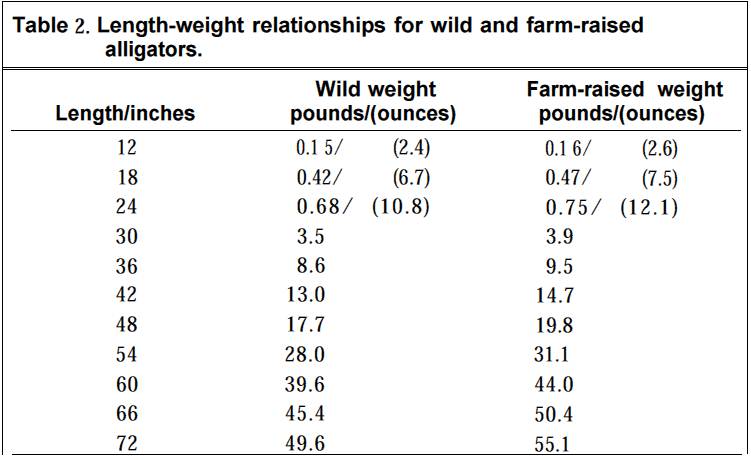
A few producers have grown alligators to 6 feet in 24 months. Farm-raised alligators are generally 10 percent heavier than wild alligators of the same length. Table 2 gives average length and weight of wild and farm-raised alligators.
Author:
Michael P. Masser


