 Background information
When are the best, worst and most unreliable periods for pasture growth on your farm? Knowing the answers to these questions will help you make the right strategic decisions for your sheep enterprise. The first and most critical step is to more reliably predict pasture availability across the year. Once you understand how pasture availability varies, you can:
- Match animal requirements to pasture production
- Achieve more precise and cost-effective supplementary feeding
- Budget feed more accurately and
- Manipulate pasture production and composition to meet the needs of your enterprise.
Key decisions, critical actions and benchmarks
To better understand your feed supply, construct pasture supply curve/s for your property and assess the variability between years. This requires knowledge of your annual rainfall and its variability, temperature patterns and your pasture types.
Review annual rainfall patterns
Annual rainfall and its distribution influence pasture availability. To review your annual rainfall pattern, graph your own average, long-term rainfall figures, or to find long term rainfall information, visit the MLA Rainfall Outlook web site (www.mla.com.au/growthoutlooktool/) or the National Agricultural monitoring System (www.nams.gov.au/) or Climate On-line web page at the Bureau of Meteorology website (www.bom.gov.au/
climate/averages).
If you use Climate On-line choose the “monthly statistics” option, then your state and closest town, and click the plot icon to graph your Decile 5 median rainfall as shown in figure 8.1. What does the annual rainfall pattern look like in your district? Can your existing pastures use the rain whenever it falls? Could pasture types with growth patterns different to those of your current pasture types fill some seasonal feed gaps in response to rain?
Construct your pasture supply curve
Figure 8.2 shows how pasture growth can vary between regions, but on any farm there may be several different pasture and feed sources (annual pasture, native or introduced perennial grass pastures, lucerne, grazing wheats, forage crops and crop stubbles) that can vary even more than the differences in figure 8.2. It is your total farm feed supply curve that indicates how well an enterprise might be suited to your growing season.
The approach to constructing a pasture supply curve will depend on the complexity of the farm’s pasture system. Where the property has only one or two different pasture sources, option 1 is likely to be suitable. Where there are multiple pasture sources, option 2 might be more suitable. Remember, this is about strategic decisions on stocking rate, enterprise structure and activity timing and does not require a high level of ‘accuracy’. You never get this mythical ‘average’ year anyway.
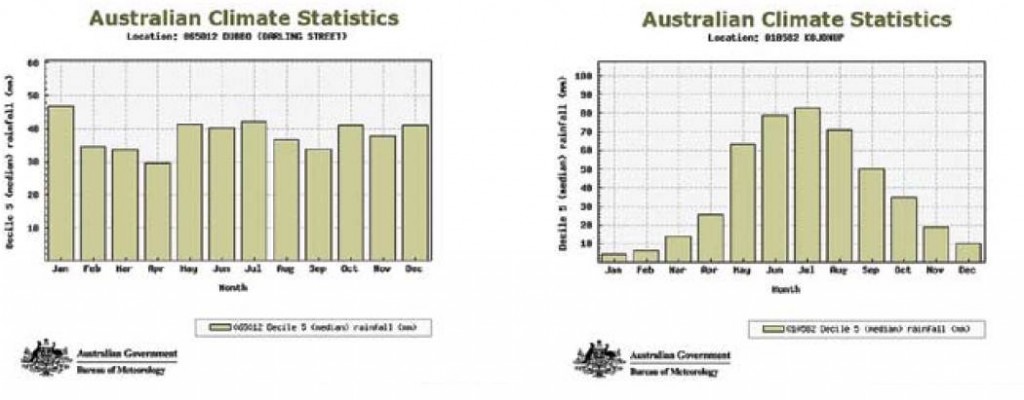
Figure 8.1 Median rainfall at Dubbo NSW (left) and Kojonup WA (right). Dubbo sheep producers could grow green feed almost all year round in response to rain, but this is much less likely at Kojonup.
Option 1
Construct a pasture supply curve for each of the main pasture types on your property and combine them into a whole farm feed supply curve (see tool 8.2). These pasture growth figures can be inserted into the MLA feed demand calculator (tool 8.3) to generate a supply curve. Alternatively, with the assistance of your consultant or adviser, use other tools such as the computer model GrassGro® to get more specific data for your pasture species, soil types and soil fertility levels.
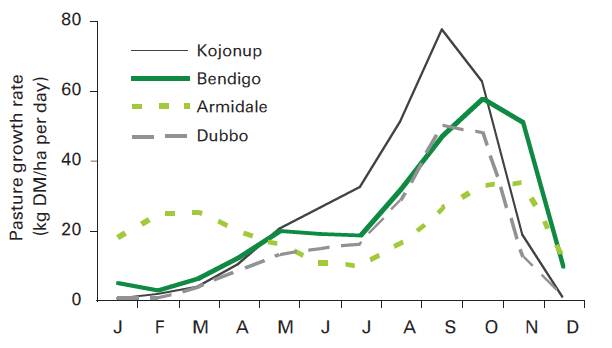
Figure 8.2 Average pasture supply curves (1965–2002) for four different environments. Kojonup, WA: annual pasture, good fertility; Bendigo, Vic: phalaris/sub clover pasture, good fertility; Armidale, NSW: native pasture (red grass)/sub clover, low fertility; Dubbo, NSW: annual pasture, moderate fertility (from GrassGro®).
Figure 8.2 Average pasture supply curves (1965–2002) for four different environments. Kojonup, WA: annual pasture, good fertility; Bendigo, Vic: phalaris/sub clover pasture, good fertility; Armidale, NSW: native pasture (red grass)/sub clover, low fertility; Dubbo, NSW: annual pasture, moderate fertility (from GrassGro®).
Option 2
Construct a single, average pasture supply curve for your property that takes account of the inputs from each pasture type (including, for example, the contribution made by grazing cereals, forage crops and stubble). Tools 8.2 and 8.3 provides guidance for the more traditional pasture types, which can be modified to account for ‘other’ pasture supplies. This pasture supply curve provides the basis for revisiting your annual livestock management calendar.
Determine variability in your pasture supply
Pasture supply varies from year to year. The variability of pasture growth between years is an indicator of risk and affects the ability to set an optimal stocking rate target or the reliability of a particular time of year for lambing (see figure 8.3).
In figure 8.3, Decile 1 represents the one-in-ten bad years (only 10% of all pasture growth records would fall below this line). Decile 5 represents an “average” year (half of the recorded years were above and half were below this line), while Decile 9 represents the records would fall below this line) – only 10% of recorded year’s pasture growth would be above this year.
The closer all three Decile lines are together in any one month, the less variability there is between years. In figure 8.3, the most reliable months are July-September at Kojonup. Autumn growth in annual pastures is variable at Kojonup, whilst spring is the most variable growth period for native pastures at Armidale.
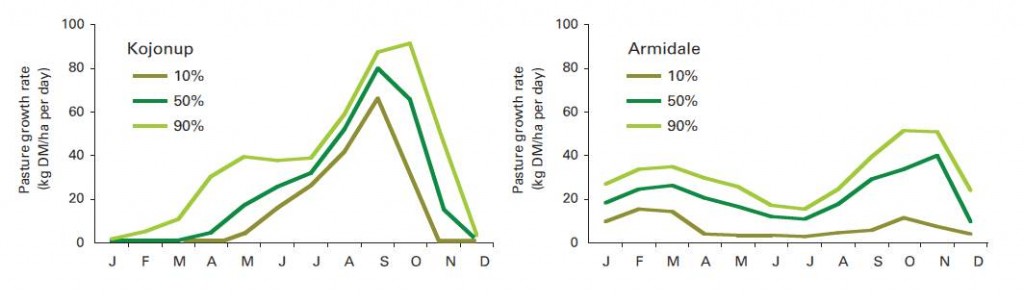
Figure 8.3 Variability in pasture growth rates for Kojonup, WA (annual pasture) and Armidale, NSW (native redgrass/sub clover pasture) (from GrassGro®).
To better understand your feed supply, construct pasture supply curve/s for your farm and assess the variability between years. The simplest approach to constructing pasture supply curve is to draw the growth curves for the main pasture types on a single graph.
Use the relevant tables in tool 8.2 to construct simple pasture supply curves for your farm. The estimates presented are only intended as a guide to help plan your annual feed availability. As an example, a pasture supply curve has been constructed for Dubbo NSW (figure 8.4) using the tables in tool 8.2. On your whole-farm pasture supply curve, draw estimates of how much higher these lines might be above the average, in the 1-in-5 best years, and how much lower the lines might be than average, in the 1-in-5 worst years, using:
- Your experience, and/or that of your adviser
- The Climate On-line web page at the Bureau of Meteorology website (www.bom.gov.au/climate/averages). Choose the “monthly statistics” option, then your state and closest town. Select “All available” and within the subsequent table will be Decile 1, Decile 5 and Decile 9 rainfall figures
- The data in tool 8.2.
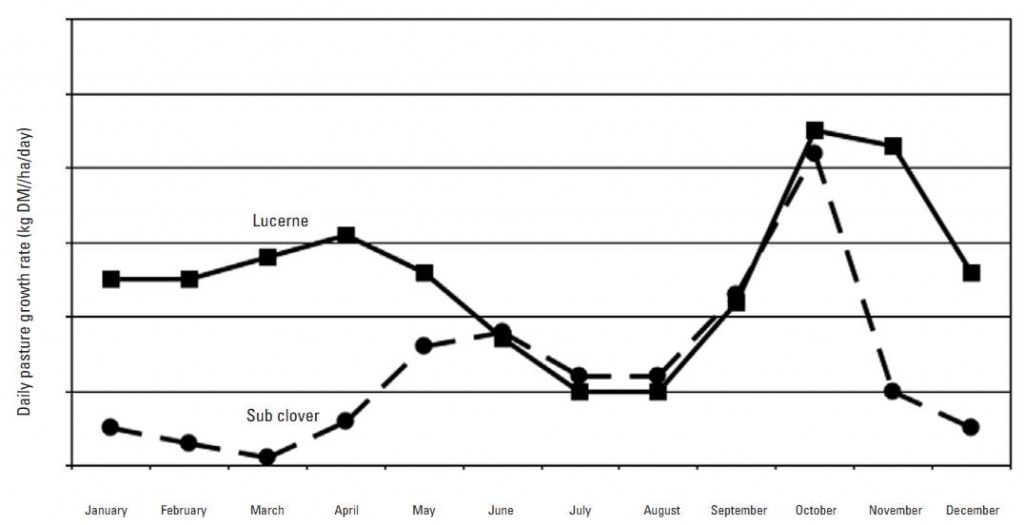
Figure 8.4 Pasture supply curves for Dubbo, NSW. Summer active pastures in winter rainfall zones can extend the growing season and provide land management benefits.
Alternatively, use tool 8.1 to calculate an index of potential pasture growth, based on actual rainfall, indices of soil moisture, pasture growth for the past nine months, and an outlook for the next three months. Use this tool to get a ‘feel’ for when to expect pasture growth; to establish where the likely deficits will be; and to identify opportunities to include different pasture types in your enterprise. Tool 8.3 (the MLA feed demand calculator), describes how best to match animal demand to your pasture supply, and minimise your exposure to risk from seasonal variability. The feed supply curve is generated as well as an inventory of stock demand across the year (all classes considering purchase, sale and lambing dates). Compare supply with demand to get a better understanding of when pasture will be in surplus or deficit and by how much. Use this information to set up your enterprises to better match available feed with animal demand.
Modify your pasture supply
Rainfall, temperature, soil moisture, soil type, fertility and pasture type combine to drive pasture availability. You can’t change your annual rainfall without moving, but you can rethink your existing pasture types and management systems to suit your location and achieve your enterprise goals.
Grow More Pasture contains procedures to alter your pasture supply curves by:
- Building and maintaining soil fertility
- Grazing to keep the desirable species productive and dominant
- Establishing new pastures
Fill feed supply gaps by using different pasture species and forage crops, or by supplementary feeding. Figure 8.4 shows how lucerne can fill a pasture supply gap over summer/autumn. Lucerne and other deep rooted, summer-active perennials such as chicory, can also prevent potential dryland salinity problems and protect the soil.
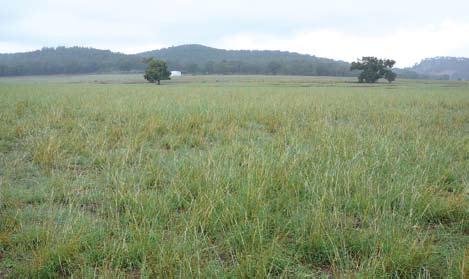
A paddock full of red grass.
Utilise cereal crops
A paddock full of red grass.
On mixed farming enterprises, crops can be another source of feed for livestock enterprises. A range of cereals can be utilized by livestock without impacting on profits or the crop. Across the southern States in the Grain & Graze project, benefits of grazing cereals to fill a feed gap are apparent. The Grain & Graze trial in Western Victoria (see signposts) showed grazing Yerong barley at the vegetative growth stages up to stem elongation:
- Had no adverse effect on eventual grain yield and even improved yield slightly
- Reduced stubble levels slightly, promising easier sowing in the following season
- Reduced the need to graze new or re-germinating legume pastures in early winter
- Gave 4-6 weeks grazing in the colder part of the year when pasture growth was slow
- Contributed 16% of the total feed requirement for the year.
It is your total farm feed supply curve and its variability that indicates how well an enterprise might be suited to your growing season. Revisit your annual livestock management calendar see your business plan now that you know your feed supply and how it varies within and between years. It may be possible to address livestock needs with addition of other plant species to provide pasture of the quality and quantity required for the production goals (eg, growing out weaners, finishing lambs, etc). Alternatively, a more cost effective option is to revisit your enterprise structure (the number of breeders and trading stock carried), as well as reviewing your target market.
For example, a better option in some locations without a summer feed supply, may be to sell lambs as stores, rather than taking them to heavier weights.
View
The MLA Rainfall to Pasture Growth Outlook Tool: estimates pasture growth for different locations across southern Australia. Visit the website: www.mla.com.au/growthoutlooktool/
Climate On-line web page at the Bureau of Meteorology. Visit the website: www.bom.gov.au/climate/averages
National Agricultural Monitoring System (NAMS): contains a range of climatic and production information, for dryland/broadacre and irrigated industries throughout Australia. Visit: www.nams.gov.au/
Attend
The MLA EDGEnetwork® program is coordinated nationally and has a range of workshops to assist sheep producers.
Contact can be made via:
- Phone: 1800 993 343
- Email: edgenetwork@mla.com.au
- Website: www.mla.com.au/edgenetwork



