 Background information
Successful joining management starts from the previous weaning period, both for ewes and rams. The first step to weaning more lambs is to ensure most ewes get pregnant in as short a joining period as possible. Both ewe and ram management must be considered.
The single most important determinant of reproductive rate is nutrition. Ewes in higher condition score conceive more lambs. A description of how to condition score (CS) is presented in tool 10.1. Use the recording sheets in tool 10.1 to plot the distribution in the mob.
The condition score at joining is a more important indicator of reproductive rate than a change in condition score through the joining period (unless extreme loss occurs). Adopt grazing management strategies to keep ewes in as high a condition score as possible, rather than feeding ewes to increase reproductive rates.
Key decisions, critical actions and benchmarks
Timing of joining
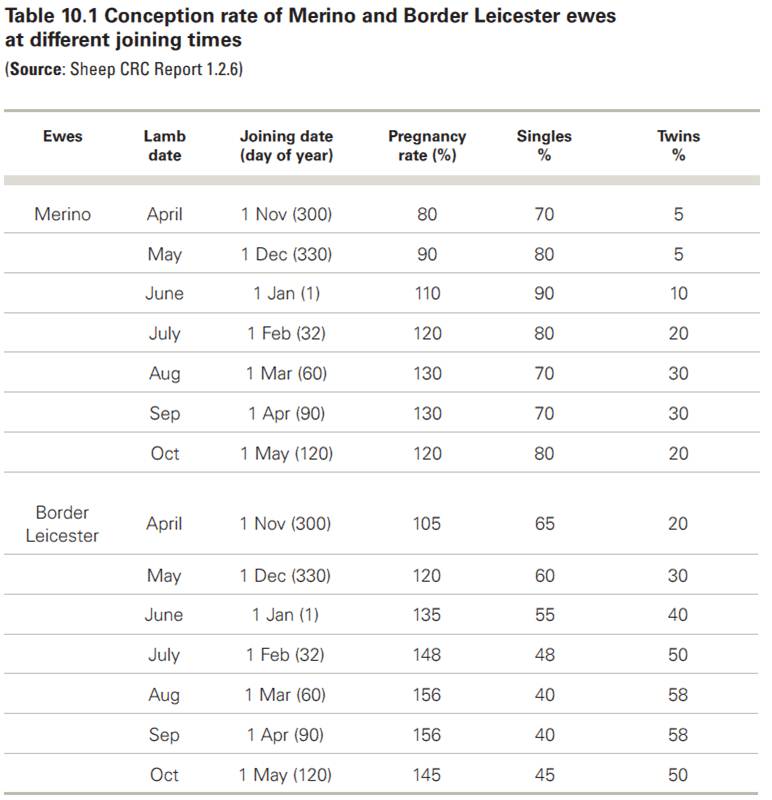
Setting the time of joining for lambing is the most important on-farm management decision you make. In the most profitable systems lambing time is planned to match feed demand with feed supply (see procedure 8.3 in Turn Pasture into Product). Use tool 10.2 to vary the management calendar for a breeding flock. Oestrus activity in ewes increases after the longest day (22 December). As day length shortens, cycling activity increases to peak between March and May when most ewes are cycling and with higher ovulation rates. Cycling in Merinos, and to a lesser extent breeds such as Poll Dorsets, are least affected by day length. Breeds such as Border Leicesters, Coopworths and Romneys are most affected by day length. Typical conception rates for Merino and Border Leicester ewes are listed in table 10.1. For out of season joining, cycling activity can be improved by the use of teasers and exploiting the ram effect to stimulate oestrus in ewes (see tool 10.3).
Timing of lambing
Where practical, aim to lamb about 3 to 4 months before the end of the growing season in Merino breeding enterprises. In a lamb production enterprise, you must decide on the most profitable compromise between number of ewes joined per hectare, likely reproductive rate, lamb sale weight and timing and market price.
Sometimes the most favourable lambing time will be outside the best phases of matching pasture growth and production. If lambing outside this time, additional supplements may be needed to maintain production and prepare ewes for the next joining. Other influences include the market choice and planned growth rates of lambs to meet market specifications (see procedures 3.1 and 3.2 in Market Focused Lamb and Sheepmeat Production).
Managing ewe nutrition
Managing ewe nutrition is the most important factor to ensure best reproductive performance. Condition scoring is a quick and reliable tool for managing ewes to meet production targets and enable timely decisions to optimise reproduction rates (see tool 10.1). The actual condition score of the ewes is the most important determinant of ovulation rate.
The target condition score is a balance between reproductive performance, stocking rate and supplementary feeding costs. The response to reproductive rate in Merinos is linear between ewes in condition score 1.5 to 4.5. The Lifetime Wool project shows an increase of about 20% extra lambs for each rise in condition score at joining. This response varies from 7% to 36%, depending on genetics and time of lambing, with later lambing likely to be more responsive.
Strategies to manage ewes for higher condition score at joining include:
- At weaning, condition score ewes (see tool 10.1) and draft those below score 3 into a separate management group for preferential grazing on pasture, or if pasture quality is low, feeding a supplement to increase liveweight.
Pasture is usually the only economic option for increasing ewe condition score after weaning. The target is to get all ewes up to score 3 by joining.
- Wean lambs at 14 weeks after the start of lambing to ensure ewes can gain weight on green pasture before next joining.
Minimum condition score 3 is the target for ewes at joining (see tool 10.4). Refer to tool 10.5 for guidelines for growth path of maiden ewes. It is important to determine the relative benefit of supplementary feeding to wean more lambs.
 Joining management
Managing ewes at joining
The following management aspects need attention in breeding flocks:
- Join maiden ewes and adults separately as they have different ram requirements.
- Ewe health is extremely important. Any health issue such as worm burdens, liver fluke or footrot will slow weight gain or cause weight loss resulting in lower reproductive rates (see procedures 11.2 and 11.3 in Healthy and Contented Sheep).
- Avoid joining ewes within two weeks of shearing as shearing can disrupt cycling activity for two weeks.
- Avoid joining ewes with full wool as mating can be physically more difficult.
- Avoid joining ewes on pastures that may be toxic to sheep. For example, high endophyte perennial rye grass pastures may lower conception rates and lambing performance by as much as 20%, even without visible rye grass staggers.
- Avoid severe stress (such as more than 1kg liveweight loss per week or extreme variation in feed quality) when joining ewes, as embryo loss may be higher.
Managing rams for joining
Ram management is important to a successful mating:
- Give rams a breeding soundness examination at least eight weeks before joining (see tool 10.6).
- Shear rams at least eight weeks before joining as shearing cuts and resulting fever, or compromising temperature change, may affect semen quality.
- Join rams at 1% plus one extra ram for mature ewes (at least five rams for a mob of 400 ewes), at least 1.5% for maiden ewes and 2% for ewe lambs.
- Higher ram joining rates are necessary in large paddocks with multiple watering points or when rams are joined outside the main breeding season.
- If rams need to increase condition score before joining, feed a high quality feed such as lupins for 50 days prior to ensure maximum testes size and sperm output.
- Avoid joining inexperienced rams with maiden ewes.
- Minimise the risk of lambing difficulties by not joining meat breeds with high Australian Sheep Breeding Values (ASBVs) for birth weight, to maiden ewes.
- Allow eight weeks for newly introduced rams to acclimatise if they have been brought in from outside your district. Housed rams may need even more time to become accustomed to paddock feed before joining commences.
- If ewes are being supplemented during joining, make sure rams are accustomed to the same supplementary feed as ewes to avoid rumen acidosis.
 Length of joining
Join rams with ewes for two 17 day cycles or five weeks. If your flock is mated outside the peak breeding season (before February) or joining paddocks are large, join ewes for six to seven weeks, or five weeks if teasers are used. Most ewes get pregnant in two cycles. On more intensively run farms, extending the joining for longer periods is not recommended because the 2-4% of extra lambs holds up completion of important management events such as marking and weaning. Delaying weaning for a few late lambs can result in serious worm burdens, leading to weight loss in both ewes and lambs. In winter lambing Merino flocks, the late lambs generally have poor survival rates because they have a lower bodyweight over summer.
Joining maiden ewes
Bodyweight is the critical factor with maiden ewes. Management practices such as regular monitoring of bodyweight and condition score are essential for a successful joining and a higher percentage of lambs weaned to ewes joined. Grow maiden Merino ewes to be at least at 75–80% of mature liveweight for successful joining (see tool 10.5). Maiden crossbred ewes can be successfully joined at 7–9 months at a minimum of 45kg bodyweight at joining, provided they have access to good quality feed during pregnancy to ensure they are condition score 3 at lambing. Do not attempt joining at 7–9 months if adequate feed cannot be provided.
What if ewes fail to get in lamb?
When joining in the peak breeding season, at least 90% of Merino ewes and up to 95% of crossbred ewes get pregnant in the first two cycles. Pregnancy rates can be 10% lower if joined outside the normal breeding season. If more than 15% of ewes are not pregnant in the target mating time an investigation to determine the reason for ewes failing to conceive is necessary.
Both ewe and ram problems can contribute to poor results. Consider pasture toxicities, including syndromes such as perennial rye grass toxicosis (see procedure 11.4 in Healthy and Contented Sheep) or oestrogenic clover infertility. Consult your animal health adviser to investigate problems.
Signposts
Read
Planning for Profit – A practical guide to assist woolgrowers recover from drought. Order your free copy from AWI by:
- Calling: 1800 070 099
- Downloading the document from: www.wool.com.au/Publications/Managing_drought/page__7134.aspx
Lifetime Wool Regional Guidelines: a series of guidelines and recommendations for managing ewe flocks throughout the year. Visit the Lifetime Wool website: www.lifetimewool.com.au/guidelines.aspx
Pasture Legumes for Temperate Farming Systems - The Ute Guide: helps sheep producers and farm advisers identify and select appropriate pasture legume species and cultivars for farming systems in Southern Australia. It also identifies oestrogenic clover varieties. Purchase your copy from Ground Cover Direct by:
- Calling: 1800 110 044
- Visiting: www.grdc.com.au/director/events/bookshop
 View
View
Grazfeed®: a decision support tool to help graziers improve the profitability of livestock production, through more efficient use of pastures and supplementary feeds. Grazfeed® can be purchased by contacting Horizon Agriculture on www.hzn.com.au/grazfeed. php
MLA Tips & Tools 45×7 - Joining ewe lambs for more profit. Stock reference LP1790. Get your copy by:
- Calling: 1800 675 717
- Emailing: publications@mla.com.au
- Downloading from: ? www.mla.com.au/tipsandtools
Lifetime Wool - Tools for Management:
a wide range of tools to help sheep producers manage their ewe flock more effectively. Visit the Lifetime Wool website at: www.lifetimewool.com.au/toolsmgt.aspx
Feed testing services analyse the quality of a range of feeds, and are provided by a number of organisations including:
- Victorian DPI FEEDTEST. Call 1300 655 474
- NSW DPI Feed Quality Service. Call the Customer Service Unit on (02) 6938 1957.
Attend
Lifetime Ewe Management: a workshop focused on the health issues associated with the Merino ewe the development of sheep producers’ skills in sheep assessment and feed budgeting. Contact the Rural Industries Skill Training (RIST) centre on:
- Telephone: (03) 5573 0943
- Email: ristvic@rist.com.au
- Website: www.rist.com.au
PROfarm is the training program developed by NSW DPI to meet the needs of farmers, primary industries, agribusiness and the community. NSW DPI PROfarm short courses are available by contacting:
- 1800 025 520 in northern NSW
- 1800 628 422 in southern NSW
- www.profarm.com.au
The PROfarm course most relevant to this procedure is Wean More Lambs: a workshop for sheep producers who want to improve the reproduction rate of their flock.
The MLA EDGEnetwork® program is coordinated nationally and has a range of courses for sheep producers. Contact can be made via:
- Phone: 1800 993 343
- Email: edgenetwork@mla.com.au
- Website: www.mla.com.au/edgenetwork



