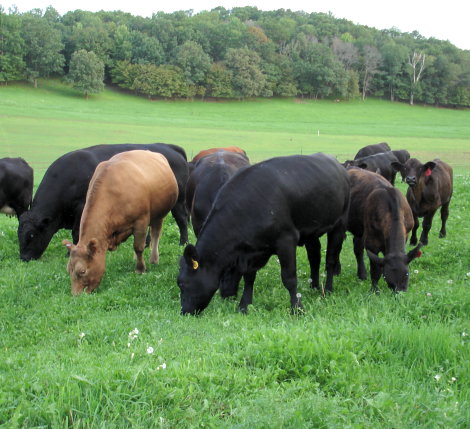
 Guidelines for determining the start of grazing
Accurately timing the start of grazing is critical to the efficiency of converting green pasture into product and the overall productivity of a beef herd. Assess the grazing start date by adopting a plant growth-based approach to grazing management. Using this approach, the best time to start grazing a unit (paddock) is just before senescence (dying-off of the first leaf) occurs in the most desirable pasture species. This is just before the pasture energy content (MJ ME/kg DM) peaks and growth starts to decline.
•In legume-based pastures, the criterion measured is either the leaf area index (a percentage relating to the plant’s ability to capture the energy from sunlight) or the condition (senescence) of the lower leaf.
• Use the MLA Pasture Ruler to measure pasture height and convert it to herbage mass. As a guide, the preferred pasture mass for grazing is between 1,500kg and 2,500kg DM/ha. At this level the pasture is of the highest nutritional quality (ME>11.5MJ/kg DM) and there is best opportunity for pasture regrowth following each grazing event.
• Aim to graze paddocks to maintain pasture in green leafy vegetative condition, and with a maximum pasture mass of 3,000kg green DM/ha.
Correct timing for the start of grazing is critical to both efficiency of pasture utilisation and stock performance. When grazing begins too early:
• The pasture regrowth period is reduced and plant health and survival may be affected through a lowering of soluble carbohydrate reserves (grasses) and reduced leaf area (legumes);
• Animal growth is reduced through less energy accumulation and lower intake on short pastures.
This can be corrected by removing cattle after a short period of grazing (where animal performance is the target) or stopping grazing before pasture reaches the minimum post-graze pasture mass limits. To ensure plants rebuild their carbohydrate reserves, an alternative approach is to extend the regrowth period by delaying the start of the next grazing.
When pastures exceed 3,000kg green DM/ha:
• If pasture is growing rapidly, there is the opportunity to increase stocking density to utilise the extra feed;
• Pasture quality (energy content) starts to decline as older leaves begin to die (senesce), resulting in reduced animal performance per kilogram of pasture consumed;
• Pasture growth (rate of energy accumulation) slows as shading of green tissue, senescence (dying-off of the first leaf) and seed head formation all occur;
• Output of animals to meet target specifications is lower through reduced energy intake and efficiency of utilisation.
What to measure and when
• Plant phenology: The number of live leaves (for grasses) or leaf cover or condition of the lowest leaf (for legumes).
• Pasture mass (kg green DM/ha): Where phenology indicators are not yet identified or not appropriate.
The recommended frequency of measurement is fortnightly and then daily once the predicted time to start grazing is less than seven days away.